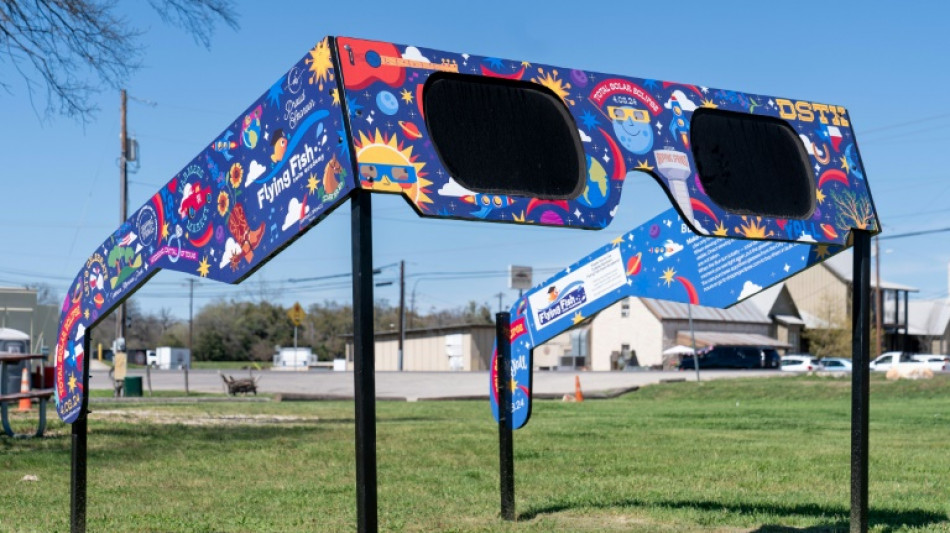
Totality ready: US braces for April 8 solar eclipse frenzy / Photo: © AFP

 'New one' Klopp promises fresh approach as Germany reign begins

 Milne returns to New Zealand squad for India T20 series

 US-led Americas coalition backs sanctions against crime groups

 'Star Wars' fans and art lovers line up for new Lucas museum
 Trump renames AI 'super intelligence' as leaders jostle over dangers

 Oil prices retreat as markets welcome US-Iran talks

 US refusing to give Sudan's de facto leader visa for UN: diplomatic sources, UN

 Macron urges world to choose UN over 'law of the jungle'

 All-rounder Jacks stars as England beat Sri Lanka in 1st ODI

 Man City peg back Bayern to start Women's Champions League
 Trump beats 'America first' drum at UN as allies tread carefully
 Snedeker backs Spaun for Ryder Cup after Presidents snub

 French prosecutors probe secret filming of women with smart glasses

 Trump renames AI "super intelligence," rejects international oversight

 Trump rejects international regulation of AI
 How is the EU approaching record fuel prices?

 Sri Lanka's Colombage strikes on debut as England dismissed for 265 in first ODI

 Hurricane Polo strengthens to top category 5 off Mexico

 11 hurt as teen opens fire outside school in western Turkey

 UN chief says 'Big Oil' treats atmosphere as open sewer

 Tunisia says 2026 summer hottest on record

 England's Rashid out of Sri Lanka ODIs with hand injury

 Houthis accuse Saudi Arabia of deadly strikes as thousands flee

 Stocks climb as oil slides, AI buzz returns

 India cricketers win in style as Afghan savours 'special' Games silver

US communities along the path of the April 8 total solar eclipse are preparing for the year's biggest astronomic event, with millions of visitors expected to brighten local economies -- and snarl up logistics.
Near the US-Canada border in Burlington, Vermont, which is set to experience the totality just before 3:30 pm (1930 GMT), many hotels have been sold out for months.
The few remaining rooms, which typically go for around $150 a night, show online prices of $600-$700 for the night of the eclipse.
"I don't know that we'll have anything quite like this again," Jeff Lawson, a vice president in the chamber of commerce, told AFP.
Lawson marveled at his city's "incredible luck" at an opportunity "quite literally falling out of the sky into your lap."
If skies are clear, the small city of 40,000 could see its population double for the day, with visitors arriving by car, train and even private jet, Lawson said.
An estimated 32 million people live inside the "path of totality" -- under which the Moon will fully block out the Sun -- with an additional 150 million residing less than 200 miles (320 kilometers) from the strip, NASA says.
- Traffic jams -
Preparations for the big day began years ago, Matt Bruning of the Ohio Department of Transportation told AFP.
He said the agency reached out to counterparts along the last major US eclipse, in 2017, and "one of the things that we heard resoundingly was it's never too early to start planning."
Despite those efforts, there will inevitably "be delays, there will be heavy congestion," he warned.
Businesses are leaping into the bonanza with special events and in Cleveland, where local officials expect some 200,000 visitors, the Rock & Roll Hall of Fame plans a four-day "Solarfest" of live music.
The Perryman Group, a Texas-based research firm, estimates direct and indirect economic impacts of this year's eclipse could reach $6 billion.
This year's path of totality is about 115 miles wide, wider than in 2017. It begins in western Mexico, arches up through the US cities of Dallas, Indianapolis, and Buffalo, before ending in eastern Canada.
Many schools along the path will be closed or letting students out early, including in Cleveland and Montreal.
Several airlines have advertised flights scheduled to pass under the eclipse, while Delta has even planned two special trips along the path of totality, the first of which sold out in 24 hours, the company said.
NASA warns that only in the path of totality -- and only during the few minutes of the actual totality -- is it safe to look at the eclipse without eye protection.
- 'Cosmic coincidence' -
Almost all of the United States will get to experience a partial eclipse, but UCLA astronomer Jean-Luc Margot says the trip to see the totality is definitely worth the hassle.
"If you have a 99 percent partial eclipse, that is a completely different experience than being in the path of totality," he told AFP.
He will be accompanying a group of UCLA alumni to view the eclipse in rural Texas, after similar trips in 2017 to Oregon and to Chile in 2019.
When people finally see the eclipse, they "tend to be emotional," Margot said.
"It is such a beautiful event. It's due to this complete cosmic coincidence, that the angular size of the Sun and the angular size of the Moon are about the same."
Scientists have traditionally used the eclipses to observe the solar corona, an outer layer of plasma that's difficult to study due to the Sun's bright light, Margot said.
New tools such as the space-based Parker Solar Probe have made such research less eclipse-dependent, but scientists will still be taking full advantage.
NASA recently highlighted several studies being planned for the eclipse, from effects on Earth's atmosphere and animal behavior to even human psychology.
"Eclipses have a special power," NASA Administrator Bill Nelson said recently.
"They move people to feel a kind of reverence for the beauty of our universe."
J.Fankhauser--BTB