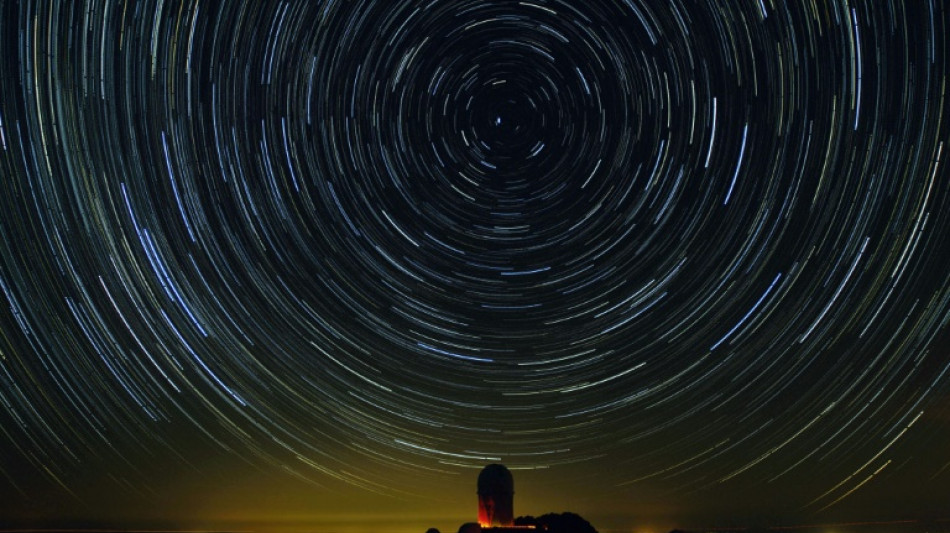
The universe's accelerated expansion might be slowing down / Photo: © AFP/File

 'New one' Klopp promises fresh approach as Germany reign begins

 Milne returns to New Zealand squad for India T20 series

 US-led Americas coalition backs sanctions against crime groups

 'Star Wars' fans and art lovers line up for new Lucas museum

 Trump renames AI 'super intelligence' as leaders jostle over dangers

 Oil prices retreat as markets welcome US-Iran talks

 US refusing to give Sudan's de facto leader visa for UN: diplomatic sources, UN

 Macron urges world to choose UN over 'law of the jungle'

 All-rounder Jacks stars as England beat Sri Lanka in 1st ODI

 Man City peg back Bayern to start Women's Champions League

 Trump beats 'America first' drum at UN as allies tread carefully

 Snedeker backs Spaun for Ryder Cup after Presidents snub

 French prosecutors probe secret filming of women with smart glasses

 Trump renames AI "super intelligence," rejects international oversight

 Trump rejects international regulation of AI

 How is the EU approaching record fuel prices?

 Sri Lanka's Colombage strikes on debut as England dismissed for 265 in first ODI

 Hurricane Polo strengthens to top category 5 off Mexico

 11 hurt as teen opens fire outside school in western Turkey

 UN chief says 'Big Oil' treats atmosphere as open sewer

 Tunisia says 2026 summer hottest on record

 England's Rashid out of Sri Lanka ODIs with hand injury

 Houthis accuse Saudi Arabia of deadly strikes as thousands flee

 Stocks climb as oil slides, AI buzz returns

 India cricketers win in style as Afghan savours 'special' Games silver

The universe is still expanding at an accelerating rate, but it may have slowed down recently compared to a few billion years ago, early results from the most precise measurement of its evolution yet suggested Thursday.
While the preliminary findings are far from confirmed, if they hold up it would further deepen the mystery of dark energy -- and likely mean there is something important missing in our understanding of the cosmos.
These signals of our universe's changing speeds were spotted by the Dark Energy Spectroscopic Instrument (DESI), which is perched atop a telescope at the Kitt Peak National Observatory in the US state of Arizona.
Each of the instrument's 5,000 fibre-optic robots can observe a galaxy for 20 minutes, allowing astronomers to chart what they have called the largest-ever 3D map of the universe.
"We measured the position of the galaxies in space but also in time, because the further away they are, the more we go back in time to a younger and younger universe," Arnaud de Mattia, a co-leader of the DESI data interpretation team, told AFP.
Just one year into its five-year survey, DESI has already drawn up a map which includes six million galaxies and quasars using light that stretches up to 11 billion years into the universe's past.
The results were announced at conferences in the United States and Switzerland on Thursday, ahead of a series of scientific papers being published in the Journal of Cosmology and Astroparticle Physics.
DESI is on a mission to shed light on the nature of dark energy -- a theoretical phenomenon thought to make up roughly 70 percent of the universe.
Another 25 percent of the universe is composed of the equally mysterious dark matter, leaving just five percent of normal matter -- such as everything you can see.
- An inconstant constant? -
For more than a century, scientists have known that the universe started expanding after the Big Bang, 13.8 billion years ago.
But in the late 1990s, astronomers were shocked to discover it has been expanding at an ever-increasing rate.
This was a surprise because gravity from matter -- both normal and dark -- was thought to have been slowing the universe down.
But obviously something was making the universe expand at ever-faster speeds, and the name "dark energy" was given to this force.
More recently, it was discovered that the acceleration of the universe significantly sped up around six billion years after the Big Bang.
In the push-and-pull between matter and dark energy, the latter certainly seems to have the upper hand, according to the leading model of the universe called the Lambda CDM.
Under this model, the quickening expansion of the universe is called the "cosmological constant," which is closely linked to dark energy.
DESI director Michael Levi said that so far, the instrument's early results were showing "basic agreement with our best model of the universe".
"But we're also seeing some potentially interesting differences which could indicate that dark energy is evolving with time," Levi said in a statement.
In other words, the data "seems to show that the cosmological constant Lambda is not really a constant," because dark energy would be displaying "dynamic" and changing behaviour, De Mattia said.
- Slowing down in old age -
This could suggest that -- after switching into high gear six billion years after the Big Bang -- the speed at which the universe has been expanding has been "slowing down in recent times," DESI researcher Christophe Yeche said.
Whether dark energy does in fact change over time would need to be verified by more data from DESI and other instruments, such as the space telescope Euclid.
But if it was confirmed, our understanding of the universe will likely have to be changed to accommodate for this strange behaviour.
For example, the cosmological constant could be replaced by some kind of field linked to some as-yet-unknown particle.
It could even necessitate updating the equations of Einstein's theory of relativity "so that they behave slightly differently on the scale of large structures," De Mattia said.
But we are not there yet.
The history of science is full of examples in which "deviations of this type have been observed then resolved over time," De Mattia emphasised.
After all, Einstein's theory of relativity has withstood more than a century of scientific poking and prodding and still stands stronger than ever.
T.Bondarenko--BTB