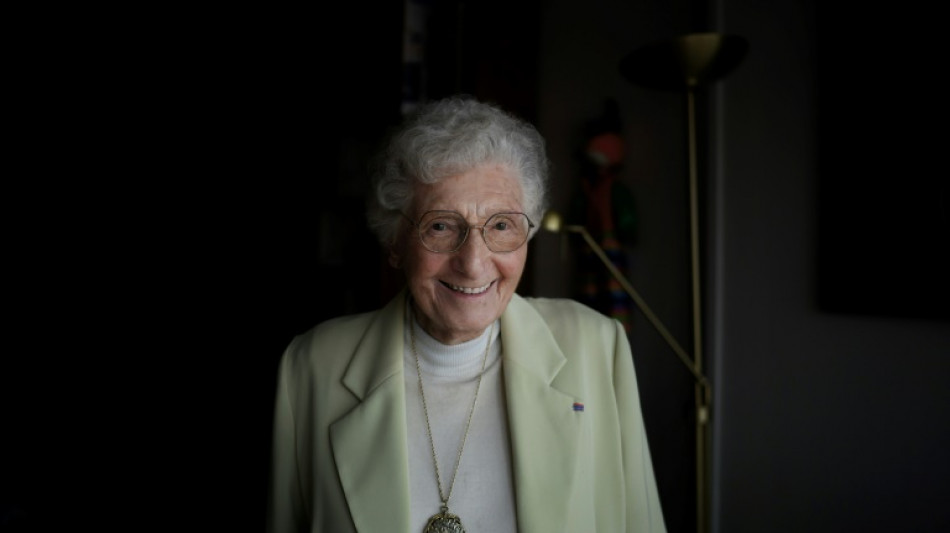
Ex-Resistance Olympic torch-bearer still wants to 'change the world' / Photo: © AFP

 'New one' Klopp promises fresh approach as Germany reign begins

 Milne returns to New Zealand squad for India T20 series

 US-led Americas coalition backs sanctions against crime groups

 'Star Wars' fans and art lovers line up for new Lucas museum

 Trump renames AI 'super intelligence' as leaders jostle over dangers

 Oil prices retreat as markets welcome US-Iran talks

 US refusing to give Sudan's de facto leader visa for UN: diplomatic sources, UN

 Macron urges world to choose UN over 'law of the jungle'

 All-rounder Jacks stars as England beat Sri Lanka in 1st ODI

 Man City peg back Bayern to start Women's Champions League

 Trump beats 'America first' drum at UN as allies tread carefully

 Snedeker backs Spaun for Ryder Cup after Presidents snub

 French prosecutors probe secret filming of women with smart glasses

 Trump renames AI "super intelligence," rejects international oversight

 Trump rejects international regulation of AI

 How is the EU approaching record fuel prices?

 Sri Lanka's Colombage strikes on debut as England dismissed for 265 in first ODI

 Hurricane Polo strengthens to top category 5 off Mexico

 11 hurt as teen opens fire outside school in western Turkey

 UN chief says 'Big Oil' treats atmosphere as open sewer

 Tunisia says 2026 summer hottest on record

 England's Rashid out of Sri Lanka ODIs with hand injury

 Houthis accuse Saudi Arabia of deadly strikes as thousands flee

 Stocks climb as oil slides, AI buzz returns

 India cricketers win in style as Afghan savours 'special' Games silver

At the age of 102, Melanie Berger-Volle will carry the Olympic torch as high as she can, despite her fragile shoulder, to champion the values of friendship between peoples that she defended during her time with the French Resistance in the Second World War.
A "woman in the shadows" during the Occupation (1940-1944), Berger-Volle was thrilled to be chosen to carry the torch as it passes through Saint-Etienne on June 22 on its way to Paris for the start of the Olympic Games.
The weight of the torch has been a concern but there was never any question of turning it down.
"I've always loved sport," says the sprightly centenarian who until recently enjoyed an hour's walk a day.
Grandmother of the gymnast Emilie Volle, who took part in the Atlanta Olympics in 1996, she also wants to be a symbol for women "who have fought to play sport like men".
"My ideal has always been to unite the world," she says. "And the Olympics are a wonderful opportunity to get to know other human beings."
- 'Mistreated' -
Born in Austria in 1921 into a Jewish working-class family, Melanie Berger began her activism as a teenager in an extreme left-wing group.
"We were atheists and when I started fighting it wasn't for religious reasons, it was political," she says. "I'm against all dictatorships."
After the annexation of Austria by Nazi Germany in 1938, she left her country, went to Belgium and then arrived in France, in Paris in the spring of 1939, disguised as a boy.
When France went to war later that year, all Austrians, even refugees, were seen as enemies and the authorities put her on a train to a camp near Pau.
At Clermont-Ferrand station, she "jumped out" of the carriage.
She was on her own as the other girls did not dare follow her.
"They weren't political, they didn't know what a camp was," she shrugs.
On the contrary, the young activist was well aware that "when you get a chance, you can't let it go by".
In 1940 after the French surrender to the Nazis, she found herself in Montauban, where a group of Trotskyist militants she had belonged to before the war was beginning to reform.
"With my French-sounding name, I rented a flat in a dilapidated house, and from there we were able to start work."
Discreetly, the group drafted and distributed German-language leaflets aimed at turning Reich soldiers.
In January 1942, however, that all came to an end when the police raided the house and she was arrested and brutally interrogated.
"I was mistreated, men beat me," she says quietly. "The after-effects are still with me. But I'm still here."
She avoided a death penalty and after 13 months in detention in Toulouse, the 22-year-old Berger was transferred to the Baumettes prison in Marseille.
Members of her group, together with the Resistance, prepared her escape.
- 'No' to Nazism -
On October 15, 1943, they came to get her, accompanied by a German soldier who had taken up the cause, while she was in hospital with jaundice.
"I escaped in my nightdress," she laughs.
Once recovered, she campaigned under false identities until the liberation in the summer of 1944.
After the war, she married Lucien Volle, another Resistance fighter who had taken part in the liberation of Le Puy-en-Velay.
Together, the couple began to devote themselves to the work of remembrance.
"We fought constantly to explain. Not what we had done but why we had done it," she says.
She has since been awarded a number of decorations, including the Legion d'Honneur.
"I didn't do much," she says. "But I did say 'no' to Nazism."
Worried again about the return of extremes in Europe, Berger-Volle hopes that young people will in turn be able to defend democracy.
And despite her advanced age, she intends to use the Olympics to get her message across.
"I wanted to change the world," she says with a smile. "And I still want to change it."
A.Gasser--BTB