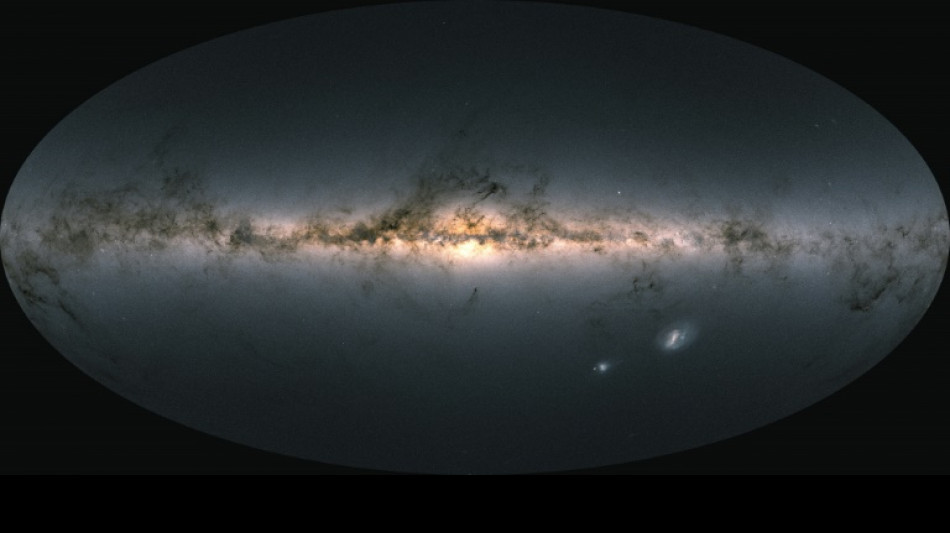
Astronomers discover largest black hole in Milky Way: study / Photo: © EUROPEAN SPACE AGENCY/AFP

 'New one' Klopp promises fresh approach as Germany reign begins

 Milne returns to New Zealand squad for India T20 series

 US-led Americas coalition backs sanctions against crime groups

 'Star Wars' fans and art lovers line up for new Lucas museum

 Trump renames AI 'super intelligence' as leaders jostle over dangers

 Oil prices retreat as markets welcome US-Iran talks

 US refusing to give Sudan's de facto leader visa for UN: diplomatic sources, UN

 Macron urges world to choose UN over 'law of the jungle'

 All-rounder Jacks stars as England beat Sri Lanka in 1st ODI

 Man City peg back Bayern to start Women's Champions League

 Trump beats 'America first' drum at UN as allies tread carefully

 Snedeker backs Spaun for Ryder Cup after Presidents snub

 French prosecutors probe secret filming of women with smart glasses

 Trump renames AI "super intelligence," rejects international oversight

 Trump rejects international regulation of AI

 How is the EU approaching record fuel prices?

 Sri Lanka's Colombage strikes on debut as England dismissed for 265 in first ODI

 Hurricane Polo strengthens to top category 5 off Mexico

 11 hurt as teen opens fire outside school in western Turkey

 UN chief says 'Big Oil' treats atmosphere as open sewer

 Tunisia says 2026 summer hottest on record

 England's Rashid out of Sri Lanka ODIs with hand injury

 Houthis accuse Saudi Arabia of deadly strikes as thousands flee

 Stocks climb as oil slides, AI buzz returns

 India cricketers win in style as Afghan savours 'special' Games silver

Astronomers identified the largest stellar black hole yet discovered in the Milky Way, with a mass 33 times that of the Sun, according to a study published on Tuesday.
The black hole, named Gaia BH3, was discovered "by chance" from data collected by the European Space Agency's Gaia mission, an astronomer from the National Centre for Scientific Research (CNRS) at the Observatoire de Paris, Pasquale Panuzzo, told AFP.
Gaia, which is dedicated to mapping the Milky Way galaxy, located BH3 2,000 light years away from Earth in the Aquila constellation.
As Gaia's telescope can give a precise position of stars in the sky, astronomers were able to characterise their orbits and measure the mass of the star's invisible companion -- 33 times that of the Sun.
Further observations from on-the-ground telescopes confirmed that it was a black hole with a mass far greater than the stellar black holes already in the Milky Way.
"No one was expecting to find a high-mass black hole lurking nearby, undetected so far. This is the kind of discovery you make once in your research life," Panuzzo said in a press release.
The stellar black hole was discovered when scientists spotted a "wobbling" motion on the companion star that was orbiting it.
"We could see a star a little smaller than the Sun (around 75 percent of its mass) and brighter, that revolved around an invisible companion," Panuzzo said.
Stellar black holes are created from the collapse of massive stars at the end of their lives and are smaller than supermassive black holes whose creation is still unknown.
Such giants have already been detected in distant galaxies via gravitational waves.
But "never in ours", said Panuzzo.
BH3 is a "dormant" black hole and is too far away from its companion star to strip it of its matter and therefore emits no X-rays -- making it difficult to detect.
Gaia's telescope identified the first two inactive black holes (Gaia BH1 and Gaia BH2) in the Milky Way.
Gaia has been operating 1.5 million kilometres from Earth for the past 10 years and in 2022 delivered a 3D map of the positions and motions of more than 1.8 billion stars.
Y.Bouchard--BTB