Einstein and anime: Hong Kong university tests AI professors / Photo: © AFP

 Schoolgirl Yu, 13, fastest again in bid for third Asian Games gold

 Oil prices fall after Trump hails 'good' talks with Iran

 AI political ads warp reality ahead of US midterms

 Kenneth Branagh embraces action hero role -- to get in shape

 'New one' Klopp promises fresh approach as Germany reign begins

 Milne returns to New Zealand squad for India T20 series

 US-led Americas coalition backs sanctions against crime groups

 'Star Wars' fans and art lovers line up for new Lucas museum

 Trump renames AI 'super intelligence' as leaders jostle over dangers

 Oil prices retreat as markets welcome US-Iran talks

 US refusing to give Sudan's de facto leader visa for UN: diplomatic sources, UN

 Macron urges world to choose UN over 'law of the jungle'

 All-rounder Jacks stars as England beat Sri Lanka in 1st ODI

 Man City peg back Bayern to start Women's Champions League

 Trump beats 'America first' drum at UN as allies tread carefully

 Snedeker backs Spaun for Ryder Cup after Presidents snub

 French prosecutors probe secret filming of women with smart glasses

 Trump renames AI "super intelligence," rejects international oversight

 Trump rejects international regulation of AI

 How is the EU approaching record fuel prices?

 Sri Lanka's Colombage strikes on debut as England dismissed for 265 in first ODI

 Hurricane Polo strengthens to top category 5 off Mexico

 11 hurt as teen opens fire outside school in western Turkey

 UN chief says 'Big Oil' treats atmosphere as open sewer
 Tunisia says 2026 summer hottest on record

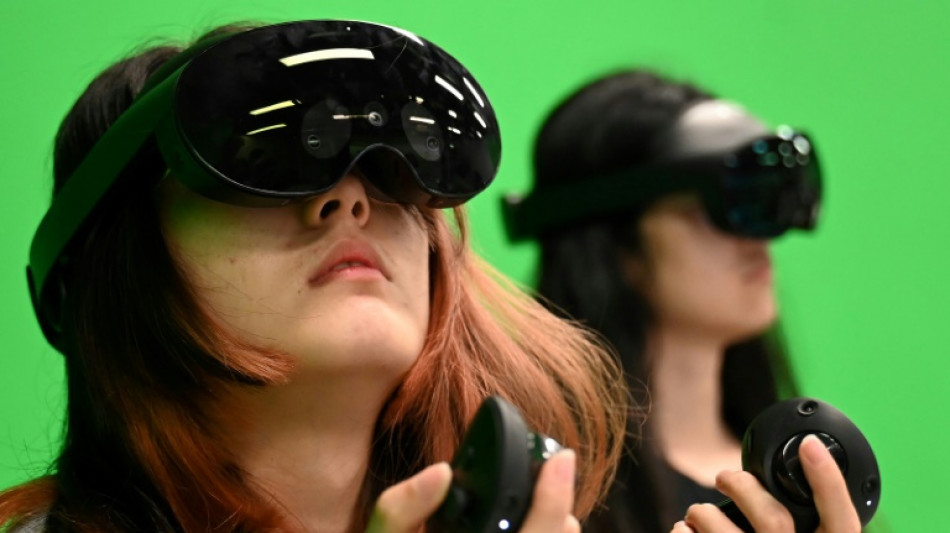
Using virtual reality headsets, students at a Hong Kong university travel to a pavilion above the clouds to watch an AI-generated Albert Einstein explain game theory.
The students are part of a course at the Hong Kong University of Science and Technology (HKUST) that is testing the use of "AI lecturers" as the artificial intelligence revolution hits campuses around the world.
The mass availability of tools such as ChatGPT has sparked optimism about new leaps in productivity and teaching, but also fears over cheating, plagiarism and the replacement of human instructors.
Professor Pan Hui, the project lead for HKUST's AI project, is not worried about being replaced by the tech and believes it can actually help ease what he described as a global shortage of teachers.
"AI teachers can bring in diversity, bring in an interesting aspect, and even immersive storytelling," Hui told AFP.
In his "Social Media for Creatives" course, AI-generated instructors teach 30 post-graduate students about immersive technologies and the impact of digital platforms.
These instructors are generated after presentation slides are fed into a programme. The looks, voices and gestures of the avatars can be customised, and they can be displayed on a screen or VR headsets.
This is mixed with in-person teaching by Hui, who says the system frees human lecturers from the "more tedious" parts of their job.
For student Lerry Yang, whose PhD research focuses on the metaverse, the advantage of AI lecturers was in the ability to tailor them to individual preferences and boost learning.
If the AI teacher "makes me feel more mentally receptive, or if it feels approachable and friendly, that erases the feeling of distance between me and the professor", she told AFP.
- 'Everybody's doing it' -
Educators around the world are grappling with the growing use of generative AI, from trying to reliably detect plagiarism to setting the boundaries for the use of such tools.
While initially hesitant, most Hong Kong universities last year allowed students to use AI to degrees that vary from course to course.
At HKUST, Hui is testing avatars with different genders and ethnic backgrounds, including the likenesses of renowned academic figures such as Einstein and the economist John Nash.
"So far, the most popular type of lecturers are young, beautiful ladies," Hui said.
An experiment with Japanese anime characters split opinion, said Christie Pang, a PhD student working with Hui on the project.
"Those who liked it really loved it. But some students felt they couldn't trust what (the lecturer) said," she said.
There could be a future where AI teachers surpass humans in terms of trustworthiness, Hui said, though he said he preferred a mix of the two.
"We as university teachers will better take care of our students in, for example, their emotional intelligence, creativity and critical thinking," he said.
For now, despite the wow factor for students, the technology is far from the level where it could pose a serious threat to human teachers.
It cannot interact with students or answer questions and like all AI-powered content generators, it can offer false, even bizarre answers -- sometimes called "hallucinations".
In a survey of more than 400 students last year, University of Hong Kong professor Cecilia Chan found that respondents preferred humans over digital avatars.
"(Students) still prefer to talk to a real person, because a real teacher would provide their own experience, feedback and empathy," said Chan, who researches the intersection of AI and education.
"Would you prefer to hear from a computer 'Well done'?"
That said, students are already using AI tools to help them learn, Chan added.
"Everybody's doing it."
At HKUST, Hui's student Yang echoed that view: "You just can't go against the advancement of this technology."
J.Horn--BTB