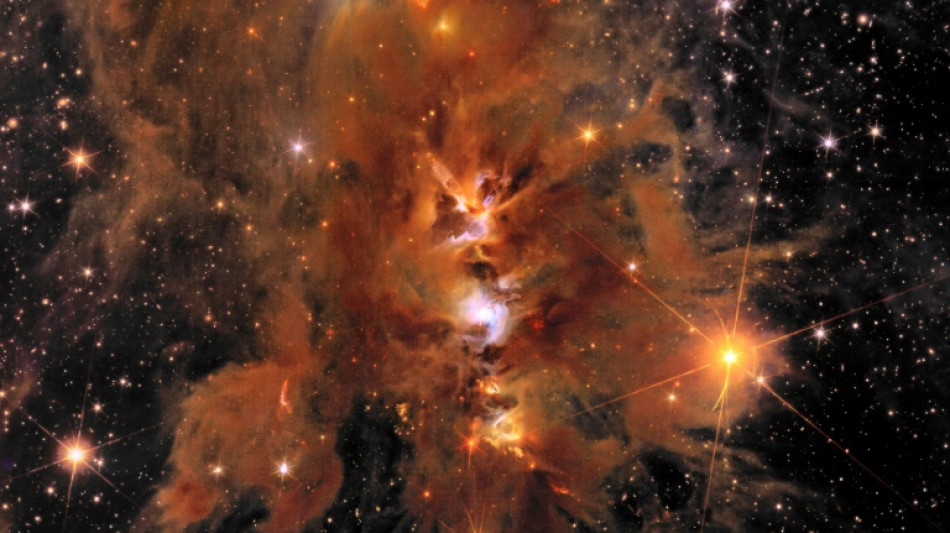
Euclid space telescope unveils new images of the cosmos / Photo: © ESA/Euclid/Euclid Consortium/NASA/AFP

 Schoolgirl Yu, 13, fastest again in bid for third Asian Games gold
 Oil prices fall after Trump hails 'good' talks with Iran

 AI political ads warp reality ahead of US midterms

 Kenneth Branagh embraces action hero role -- to get in shape

 'New one' Klopp promises fresh approach as Germany reign begins

 Milne returns to New Zealand squad for India T20 series

 US-led Americas coalition backs sanctions against crime groups

 'Star Wars' fans and art lovers line up for new Lucas museum

 Trump renames AI 'super intelligence' as leaders jostle over dangers

 Oil prices retreat as markets welcome US-Iran talks

 US refusing to give Sudan's de facto leader visa for UN: diplomatic sources, UN

 Macron urges world to choose UN over 'law of the jungle'

 All-rounder Jacks stars as England beat Sri Lanka in 1st ODI

 Man City peg back Bayern to start Women's Champions League

 Trump beats 'America first' drum at UN as allies tread carefully

 Snedeker backs Spaun for Ryder Cup after Presidents snub

 French prosecutors probe secret filming of women with smart glasses

 Trump renames AI "super intelligence," rejects international oversight

 Trump rejects international regulation of AI

 How is the EU approaching record fuel prices?

 Sri Lanka's Colombage strikes on debut as England dismissed for 265 in first ODI

 Hurricane Polo strengthens to top category 5 off Mexico

 11 hurt as teen opens fire outside school in western Turkey

 UN chief says 'Big Oil' treats atmosphere as open sewer

 Tunisia says 2026 summer hottest on record

A mind-boggling number of shining galaxies, a purple and orange star nursery and a spiral galaxy similar to our Milky Way: new images were revealed from Europe's Euclid space telescope on Thursday.
It is the second set of images released by the European Space Agency since Euclid launched last year on the first-ever mission to investigate the mysteries of dark matter and dark energy.
Scientific data from Euclid was also published for the first time in the six-year mission, which aims to use its wide view to chart two billion galaxies across a third of the sky.
Euclid project scientist Rene Laureijs told AFP that he was "personally most excited" about the image of a massive cluster of galaxies called Abell 2390.
The image of the cluster, which is 2.7 billion light years away from Earth, encompasses more than 50,000 galaxies.
Just one galaxy -- such as our own -- can be home to hundreds of billions or even trillions of stars, each of which could be bigger than the Sun.
In Abell 2390, Euclid was able to detect the faint light of "orphan stars" drifting between galaxy clusters, said Jean-Charles Cuillandre, a French scientist working on Euclid.
These stars are ejected from the galaxies, "creating a kind of cloud which surrounds the entire cluster," Cuillandre told AFP.
According to astronomers, this strange phenomenon points towards the presence of dark matter between the galaxies.
Dark matter and dark energy are thought to make up 95 percent of the universe -- but we know almost nothing about them.
- A star is born -
Euclid also captured the deepest-ever image of the Messier 78, a nursery where stars are born 1,300 light years from Earth in the Orion constellation.
Stars are still in the process of forming in the bluish centre of the image. After gestating for millions of years, they emerge from the purple and orange clouds at the bottom of the image. "Bright things are trying to come out," said Cuillandre.
Laureijs emphasised that "only Euclid can show this in one shot."
That is because Euclid has a very wide field view, in contrast to far-seeing fellow space telescope the James Webb, its neighbour at a stable hovering spot 1.5 million kilometres (9.3 million miles) from Earth.
Another image, of the huge galaxy cluster Abell 2764, depicts a black expanse in which one yellow star stands out.
Cuillandre admitted this was the result of an error in pointing the telescope. But he said the image demonstrated "Euclid's absolutely unique ability to concentrate light," because it was still able to pick up very faint objects next to the bright star.
Euclid's image of the young Dorado cluster contained a surprise. Though the cluster was already well studied, Euclid discovered a never-before-seen dwarf galaxy, the scientists said.
"I've never seen anything like it," Cuillandre said.
In the fifth new image, the spiral galaxy NGC 6744 -- which bears a striking resemblance to the Milky Way -- fans out against a backdrop of shining stars.
- On the trail of dark matter -
It is still early days for the mission, and the five new images were captured in just one day.
In the years ahead, scientists plan to sift through Euclid's data in the hopes of spotting all manner of celestial bodies such as "rogue" planets, which float freely through the universe unconnected to a star.
But researchers have already been analysing Euclid's first batch of images, which were released in November.
In one of 10 pre-print studies published on Thursday, scientists looked into the faint light from orphan stars in the Perseus cluster.
These lost stars "are now trapped in the gravity of the dark matter," Laureijs said.
This remains only "indirect detection of dark matter," he emphasised, adding that it was too early "to say something about dark energy".
The mission has not been entirely smooth sailing.
In March, a delicate operation successfully melted a thin layer that had been slowing clouding the telescope's sight by warming one of the telescope's mirrors.
There are signs that the ice is building up again, Laureijs said, adding that the team has time to investigate what to do next.
H.Seidel--BTB