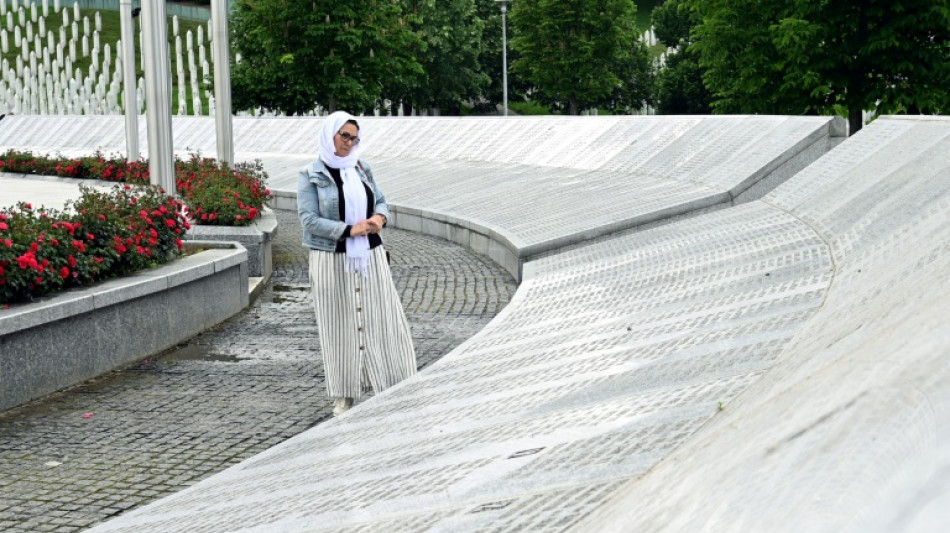
UN creates Srebrenica genocide memorial day / Photo: © AFP

 Schoolgirl Yu, 13, fastest again in bid for third Asian Games gold
 Oil prices fall after Trump hails 'good' talks with Iran

 AI political ads warp reality ahead of US midterms

 Kenneth Branagh embraces action hero role -- to get in shape

 'New one' Klopp promises fresh approach as Germany reign begins
 Milne returns to New Zealand squad for India T20 series

 US-led Americas coalition backs sanctions against crime groups

 'Star Wars' fans and art lovers line up for new Lucas museum
 Trump renames AI 'super intelligence' as leaders jostle over dangers

 Oil prices retreat as markets welcome US-Iran talks
 US refusing to give Sudan's de facto leader visa for UN: diplomatic sources, UN
 Macron urges world to choose UN over 'law of the jungle'
 All-rounder Jacks stars as England beat Sri Lanka in 1st ODI
 Man City peg back Bayern to start Women's Champions League
 Trump beats 'America first' drum at UN as allies tread carefully

 Snedeker backs Spaun for Ryder Cup after Presidents snub

 French prosecutors probe secret filming of women with smart glasses

 Trump renames AI "super intelligence," rejects international oversight
 Trump rejects international regulation of AI

 How is the EU approaching record fuel prices?

 Sri Lanka's Colombage strikes on debut as England dismissed for 265 in first ODI
 Hurricane Polo strengthens to top category 5 off Mexico

 11 hurt as teen opens fire outside school in western Turkey

 UN chief says 'Big Oil' treats atmosphere as open sewer

 Tunisia says 2026 summer hottest on record

The UN General Assembly voted Thursday to establish an annual day of remembrance for the 1995 Srebrenica genocide, despite furious opposition from Bosnian Serbs and Serbia.
The resolution written by Germany and Rwanda -- countries synonymous with genocide in the 20th century -- received 84 votes in favor, 19 against with 68 abstentions and makes July 11 "International Day of Remembrance of the Srebrenica Genocide."
Ahead of the vote, Serbian President Aleksandar Vucic warned the General Assembly that the move "will just open old wounds and that will create a complete political havoc."
But he said he did not deny the killings at Srebrenica, adding that he bowed his "head to all the victims of the conflict in Bosnia."
"This resolution seeks to foster reconciliation, in the present and for the future," said Germany's ambassador to the UN Antje Leendertse.
Church bells rang out across Serbia on Thursday in protest. The Serbian Orthodox Church said it hoped the gesture would unite Serbs in "prayers, serenity, mutual solidarity and firmness in doing good, despite untrue and unjust accusations it faces at the UN."
Bosnian Serb leader Milorad Dodik, meanwhile, denied a genocide had even taken place in the Bosnian city and said that his administration would not recognize the UN resolution.
"There was no genocide in Srebrenica," Dodik told a press conference in Srebrenica.
Bosnian Serb forces captured Srebrenica -- a UN-protected enclave at the time -- on July 11, 1995, a few months before the end of Bosnia's civil war, which saw approximately 100,000 people killed.
In the following days, Bosnian Serb forces killed around 8,000 Muslim men and teenagers -- a crime described as a genocide by the International Criminal Tribunal for the former Yugoslavia (ICTY) and the International Court of Justice.
The incident is considered the worst single atrocity in Europe since World War II.
In addition to establishing the memorial day, the resolution condemns "any denial" of the genocide and urges UN member countries to "preserve the established facts."
In a letter to other UN members, Germany and Rwanda described the vote as a "crucial opportunity to unite in honoring the victims and acknowledging the pivotal role played by international courts."
- Threat to peace, security -
However, there has been a furious response from Serbia and the Bosnian Serb leadership.
In an attempt to defuse tensions, the authors of the resolution added -- at Montenegro's request -- that culpability for the genocide is "individualized and cannot be attributed to any ethnic, religious or other group or community as a whole."
That has not been enough for Belgrade.
In a letter sent Sunday to all UN delegations, Serbian charge d'affaires Sasa Mart warned that raising "historically sensitive topics serves only to deepen division and may bring additional instability to the Balkans."
Russia's UN ambassador, Vasily Nebenzia, called the resolution "provocative" and a "threat to peace and security."
Moscow previously vetoed a UN Security Council resolution condemning the "crime of genocide at Srebrenica."
Milorad Dodik, political leader in the Bosnian Serb entity -- where thousands of people demonstrated this April against the resolution -- said the Srebrenica genocide had been a "sham."
The European Union has responded strongly, with foreign affairs spokesman Peter Stano saying "there cannot be any denial" and "anyone trying to put it in doubt has no place in Europe."
For relatives of the victims of the massacre, the UN debate is an important moment in their quest for peace.
"Those who led their people into this position (of genocide denial) must accept the truth, so that we can all find peace and move on with our lives," said Kada Hotic, 79-year-old co-director of an association of Srebrenica mothers, who lost her son, husband and two brothers.
The resolution is "of the highest importance for spreading the truth," said Denis Becirovic, the Bosnian member of Bosnia and Herzegovina's tripartite presidency.
F.Pavlenko--BTB


