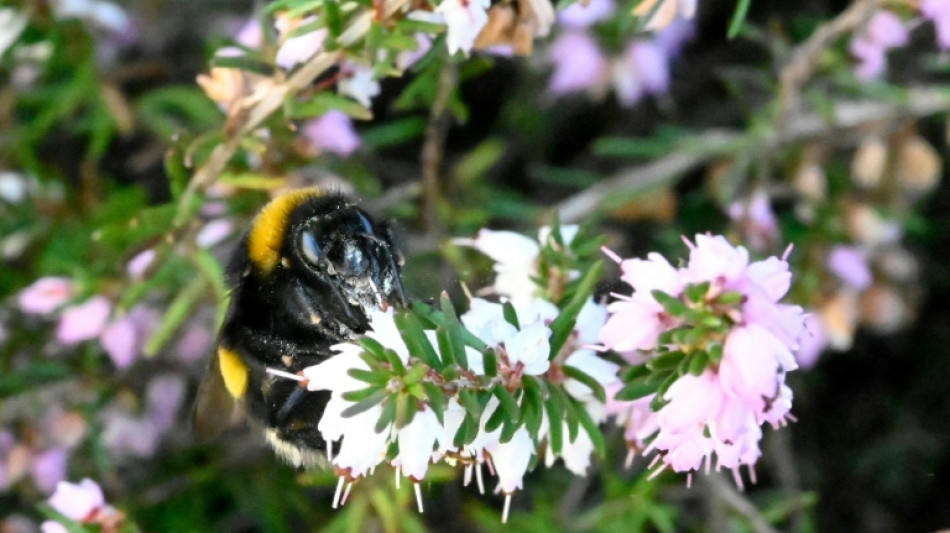
Small bees better at coping with warming, bumblebees struggle: study / Photo: © AFP/File

 Ed Sheeran returns to stage after Palestinian controversy

 Asian Games to open in Japan after troubled build-up

 Drone owners rush to offload devices ahead of Beijing ban

 Trump's beef policies irk Texas ranchers, testing their loyalty

 Nvidia, OpenAI CEOs to attend Xi dinner at White House

 Anthropic picks Accenture for in-house AI safety evaluation
 Balogun returns as Monaco beat Lens to continue strong Ligue 1 start

 'Pause' on overt repression in Venezuela, but reforms still needed: HRW

 Global stocks mixed as yen falls despite Bank of Japan rate hike

 Cuba hit with seventh major blackout of the year

 Murray out with concussion so Wentz will start for Vikings

 UN chief 'deeply regrets' US visa refusal to Abbas for annual meeting

 England quick Carse to face no charges over alleged nightclub assault

 Mancini brings nine newcomers into the first squad of his Italy comeback

 Czechs level Davis Cup tie against USA as South Korea eye Finals

 New France boss Zidane confirms Mbappe as captain after naming first squad

 California governor signs order to explore AI 'kill switch'

 Head leads run spree as Australia win Zimbabwe ODI series

 In-form Raphinha wants to finish career at Barcelona

 Warren Buffett steps down as Berkshire Hathaway chairman

 Carrick confident Man Utd can 'work through' tough time

 Mbappe ends Nike partnership to join Swiss brand On

 Liverpool boss Iraola puts Bournemouth love affair on hold

 'A disaster' if Man City do not win says Maresca after flawless start

 Kerry James Marshall: American 'blackness' painter celebrated in Europe

Climate change could lead to more small-bodied bees but fewer bumblebees, according to research published Wednesday, warning of potential "cascading" effects on plant pollination and across whole ecosystems.
Scientists in the United States trapped and studied more than 20,000 bees over eight years in an area of the Rocky Mountains to find out how different types of bees reacted to changing climatic conditions.
The authors said that while environmental conditions varied from year to year, the sub-alpine region from which they took samples is "particularly vulnerable to climate change", with generally warming spring temperatures and earlier snow melt.
They found that comb-building cavity nesters and larger bodied bees declined in abundance as temperatures increased, while smaller, soil-nesting bees increased.
"Our research suggests that climate-induced changes in temperature, snowpack and summer precipitation may drastically reshape bee communities," the authors said.
- Bumblebees 'more threatened' -
Researchers said the findings suggest a reduction of bigger bees, including in the families of bumblebee, leafcutters and mason bees, with higher temperatures.
Declines were particularly marked for bumblebees, which the researchers said suggests "this group is more threatened under climate warming than other bees in our system".
That tallies with other studies showing that bumblebees, the dominant pollinators in many ecosystems, have a lower heat tolerance than other bees and move to cooler regions at higher altitudes as temperatures warm.
Researchers said their findings suggest both bumblebees' body size and nest behaviour could also make them more vulnerable in a warming world.
In general, the authors said climate-driven changes to pollinator communities "could have cascading effects on pollination and ecosystem functioning".
For example, they said losing bigger bees, which tend to fly further for food, may mean a reduction in longer-distance pollination.
The study, published in the journal Proceedings of the Royal Society B, was specifically focused on mountainous areas, but the researchers said other research across the US showed declines in larger bees in response to environmental changes.
They did however say their findings that drier conditions favoured bees with specialist diets may not be applicable to other ecosystems, where climate change is expected to bring more rainfall.
Insects are the world's top pollinators -- 75 percent of 115 top global food crops depend on animal pollination, including cocoa, coffee, almonds and cherries, according to the UN.
In a landmark 2019 report, scientists concluded that nearly half of all insect species worldwide are in decline and a third could disappear altogether by century's end.
One in six species of bees have gone regionally extinct somewhere in the world.
The main drivers of extinction are thought to be habitat loss and pesticide use.
E.Schubert--BTB