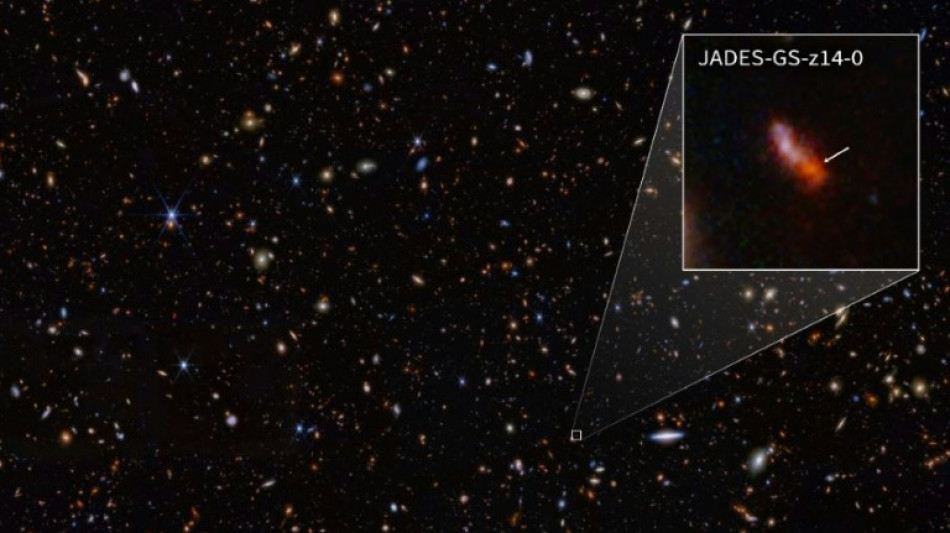
Webb telescope finds most distant galaxy ever observed, again / Photo: © ESA, NASA, CSA, STScI/AFP

 Schoolgirl Yu, 13, fastest again in bid for third Asian Games gold

 Oil prices fall after Trump hails 'good' talks with Iran

 AI political ads warp reality ahead of US midterms

 Kenneth Branagh embraces action hero role -- to get in shape

 'New one' Klopp promises fresh approach as Germany reign begins

 Milne returns to New Zealand squad for India T20 series

 US-led Americas coalition backs sanctions against crime groups

 'Star Wars' fans and art lovers line up for new Lucas museum

 Trump renames AI 'super intelligence' as leaders jostle over dangers

 Oil prices retreat as markets welcome US-Iran talks

 US refusing to give Sudan's de facto leader visa for UN: diplomatic sources, UN

 Macron urges world to choose UN over 'law of the jungle'

 All-rounder Jacks stars as England beat Sri Lanka in 1st ODI

 Man City peg back Bayern to start Women's Champions League

 Trump beats 'America first' drum at UN as allies tread carefully

 Snedeker backs Spaun for Ryder Cup after Presidents snub

 French prosecutors probe secret filming of women with smart glasses

 Trump renames AI "super intelligence," rejects international oversight

 Trump rejects international regulation of AI

 How is the EU approaching record fuel prices?

 Sri Lanka's Colombage strikes on debut as England dismissed for 265 in first ODI

 Hurricane Polo strengthens to top category 5 off Mexico

 11 hurt as teen opens fire outside school in western Turkey

 UN chief says 'Big Oil' treats atmosphere as open sewer

 Tunisia says 2026 summer hottest on record

The James Webb Space Telescope has discovered what appears to be a new record-holder for the most distant known galaxy, a remarkably bright star system that existed just 290 million years after the Big Bang, NASA said Thursday.
Since coming online in 2022, the Webb telescope has ushered in a new era of scientific breakthroughs, peering farther than ever before into the universe's distant reaches -- which also means it is looking back in time.
And the latest finding has "profound implications" for our understanding of the so-called Cosmic Dawn, researchers said.
An international team of astronomers first spotted the galaxy called JADES-GS-z14-0 in early 2023, but they needed further observations to be sure it really was a record-breaker rather than a "confounding oddball," they said in a joint statement.
"The source was surprisingly bright, which we wouldn't expect for such a distant galaxy, and it was very close to another galaxy such that the two appeared to be part of one larger object," said Stefano Carniani from Scuola Normale Superiore in Italy and Kevin Hainline from the University of Arizona.
By the time light from the most distant galaxies reaches Earth, it has been stretched by the expansion of the universe and shifted to the infrared region of the light spectrum, which Webb is equipped to detect with unprecedented clarity.
The team carried out two confirmatory observations in October and then January -- first with Webb's primary imager called NIRCam, and second with its NIRSpec that analyzes the light from an object to determine its physical properties -- to be more certain of their hypothesis.
Not only does the new finding comfortably beat the previous record for oldest known galaxy -- which was held by JADES-GS-z13-0 that was present 320 million years after the Big Bang -- it also raises intriguing new questions for astronomy.
- Upends predictions -
"The most important aspect of JADES-GS-z14-0 was that at this distance, we know that this galaxy must be intrinsically very luminous," said Carniani and Hainline.
From the images, the galaxy was determined to be 1,600 light years across, suggesting that the light is coming from mostly young stars and not from emission near a growing supermassive black hole.
"This starlight implies that the galaxy is several hundreds of millions of times the mass of the Sun!" said the researchers. "This raises the question: How can nature make such a bright, massive, and large galaxy in less than 300 million years?"
Further analysis of the light emissions indicates the presence of oxygen, another surprising finding that points to "multiple generations of very massive stars had already lived their lives before we observed the galaxy."
Taken together, the observations of JADES-GS-z14-0 upend astronomical predictions of what the earliest galaxies may have looked like following the Big Bang 13.8 billion years ago.
Given the relatively small portion of the night sky they looked at, it's highly likely more luminous galaxies at possibly even earlier times will be found in the coming years, said the researchers, who will now look to publish their findings in a peer-reviewed journal.
K.Thomson--BTB