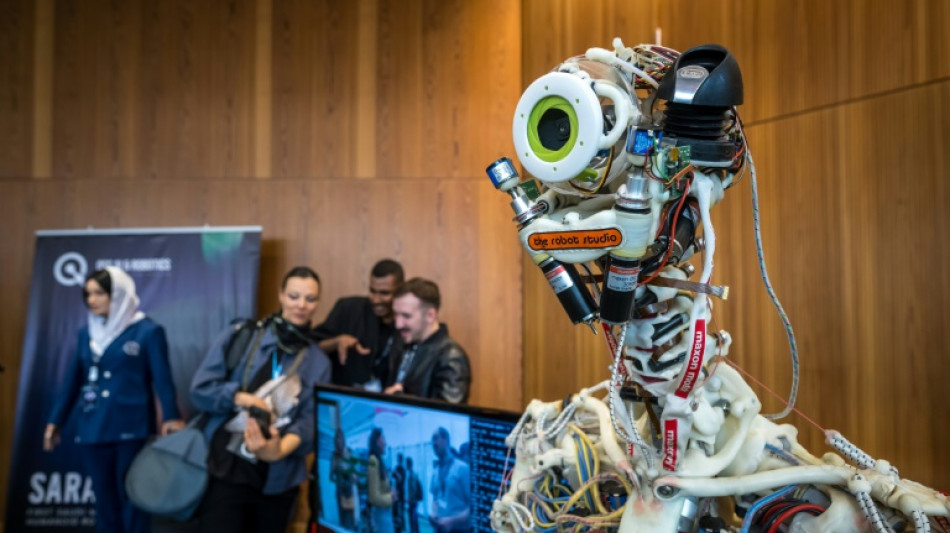
Humanity in 'race against time' on AI: UN / Photo: © AFP

 Schoolgirl Yu, 13, fastest again in bid for third Asian Games gold

 Oil prices fall after Trump hails 'good' talks with Iran

 AI political ads warp reality ahead of US midterms

 Kenneth Branagh embraces action hero role -- to get in shape

 'New one' Klopp promises fresh approach as Germany reign begins
 Milne returns to New Zealand squad for India T20 series

 US-led Americas coalition backs sanctions against crime groups

 'Star Wars' fans and art lovers line up for new Lucas museum

 Trump renames AI 'super intelligence' as leaders jostle over dangers

 Oil prices retreat as markets welcome US-Iran talks

 US refusing to give Sudan's de facto leader visa for UN: diplomatic sources, UN

 Macron urges world to choose UN over 'law of the jungle'

 All-rounder Jacks stars as England beat Sri Lanka in 1st ODI

 Man City peg back Bayern to start Women's Champions League

 Trump beats 'America first' drum at UN as allies tread carefully

 Snedeker backs Spaun for Ryder Cup after Presidents snub

 French prosecutors probe secret filming of women with smart glasses

 Trump renames AI "super intelligence," rejects international oversight

 Trump rejects international regulation of AI

 How is the EU approaching record fuel prices?

 Sri Lanka's Colombage strikes on debut as England dismissed for 265 in first ODI

 Hurricane Polo strengthens to top category 5 off Mexico

 11 hurt as teen opens fire outside school in western Turkey

 UN chief says 'Big Oil' treats atmosphere as open sewer

 Tunisia says 2026 summer hottest on record

Humanity is in a race against time to harness the colossal emerging power of artificial intelligence for the good of all, while averting dire risks, a top UN official said Thursday.
"We've let the genie out of the bottle," said Doreen Bogdan-Martin, head of the United Nations' International Telecommunications Union (ITU).
"We are in a race against time," she told the opening of a two-day AI for Good Global Summit in Geneva.
"Recent developments in AI have been nothing short of extraordinary."
The thousands gathered at the conference heard how advances in generative AI are already speeding up efforts to solve some of the world's most pressing problems, such as climate change, hunger and social care.
"I believe we have a once-in-a-generation opportunity to guide AI to benefit all the world's people," Bogdan-Martin told AFP ahead of the summit.
But she lamented Thursday that one-third of humanity still remains completely offline, and is "excluded from the AI revolution without a voice".
"This digital and technological divide is no longer acceptable."
Bogdan-Martin highlighted that AI holds "immense potential for both good and bad", stressing that it was vital to "make AI systems safe".
- Concentrated power -
She said that was especially important given that "2024 is the biggest election year in history", with votes in dozens of countries, including in the United States.
She flagged the "rise of sophisticated deep fakes disinformation campaigns" and warned that the "misuse of AI threaten democracy (and) also endangers young people's mental health and compromises cyber-security."
Other experts at Thursday's conference agreed.
"We have to understand what we're steering towards," said Tristan Harris, a technology ethicist who co-founded the Center for Humane Technology.
He pointed to lessons from social media -- initially touted as a way to connect people and give everyone a voice, but which also brought addiction, viral misinformation, online harassment and ballooning mental health issues.
Harris warned the incentive driving the companies rolling out the technology risked dramatically swelling such negative impacts.
"The number one thing that is driving Open AI or Google behaviour is the race to actually achieve market dominance," he said.
In such a world, he said, "governance that moves at the speed of technology" is vital.
- Changing the social contract -
OpenAI chief Sam Altman, who rose to global prominence after OpenAI released ChatGPT in 2022, acknowledged the dangers.
Speaking via video-link, he told the gathering that "cyber-security" was currently the biggest concern when it came to negative impacts of the technology.
Further down the road, he said there would likely "be some change required to the social contract, given how powerful we expect this technology to be".
"I'm not a believer that there won't be any jobs... but I do think the whole structure of society itself will be (open to) some degree of debate and reconfiguration."
Overall though, he insisted that from the perspective of how new technologies evolve historically, the AI systems were "generally considered safe and robust".
While welcoming discussions around regulations to stem short-term negative impacts of AI, he warned that it was "difficult" to suggest regulations aimed at reining in future impacts.
"We don't know how society and this technology are going to co-evolve," he said.
Bogdan-Martin meanwhile hailed that governments and others had recently "raced to establish protections" and regulation around the use of AI.
On Wednesday the European Union announced the creation of an AI Office to regulate artificial intelligence under a sweeping new law.
"It's our responsibility to write the next chapter in the great story of humanity, and technology, and to make it safe, to make it inclusive and to make it sustainable," Bogdan-Martin said.
L.Janezki--BTB