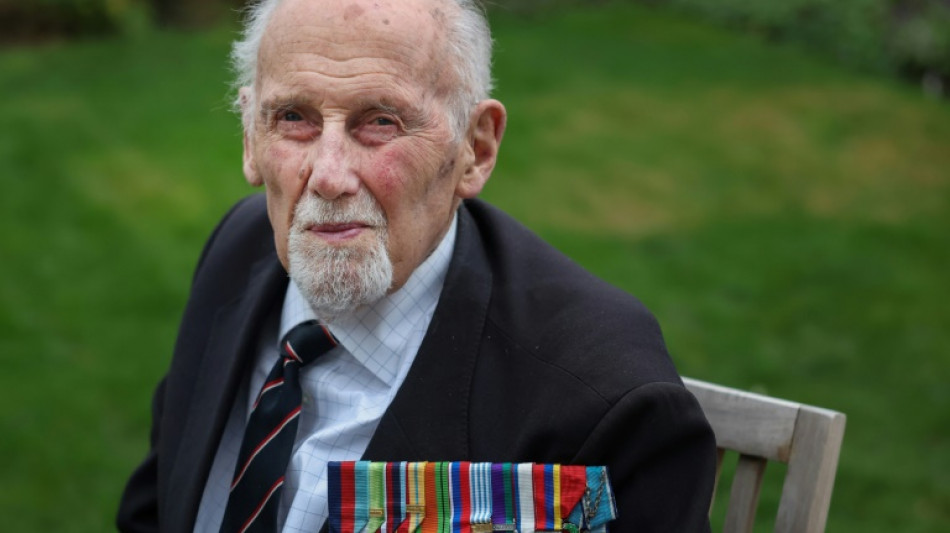
'This is what we've been fighting for.' British veteran remembers D-Day / Photo: © AFP

 Schoolgirl Yu, 13, fastest again in bid for third Asian Games gold

 Oil prices fall after Trump hails 'good' talks with Iran

 AI political ads warp reality ahead of US midterms

 Kenneth Branagh embraces action hero role -- to get in shape

 'New one' Klopp promises fresh approach as Germany reign begins

 Milne returns to New Zealand squad for India T20 series

 US-led Americas coalition backs sanctions against crime groups

 'Star Wars' fans and art lovers line up for new Lucas museum

 Trump renames AI 'super intelligence' as leaders jostle over dangers

 Oil prices retreat as markets welcome US-Iran talks

 US refusing to give Sudan's de facto leader visa for UN: diplomatic sources, UN

 Macron urges world to choose UN over 'law of the jungle'

 All-rounder Jacks stars as England beat Sri Lanka in 1st ODI

 Man City peg back Bayern to start Women's Champions League

 Trump beats 'America first' drum at UN as allies tread carefully

 Snedeker backs Spaun for Ryder Cup after Presidents snub

 French prosecutors probe secret filming of women with smart glasses

 Trump renames AI "super intelligence," rejects international oversight

 Trump rejects international regulation of AI

 How is the EU approaching record fuel prices?

 Sri Lanka's Colombage strikes on debut as England dismissed for 265 in first ODI

 Hurricane Polo strengthens to top category 5 off Mexico

 11 hurt as teen opens fire outside school in western Turkey

 UN chief says 'Big Oil' treats atmosphere as open sewer

 Tunisia says 2026 summer hottest on record

John Roberts was a 20-year-old British Royal Navy officer during the D-Day landings 80 years ago and remembers making light of the daring mission at the time.
The former sub-lieutenant was aboard the destroyer HMS Serapis during the Allied invasion of France on June 6, 1944, protecting minesweepers during the crossing of the Channel.
"I have a letter now that I wrote to my mother at that time and I said, 'It's all good fun'," Roberts, now aged 100 and one of Britain's few remaining D-Day veterans, told AFP.
"I had just had my 20th birthday and at that age, one was oblivious to the dangers. And one wouldn't have missed being in this for the rest of one's life."
Roberts' vessel provided cover for around 25 minesweepers tasked with clearing explosive devices from the Channel.
"The minesweepers only go at six or seven knots, very slow, so we were going very slowly with them," he recalled.
"And then we got to about eight miles from the coast at about 6:00 am. And it was just beginning to get light then and in the distance I could see France.
"I thought, 'This is what we've been fighting for. It was Poland to begin with and then France. And there it is'."
Hundreds of Allied aircraft, including around 500 US Boeing B-17 Flying Fortresses, turned the sky dark as they flew along Sword Beach on the Normandy coast, where British troops landed.
Then they "let loose their bombs, so the whole beach became a mass of flames", said Roberts.
"At 7:00 am we started bombarding the coast. And at 7:35 am, I think, that was the hour when the first soldiers stepped ashore," he added.
- Ghastly -
Arriving at the beach was a relief for many soldiers, despite the dangers ahead, due to the rough waters that had left many seasick.
Roberts, who joined the Royal Navy at the age of 13 and served until 1978, remained on board HMS Serapis but still had some close scrapes.
"We had one or two times when shells landed near us. If we were a bit careless and went too close to the coast, a German gun would open up," he said.
"But the moment we saw a German gun opening up, we fired back and they soon stopped."
Roberts, who turned 100 in April, drew parallels with the German soldiers' loyalty to Adolf Hitler and the current war between Russia and Ukraine.
"It was pretty grim. The Germans didn't give in easily," he said.
"It reminds me of (Russian President Vladimir) Putin, which is not a good thing to do. Like Russians have allegiance to Putin, the Germans all had allegiance to Hitler."
The ongoing war in Eastern Europe, along with other major conflicts, were "very sad," he added.
"At the end of World War I as well as World War II, everybody said, 'Well thank God that's over.' They'd both been so ghastly that we thought we'd never have another one."
O.Lorenz--BTB


