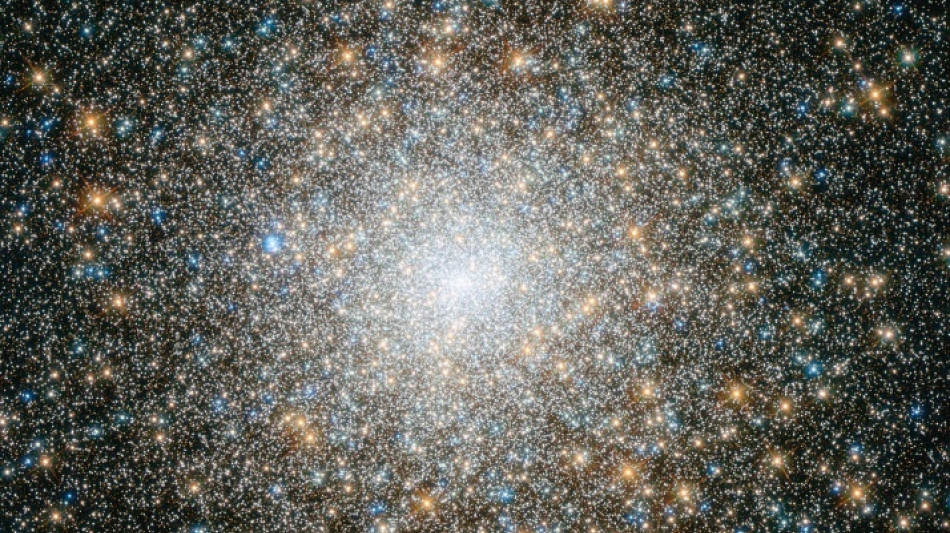
Webb spots giant star clusters shaping galaxy in early universe / Photo: © ESA/HUBBLE/AFP/File

 Battered Duerer masterpiece up for five-year revamp

 Trump met with Venezuela's interim leader at UN

 Malaysia furore after Najib wins conditional house arrest
 Italy hope for new dawn under Mancini

 Mongolian herders enlist new tech against harsher, drier climate

 Tata turmoil shines light on India succession woes

 World Cup 'not enough' as Spain begin next chapter

 Meta acts against 3.7 mn scammers' accounts with Singapore police help

 Australia PM says draft social media rules about taking back control

 Voting opens in Alaska's annual Fat Bear Week

 MLS coach axed for telling female ref 'It's a man's game'

 US refuses to give Sudan's de facto leader visa for UN

 Man City hold Bayern to start Women's Champions League, Arsenal win late

 Trump threatens Iran with 'hell' but reveals fresh talks

 Trump signs security deal with Greenland, Denmark at UN

 Trump threatens Iran with 'hell' but unveils fresh talks

 Chile's Atacama Desert blossoms with life after El Nino rains

 Sri Lanka hands 220-year jail terms to 15 convicted of Easter bombings

 Typhoon Dujuan leaves 7 dead in Japan from landslides, flooding: media

 Ganna and Borghini lead Italy to mixed relay gold at cycling worlds

 Drug cocktail killed former child star Hayden Panettiere: coroner

 Moldova declares energy, water emergency

 French Holocaust denier jailed for eight months

 Oil prices slide, AI stock buzz fades

 Trump threatens to 'annihilate' Iran in bombastic UN speech

The James Webb space telescope has discovered massive clusters of stars in the early universe so huge and densely packed that they influenced how their galaxy formed, astronomers said on Monday.
The five clumps of stars, known as globular proto-clusters, are the earliest ever observed, dating back to 460 million years after the Big Bang when the universe was three percent its current age.
They were spotted in the Cosmic Gems Arc, an infant galaxy discovered by the Hubble telescope in 2018.
Looking into space means looking back in time, and the galaxy exists in what is called the epoch of reionisation, when the first stars and galaxies emerged and lit up the universe.
It is difficult to see that far back, but the Webb telescope's ability to detect infrared wavelengths has allowed it peer farther back into this cosmic dawn than ever before.
The discovery of the five globular proto-clusters marks "the first time we have been able to observe this type of object at this distance," said Adelaide Claeyssens, a co-author of the new study in the journal Nature.
It should help scientists better understand the "formation of star clusters that we can see in the nearby universe -- which are now very old -- and their influence on the formation of galaxies," the Stockholm University astronomer told AFP.
- Black hole seeds? -
There is nothing like these clusters in the universe we see around us, said lead study author Angela Adamo, also from Stockholm University.
Our home galaxy, the Milky Way, is now home to around 170 globular clusters.
But there were once thousands of them, before they were broken up and scattered when the galaxy expanded, Adamo told AFP.
Those that did survive are relative lightweights, making up an "insignificant" mass compared to all the other stars in the galaxy.
However the five clusters in the Cosmic Gems Arc are true heavyweights, representing nearly a third of their galaxy's total mass.
The young stars are also packed closely together.
Imagine there were a million stars jammed into the four light years of space that separate the Sun and its nearest star Proxima Centauri, Adamo said.
A separate study recently suggested that stars near the heart of globular proto-clusters are up to 10,000 more massive than the Sun.
Adamo said that such huge stars produce immense amounts of radiation, which means they "shape how galaxies form stars" and how gas is distributed around the galaxies.
And at the end of their short and violent lives, some of these behemoth stars likely create black holes, she added.
Some could even become the seeds that grow into the supermassive black holes squatting at the centre of galaxies, Adamo speculated.
To find out more, the researchers want to study more globular proto-clusters near the cosmic dawn. The James Webb Space telescope will help in this hunt, Adamo said.
But it will be the European Southern Observatory's Extremely Large Telescope, expected to start scanning the skies in 2028, that will help scientists "understand the physical processes within this galaxy," Adamo said.
So we have to wait a few more years to find out more about what happened over 13.2 billion years ago.
I.Meyer--BTB