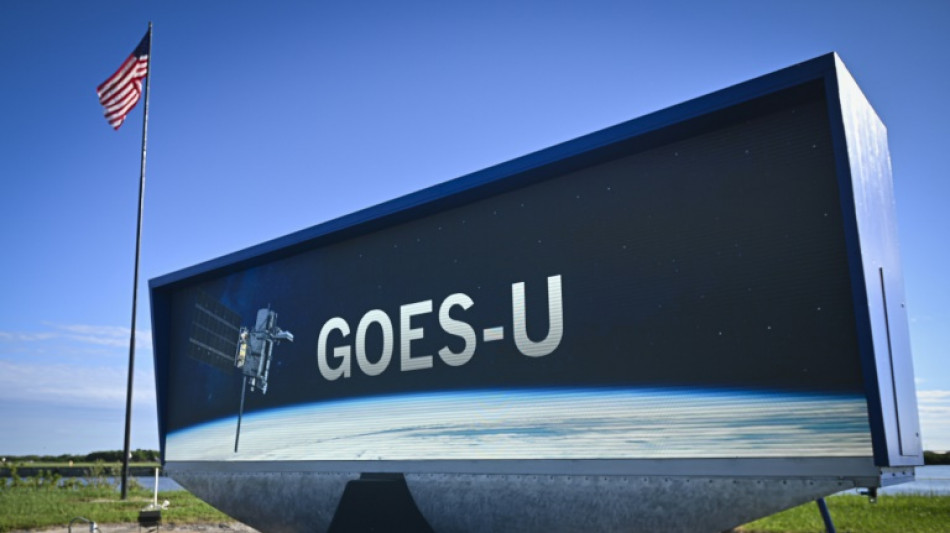
US to launch satellite to better prepare for space weather / Photo: © AFP

 Battered Duerer masterpiece up for five-year revamp

 Trump met with Venezuela's interim leader at UN

 Malaysia furore after Najib wins conditional house arrest

 Italy hope for new dawn under Mancini

 Mongolian herders enlist new tech against harsher, drier climate

 Tata turmoil shines light on India succession woes

 World Cup 'not enough' as Spain begin next chapter

 Meta acts against 3.7 mn scammers' accounts with Singapore police help

 Australia PM says draft social media rules about taking back control

 Voting opens in Alaska's annual Fat Bear Week

 MLS coach axed for telling female ref 'It's a man's game'

 US refuses to give Sudan's de facto leader visa for UN
 Man City hold Bayern to start Women's Champions League, Arsenal win late

 Trump threatens Iran with 'hell' but reveals fresh talks

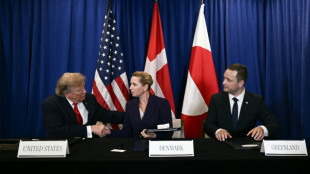 Trump signs security deal with Greenland, Denmark at UN

 Trump threatens Iran with 'hell' but unveils fresh talks

 Chile's Atacama Desert blossoms with life after El Nino rains

 Sri Lanka hands 220-year jail terms to 15 convicted of Easter bombings

 Typhoon Dujuan leaves 7 dead in Japan from landslides, flooding: media

 Ganna and Borghini lead Italy to mixed relay gold at cycling worlds
 Drug cocktail killed former child star Hayden Panettiere: coroner
 Moldova declares energy, water emergency
 French Holocaust denier jailed for eight months

 Oil prices slide, AI stock buzz fades

 Trump threatens to 'annihilate' Iran in bombastic UN speech

The United States is aiming Tuesday to launch a new satellite expected to significantly improve forecasts of solar flares and coronal mass ejections -- huge plasma bubbles that can crash into Earth, disrupting power grids and communications.
A SpaceX Falcon Heavy rocket is set to carry the satellite into orbit from NASA's Kennedy Space Center in Florida, though weather so far appears unfavorable for the two-hour launch window opening at 5:16 pm (2016 GMT).
The GOES-U (Geostationary Operational Environmental Satellite U) mission is a collaboration between the space agency NASA and the National Oceanic and Atmospheric Agency (NOAA).
It will be the fourth and final in the GOES-R series of satellites that have tracked hurricanes and tornadoes, monitored climate and sea surface temperature, air quality and even meteor detections since 2016.
Orbiting 22,236 miles (35,785 kilometers) above the equator, the satellites match the speed of Earth's rotation in order to hold their positions over specific regions and provide continuous coverage.
They "are an indispensable tool for protecting the United States and the one billion people who live and work in the Americas," Pam Sullivan, of NOAA said in a press conference.
GOES-U is the first of the four to include a coronagraph, called the Compact Coronagraph-1 (CCOR-1). Coronagraphs block the Sun's disk and allow observation of its outermost layer, called the corona.
"That allows us to observe large explosions off the sun, called coronal mass ejections that can hurtle billions of tons of matter at millions of miles per hour towards Earth," said Elsayed Talaat, in charge of space weather observations at NOAA.
The ejections, known as CMEs, can disrupt Earth's magnetic field, causing satellites, energy infrastructure, and navigation systems to go down. Collecting space weather data allows authorities to issue warnings one to four days in advance.
In early May, the planet experienced its first level 5 geomagnetic storm in two decades, the highest rating on the scale, which unleashed spectacular auroras worldwide.
With the new coronagraph, the speed and direction of this event could have been better understood from the start, said Talaat.
Major disruptions weren't felt, but some farmers "reported being unable to plant their crops because the precision GPS relied upon by their equipment had malfunctioned," he said.
For the first time, the United States will have a coronagraph observing the solar corona almost continuously, with the CCOR-1 taking readings every 30 minutes.
Currently, such observations are received with a delay of up to eight hours. They are carried out by a satellite launched in 1995, which should cease operating within two years.
"Once operational CCOR-1 will mark a new chapter in space weather observations," said Talaat.
"Although the sun is no more active than in previous generations, our society has changed, and we are more sensitive than ever to the sun's changing mood."
F.Pavlenko--BTB