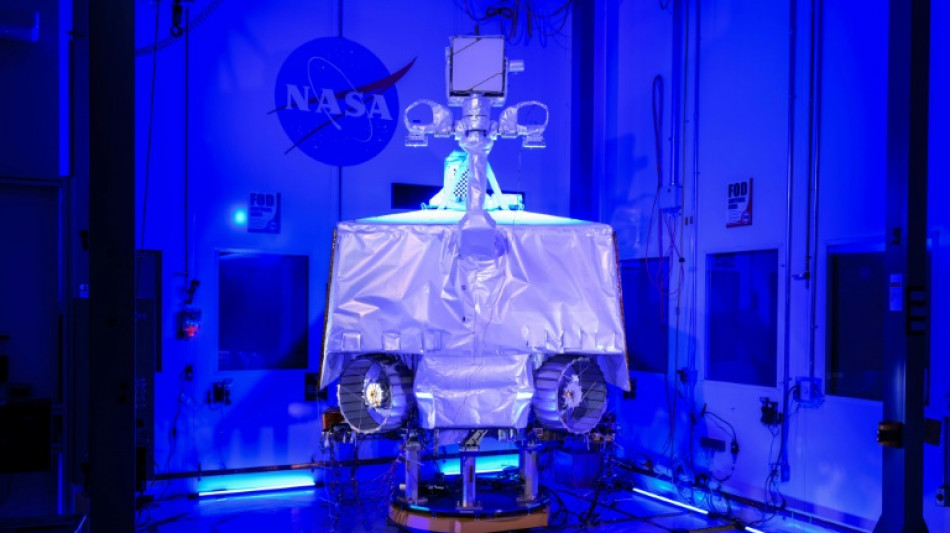
NASA cans lunar rover after spending $450 million building it / Photo: © NASA/AFP

 Battered Duerer masterpiece up for five-year revamp

 Trump met with Venezuela's interim leader at UN

 Malaysia furore after Najib wins conditional house arrest
 Italy hope for new dawn under Mancini

 Mongolian herders enlist new tech against harsher, drier climate

 Tata turmoil shines light on India succession woes
 World Cup 'not enough' as Spain begin next chapter

 Meta acts against 3.7 mn scammers' accounts with Singapore police help

 Australia PM says draft social media rules about taking back control

 Voting opens in Alaska's annual Fat Bear Week
 MLS coach axed for telling female ref 'It's a man's game'

 US refuses to give Sudan's de facto leader visa for UN

 Man City hold Bayern to start Women's Champions League, Arsenal win late

 Trump threatens Iran with 'hell' but reveals fresh talks

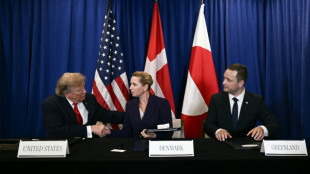 Trump signs security deal with Greenland, Denmark at UN

 Trump threatens Iran with 'hell' but unveils fresh talks

 Chile's Atacama Desert blossoms with life after El Nino rains

 Sri Lanka hands 220-year jail terms to 15 convicted of Easter bombings

 Typhoon Dujuan leaves 7 dead in Japan from landslides, flooding: media

 Ganna and Borghini lead Italy to mixed relay gold at cycling worlds

 Drug cocktail killed former child star Hayden Panettiere: coroner

 Moldova declares energy, water emergency

 French Holocaust denier jailed for eight months

 Oil prices slide, AI stock buzz fades

 Trump threatens to 'annihilate' Iran in bombastic UN speech

NASA announced Wednesday that cost overruns and delays have forced it to cancel a planned Moon rover it already spent $450 million to develop, marking a significant setback for the agency's lunar exploration program.
The Volatiles Investigating Polar Exploration Rover (VIPER) was intended to explore the lunar south pole in search of ice and other resources, paving the way for planned crewed missions by American astronauts under the Artemis program later this decade.
"Decisions like this are never easy," said Nicky Fox, NASA's associate administrator of the science mission directorate.
"But in this case, the projected remaining expenses for VIPER would have resulted in having to either cancel or disrupt many other missions."
The mobile robot, which NASA had hoped would venture into the Moon's permanently shadowed craters, where ice reserves have endured for billions of years, was originally planned to launch in 2023.
But in 2022, the US space agency requested a launch delay to late 2024 to allow more time for preflight testing of the Griffin lander vehicle, supplied by the Pittsburgh-based company Astrobotic under the new Commercial Lunar Payload Services (CLPS) program, a public-private venture.
The launch readiness date of the rover then slipped back further to September 2025, while the cost was projected to rise to $609.6 million.
Joel Kearns, deputy associate administrator for exploration in NASA's science mission directorate, added that Congress had been notified of the agency's decision.
The rover was "completely assembled" but had not yet undergone certain tests that would certify it could withstand launch, flying through the vacuum of space, and experiencing extreme temperatures, said Kearns.
But it was still possible the rover could be re-used in future missions, either in whole or in component parts, if NASA could reach a suitable agreement with industry partners who might be interested, he said.
Astrobotic, which in January launched the Peregrine lander that failed to reach the Moon, is still on track to launch in late 2025, but it will now carry a "mass simulator" or heavy weight in place of a NASA rover.
Kearns insisted that despite the setback, the United States was not falling behind in its space rivalry with China, which in June succeeded in returning the first ever samples from the far side of the Moon.
"We congratulate China's national space agency for the seemingly very successful Chang'e-6 mission," he said.
But he added that, by partnering with the space industry under the CLPS program, "we think that we're going to have a more robust science program and a more robust lunar landing capability in the United States."
P.Anderson--BTB