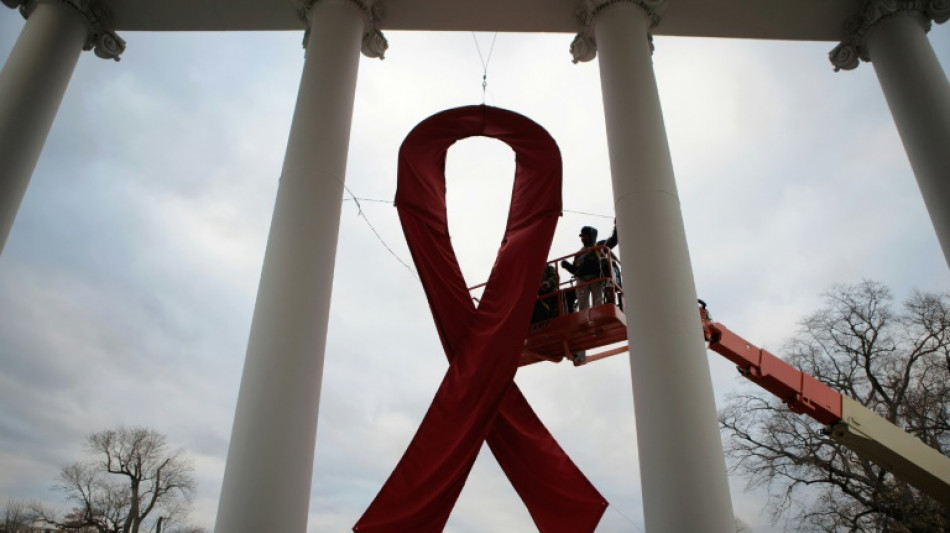
Seventh person likely 'cured' of HIV, doctors announce / Photo: © GETTY IMAGES NORTH AMERICA/AFP/File

 Battered Duerer masterpiece up for five-year revamp

 Trump met with Venezuela's interim leader at UN

 Malaysia furore after Najib wins conditional house arrest

 Italy hope for new dawn under Mancini

 Mongolian herders enlist new tech against harsher, drier climate

 Tata turmoil shines light on India succession woes

 World Cup 'not enough' as Spain begin next chapter

 Meta acts against 3.7 mn scammers' accounts with Singapore police help

 Australia PM says draft social media rules about taking back control

 Voting opens in Alaska's annual Fat Bear Week

 MLS coach axed for telling female ref 'It's a man's game'

 US refuses to give Sudan's de facto leader visa for UN

 Man City hold Bayern to start Women's Champions League, Arsenal win late

 Trump threatens Iran with 'hell' but reveals fresh talks

 Trump signs security deal with Greenland, Denmark at UN

 Trump threatens Iran with 'hell' but unveils fresh talks

 Chile's Atacama Desert blossoms with life after El Nino rains

 Sri Lanka hands 220-year jail terms to 15 convicted of Easter bombings

 Typhoon Dujuan leaves 7 dead in Japan from landslides, flooding: media

 Ganna and Borghini lead Italy to mixed relay gold at cycling worlds

 Drug cocktail killed former child star Hayden Panettiere: coroner

 Moldova declares energy, water emergency

 French Holocaust denier jailed for eight months

 Oil prices slide, AI stock buzz fades

 Trump threatens to 'annihilate' Iran in bombastic UN speech

A 60-year-old German man is likely the seventh person to be effectively cured from HIV after receiving a stem cell transplant, doctors announced on Thursday.
The painful and risky procedure is for people who have both HIV and aggressive leukaemia, so is not an option for almost all of the nearly 40 million people living with the deadly virus across the world.
The German man, whose wished to remain anonymous, was dubbed the "next Berlin patient".
The original Berlin patient, Timothy Ray Brown, was the first person declared cured of HIV back in 2008. Brown died from cancer in 2020.
The second man from Berlin to achieve long-term HIV remission was announced ahead of the 25th International AIDS Conference being held in the German city of Munich next week.
He was first diagnosed with HIV in 2009, according to the research abstract being presented at the conference.
The man received a bone marrow transplant for his leukaemia in 2015. The procedure, which has a 10 percent risk of death, essentially replaces a person's immune system.
Then he stopped taking anti-retroviral drugs -- which reduce the amount of HIV in the blood -- in late 2018.
Nearly six years later, he appears to be both HIV and cancer free, the medical researchers said.
Christian Gaebler, a doctor-researcher at Berlin's Charite university hospital treating the patient, told AFP that the team cannot be "absolutely certain" every last trace of HIV has been eradicated.
But "the patient's case is highly suggestive of an HIV cure," Gaebler added. "He feels well and is enthusiastic about contributing to our research efforts."
- 'Promising' for wider cure -
International AIDS Society President Sharon Lewin said researchers hesitate to use the word "cure" because it is not clear how long they need to follow up such cases.
But more than five years in remission means the man "would be close" to being considered cured, she told a press conference.
There is an important difference between the man's case and the other HIV patients who have reached long-term remission, she said.
All but one of the other patients received stem cells from donors with a rare mutation in which part of their CCR5 gene was missing, blocking HIV from entering their body's cells.
Those donors had inherited two copies of the mutated CCR5 gene -- one from each parent -- making them "essentially immune" to HIV, Lewin said.
But the new Berlin patient is the first to have received stem cells from a donor who had inherited only one copy of the mutated gene.
Around 15 percent of people from European origin have one mutated copy, compared to one percent for both.
Researchers hope the latest success means there will be a much larger potential donor pool in the future.
The new case is also "promising" for the wider search for an HIV cure that works for all patients, Lewin said.
This is "because it suggests that you don't actually have to get rid of every single piece of CCR5 for gene therapy to work," she added.
The Geneva patient, whose case was announced at last year's AIDS conference, is the other exception among the seven. He received a transplant from a donor without any CCR5 mutations -- yet still achieved long-term remission.
This showed that the effectiveness of the procedure was not just down to the CCR5 gene, Lewin said.
K.Brown--BTB