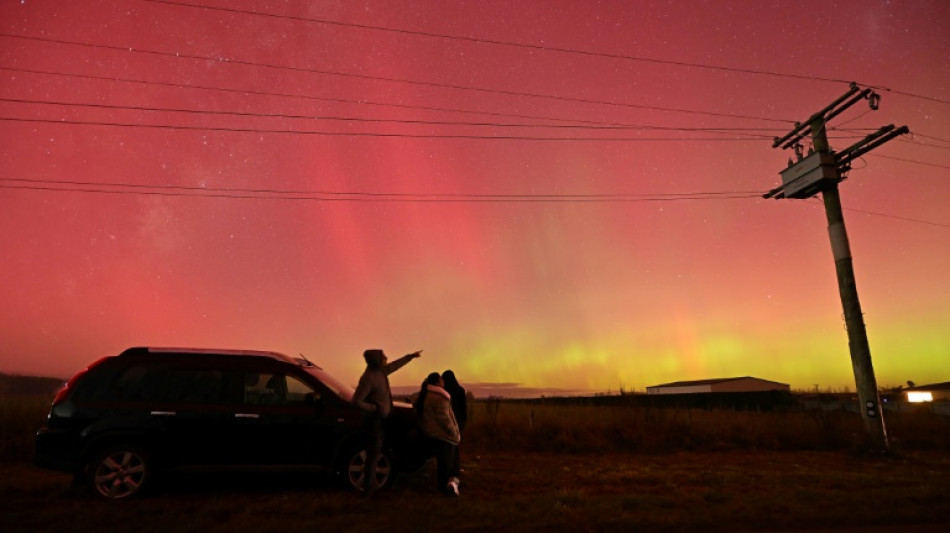
Solar storms could cause more auroras on Tuesday night / Photo: © AFP/File

 Battered Duerer masterpiece up for five-year revamp

 Trump met with Venezuela's interim leader at UN

 Malaysia furore after Najib wins conditional house arrest

 Italy hope for new dawn under Mancini

 Mongolian herders enlist new tech against harsher, drier climate

 Tata turmoil shines light on India succession woes

 World Cup 'not enough' as Spain begin next chapter

 Meta acts against 3.7 mn scammers' accounts with Singapore police help

 Australia PM says draft social media rules about taking back control

 Voting opens in Alaska's annual Fat Bear Week

 MLS coach axed for telling female ref 'It's a man's game'

 US refuses to give Sudan's de facto leader visa for UN

 Man City hold Bayern to start Women's Champions League, Arsenal win late

 Trump threatens Iran with 'hell' but reveals fresh talks

 Trump signs security deal with Greenland, Denmark at UN

 Trump threatens Iran with 'hell' but unveils fresh talks

 Chile's Atacama Desert blossoms with life after El Nino rains

 Sri Lanka hands 220-year jail terms to 15 convicted of Easter bombings

 Typhoon Dujuan leaves 7 dead in Japan from landslides, flooding: media

 Ganna and Borghini lead Italy to mixed relay gold at cycling worlds

 Drug cocktail killed former child star Hayden Panettiere: coroner

 Moldova declares energy, water emergency

 French Holocaust denier jailed for eight months

 Oil prices slide, AI stock buzz fades

 Trump threatens to 'annihilate' Iran in bombastic UN speech

Massive explosions on the Sun have triggered warnings of geomagnetic storms that could create dazzling auroras in the northern United States, Europe and southern Australia on Tuesday night.
In May, the most powerful geomagnetic storm to strike Earth in more than two decades lit up night skies with colourful light displays in Hawaii, Spain, South Africa and other places far from the extreme latitudes where they are normally seen.
These storms are caused by coronal mass ejections (CMEs) -- expulsions of plasma and magnetic fields from the Sun which take days to reach Earth.
At least four CMEs that erupted in recent days are headed towards Earth, the US-based National Oceanic and Atmospheric Administration (NOAA) said late Monday.
They will arrive from Tuesday to Thursday, with "geomagnetic storm watches" declared by the NOAA on those days.
But "the brunt of the activity is most likely" to come on Tuesday, when there is a "strong" geomagnetic storm warning of G3, the NOAA said.
May's record storms were classified as the most extreme level of G5. This means any potential auroras this week are unlikely to stray as far, or as be as powerful, as those seen earlier this year.
But if the current forecast is correct, during the late evening hours in the US on Tuesday, an "aurora could become visible as far south as the northeast US through the upper Midwest and across the rest of the northern states to include northern Oregon", the NOAA said.
"With a bit of luck," aurora borealis -- also known as the northern lights -- could also be seen in areas such as England, northern Germany, the Netherlands and Belgium, according to the website SpaceWeatherLive.
Australia's Bureau of Meteorology said that a sequence of CMEs arriving in the next few days mean that aurora australis might be visible in some areas.
- 'Cannibal CME' -
When CMEs erupt, they shoot around a billion tons of plasma -- with an accompanying magnetic field -- from the Sun towards our home planet.
One of the CMEs coming towards Earth this week merged with another, forming what is called a "Cannibal CME", according to spaceweather.com.
The NOAA warned that more CMEs are continuing to erupt, so more could be coming our way.
When the CMEs slam into Earth's magnetosphere, they can create geomagnetic storms.
These storms can mess with satellites orbiting Earth and affect things like radio signals and GPS positioning systems.
They can also knock out electricity grids -- the "Halloween Storms" of October 2003 sparked blackouts in Sweden and damaged power infrastructure in South Africa.
Astronauts on the International Space Station often shelter during extreme solar activity to avoid being exposed to radiation.
Numerous strong solar flares -- huge explosions on the Sun's surface which can cause CMEs -- have also been emitted in recent days.
Most CMEs and flares come from sunspots, which are massive, darker areas of intense activity on the solar surface. The sunspot cluster that caused May's storms was 17 times the size of Earth.
More geomagnetic storms could be yet to come, because solar activity is only just approaching the peak of its roughly 11-year cycle.
The peak -- called "solar maximum" -- is expected between late 2024 and early 2026.
K.Brown--BTB