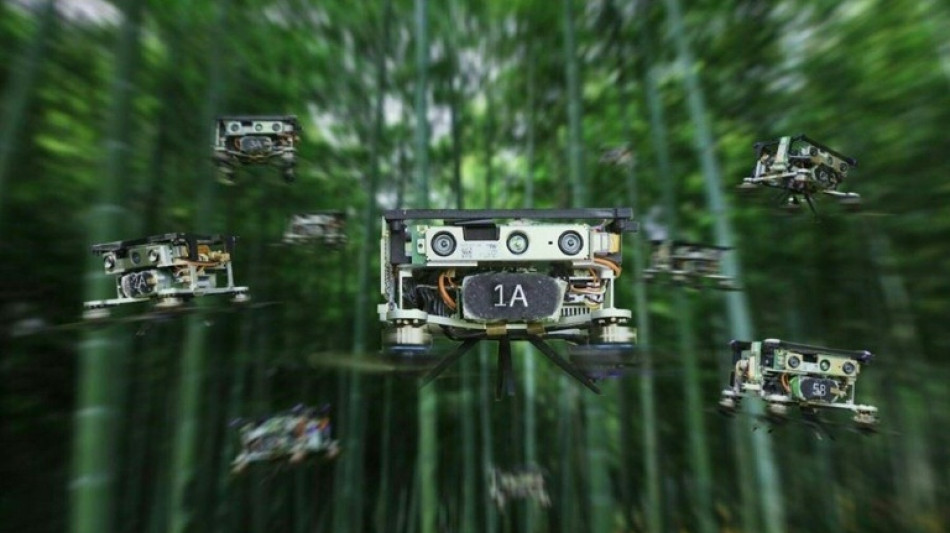
Drone swarms can now fly autonomously through thick forest / Photo: © Yuman Gao and Rui Jin/AFP

 Indians living in Japan on stand-by to house Asian Games athletes
 Trump signs bill authorizing sweeping Russia sanctions

 Protesters form human chain at Kennedy Center after Trump threat
 Death toll from attack at police HQ in Pakistan rises to 31

 Trump says Denmark to give US 'permanent control' over Greenland security
 Kennedy Center: future unclear for iconic Washington arts hub

 Trump claims 'infinite' Greenland security deal with Denmark

 Helicopters battle wildfire threatening Ecuador's capital

 Brentford batter Chelsea to undo Alonso's promising start

 Kane hits Bundesliga century as Bayern rout Union

 Trump says CNN, MS NOW, Politico banned from White House

 Hushing and hedging: US companies retreat on climate

 Springboks to face Fiji before 2027 Rugby World Cup

 Nigeria miners struggled to breathe in cell before 37 died: survivors

 McIlroy on the charge at PGA Championship as Reed withdraws

 McIlroy on the charge at PGA Championship

 Crisis-wracked Volkswagen warns of 10-bn-euro hit to profits

 Costa Rica's Grynspan tops third informal poll for UN chief: diplomat

 Stock markets retreat after central bank rate hikes

 Russia labels director of Cannes Grand Prix winner a 'foreign agent'

 Macron warns of Russian 'hybrid' threat after meeting presidential hopefuls

 UN holds third informal poll for new chief

 Kulusevski return can spark Spurs: De Zerbi

 Shakira to cap off world tour with Madrid 12-gig run

 Isolated Syrian-Druze city blames Damascus for shortages

A swarm of 10 bright blue drones lifts off in a bamboo forest in China, then swerves its way between cluttered branches, bushes and over uneven ground as it autonomously navigates the best flight path through the woods.
The experiment, led by scientists at Zhejiang University, evokes scenes from science fiction -- and the authors in fact cite films such as "Star Wars," "Prometheus" and "Blade Runner 2049" in the opening of their paper published Wednesday in the journal Science Robotics.
"Here, we take a step forward (to) such a future," wrote the team, led by Xin Zhou.
In theory, there are myriad real world applications, including aerial mapping for conservation and disaster relief work. But the technology has needed to mature so that flying robots can adapt to new environments without crashing into one another or objects, thus endangering public safety.
Drone swarms have been tested in the past, but either in open environments without obstacles, or with the location of those obstacles programmed in, Enrica Soria, a roboticist at the Swiss Federal Institute of Technology Lausanne, who was not involved in the research, told AFP.
"This is the first time there's a swarm of drones successfully flying outside in an unstructured environment, in the wild," she said, adding the experiment was "impressive."
The palm-sized robots were purpose-built, with depth cameras, altitude sensors and an on-board computer. The biggest advance was a clever algorithm that incorporates collision avoidance, flight efficiency and coordination within the swarm.
Since these drones do not rely on any outside infrastructure, such as GPS, swarms could be used during natural disasters.
For example, they could be sent into earthquake-hit areas to survey damage and identify where to send help, or into buildings where it's unsafe to send people.
It's certainly possible to use single drones in such scenarios, but a swarm approach would be far more efficient, especially given limited flight times.
Another possible use is having the swarm collectively lift and deliver heavy objects.
There's also a darker side: swarms could be weaponized by militaries, just as remote-piloted single drones are today. The Pentagon has repeatedly expressed interest and is carrying out its own tests.
"Military research is not shared with the rest of the world just openly, and so it's difficult to imagine at what stage they are with their development," said Soria.
But advances shared in scientific journals could certainly be put to military use.
- Coming soon? -
The Chinese team tested their drones in different scenarios -- swarming through the bamboo forest, avoiding other drones in a high-traffic experiment, and having the robots follow a person's lead.
"Our work was inspired by birds that fly smoothly in a free swarm through even very dense woods," wrote Zhou in a blog post.
The challenge, he said, was balancing competing demands: the need for small, lightweight machines, but with high-computational power, and plotting safe trajectories without greatly prolonging flight time.
For Soria, it's only a matter of a few years before we see such drones deployed in real-life work. First, though, they will need to be tested in ultra-dynamic environments like cities, where they'll constantly come up against people and vehicles.
Regulations will also need to catch up, which takes additional time.
M.Ouellet--BTB