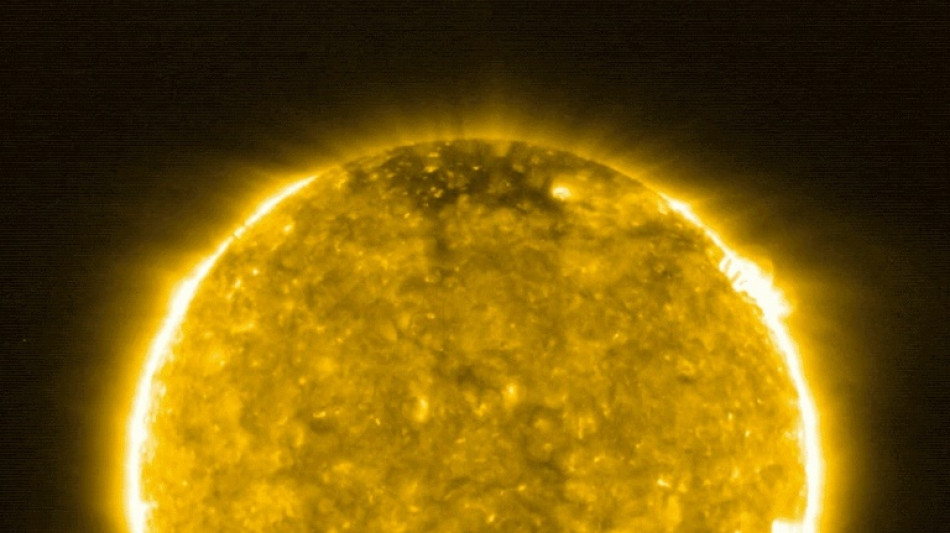
Earth hit by 'severe' solar storm / Photo: © Solar Orbiter/EUI/ESA/NASA/AFP

 Battered Duerer masterpiece up for five-year revamp

 Trump met with Venezuela's interim leader at UN

 Malaysia furore after Najib wins conditional house arrest

 Italy hope for new dawn under Mancini

 Mongolian herders enlist new tech against harsher, drier climate

 Tata turmoil shines light on India succession woes

 World Cup 'not enough' as Spain begin next chapter

 Meta acts against 3.7 mn scammers' accounts with Singapore police help

 Australia PM says draft social media rules about taking back control

 Voting opens in Alaska's annual Fat Bear Week

 MLS coach axed for telling female ref 'It's a man's game'

 US refuses to give Sudan's de facto leader visa for UN

 Man City hold Bayern to start Women's Champions League, Arsenal win late

 Trump threatens Iran with 'hell' but reveals fresh talks

 Trump signs security deal with Greenland, Denmark at UN

 Trump threatens Iran with 'hell' but unveils fresh talks

 Chile's Atacama Desert blossoms with life after El Nino rains

 Sri Lanka hands 220-year jail terms to 15 convicted of Easter bombings

 Typhoon Dujuan leaves 7 dead in Japan from landslides, flooding: media

 Ganna and Borghini lead Italy to mixed relay gold at cycling worlds

 Drug cocktail killed former child star Hayden Panettiere: coroner

 Moldova declares energy, water emergency

 French Holocaust denier jailed for eight months

 Oil prices slide, AI stock buzz fades

 Trump threatens to 'annihilate' Iran in bombastic UN speech

The Earth was hit Monday by an intense solar storm that could bring the northern lights to night skies further south than normal, a US agency announced.
Conditions of a level-four geomagnetic storm -- on a scale of five -- were observed Monday from 1500 GMT, according to a specialized center at the US National Oceanic and Atmospheric Administration (NOAA).
These conditions may persist for several hours, but were not expected to increase further in intensity, NOAA added in a statement.
"A severe geomagnetic storm includes the potential for aurora to be seen faintly as far south as Alabama and northern California," NOAA said in a statement, referring to US states.
The new solar storm is caused by coronal mass ejections (CMEs), which are explosions of particles leaving the Sun. When these particles arrive on Earth, they disrupt its magnetic field.
"There are a lot of auroras now... If it lasts until nightfall here, we might be able to see some," Eric Lagadec, an astrophysicist at the Cote d'Azur Observatory in France, said on X.
On Sunday, NASA astronaut Matthew Dominick published on X a superb photo of the aurora borealis -- or Northern Lights -- taken from the International Space Station, where he is currently stationed.
But solar or geomagnetic storms can also trigger undesirable effects.
For example, they can degrade high-frequency communications, disrupt satellites, and cause overloads on the electricity grid. Operators of sensitive infrastructure have been notified to put in place measures to limit these effects, NOAA said.
In May, the planet went through the most powerful geomagnetic storms recorded in 20 years. They caused auroras to light up the night sky in the United States, Europe, and Australia, at much lower latitudes than usual.
This type of event has increased recently because the Sun is currently close to its peak activity, as per its 11-year cycle.
R.Adler--BTB