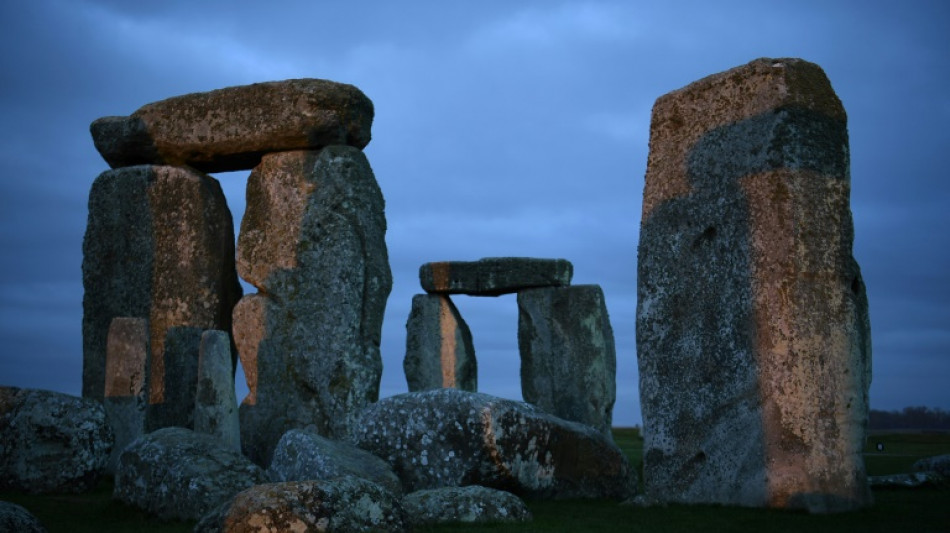
Stonehenge mystery deepens as altar traced to Scotland / Photo: © AFP/File

 Battered Duerer masterpiece up for five-year revamp

 Trump met with Venezuela's interim leader at UN

 Malaysia furore after Najib wins conditional house arrest

 Italy hope for new dawn under Mancini

 Mongolian herders enlist new tech against harsher, drier climate

 Tata turmoil shines light on India succession woes

 World Cup 'not enough' as Spain begin next chapter

 Meta acts against 3.7 mn scammers' accounts with Singapore police help

 Australia PM says draft social media rules about taking back control

 Voting opens in Alaska's annual Fat Bear Week

 MLS coach axed for telling female ref 'It's a man's game'

 US refuses to give Sudan's de facto leader visa for UN

 Man City hold Bayern to start Women's Champions League, Arsenal win late

 Trump threatens Iran with 'hell' but reveals fresh talks

 Trump signs security deal with Greenland, Denmark at UN

 Trump threatens Iran with 'hell' but unveils fresh talks

 Chile's Atacama Desert blossoms with life after El Nino rains

 Sri Lanka hands 220-year jail terms to 15 convicted of Easter bombings

 Typhoon Dujuan leaves 7 dead in Japan from landslides, flooding: media

 Ganna and Borghini lead Italy to mixed relay gold at cycling worlds

 Drug cocktail killed former child star Hayden Panettiere: coroner

 Moldova declares energy, water emergency

 French Holocaust denier jailed for eight months

 Oil prices slide, AI stock buzz fades

 Trump threatens to 'annihilate' Iran in bombastic UN speech

A central stone of the famous Stonehenge monument in southwest England came from 750 kilometres away in northeast Scotland, surprised scientists said Wednesday, solving one mystery but raising another: how did its prehistoric builders move the huge slab so far?
The Neolithic circle of giant stones has been a source of wonder and mystery for nearly 5,000 years -- in the Middle Ages, the wizard Merlin of Arthurian legend was said to have stolen the monument from Ireland.
More recently, scientists have determined that the site's upright sandstones came from relatively nearby Marlborough, while the bluestones arrayed near its centre came from Wales.
But the origin of the Altar Stone, a unique six-tonne slab laying on its side at the heart of the circle, remained elusive.
It was long thought to have also come from Wales, but tests along those lines always "drew a blank," said Richard Bevins, a professor from Aberystwyth University, mid-Wales, and co-author of a new study.
This prompted a team of British and Australian researchers to broaden their horizons -- and in turn discover something "quite sensational", he told AFP.
Using chemical analysis, they determined that the Altar Stone came from Scotland's Orcadian Basin, which is at least 750 kilometres (460 miles) from Stonehenge, according to the study in the journal Nature.
- 'Genuinely shocking' -
The researchers were stunned.
"This is a genuinely shocking result," study co-author Robert Ixer of University College London said in a statement.
The "astonishing" distance was the longest recorded journey for any stone at the time, said fellow co-author Nick Pearce of Aberystwyth University.
Whether people around 2,500 BC were capable of transporting such huge stones from Wales had already been a matter of heated debate among archaeologists and historians.
That a five-by-one-metre (16-by-three-feet) stone made the trip across much of the length of the UK suggests that the British isles were home to a highly organised and well-connected society at the time, the researchers said.
They called for further research to find out exactly where in Scotland the stone came from -- and how it made its way to Stonehenge.
One theory is that the stone was brought to southern England not by humans but by naturally moving ice flows.
However research has shown that ice would actually have carried such stones "northwards, away from Stonehenge", lead study author Anthony Clarke from Australia's Curtin University told a news conference.
Another option was that the Neolithic builders moved the stones over land -- though this would have been extraordinarily difficult.
Dense forest, marshy bogs and mountains all formed "formidable barriers" for prehistoric movers, Clarke said.
- 'Incredibly important' -
Another option is that the stone was transported by sea.
There is evidence of an "extensive network of Neolithic shipping," which moved pottery and gems around the region, Clarke said.
To work out where it came from, the researchers fired laser beams into the crystals of a thin slice of the Altar Stone.
The ratio of uranium and lead in these crystals act as "miniature clocks" for rocks, providing their age, said study co-author Chris Kirkland of Curtin University.
The team then compared the stone's age to other rocks across the UK and found "with a high degree of certainty" that it came from the Orcadian Basin, Kirkland said.
Susan Greaney, an archaeologist at the UK's University of Exeter not involved in the study, said it established the first "direct link" between southern England and northern Scotland during this time.
"The placement of this stone at the heart of the monument, on the solstice axis, shows that they thought this stone, and by implication, the connection with the area to the north, was incredibly important," she told AFP.
T.Bondarenko--BTB