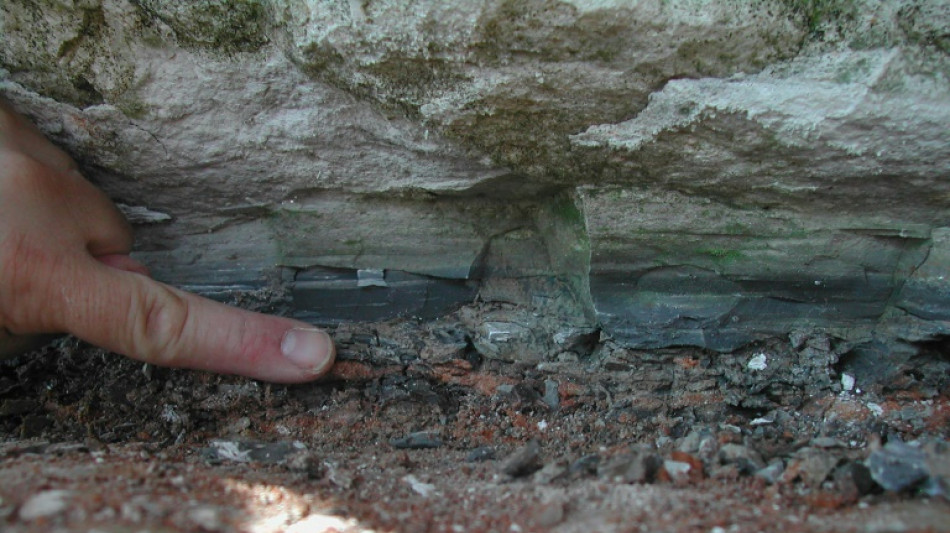
Scientists pinpoint dino-killing asteroid's origin: past Jupiter / Photo: © EUREKALERT!/AFP

 Battered Duerer masterpiece up for five-year revamp

 Trump met with Venezuela's interim leader at UN

 Malaysia furore after Najib wins conditional house arrest

 Italy hope for new dawn under Mancini

 Mongolian herders enlist new tech against harsher, drier climate

 Tata turmoil shines light on India succession woes

 World Cup 'not enough' as Spain begin next chapter

 Meta acts against 3.7 mn scammers' accounts with Singapore police help

 Australia PM says draft social media rules about taking back control

 Voting opens in Alaska's annual Fat Bear Week

 MLS coach axed for telling female ref 'It's a man's game'

 US refuses to give Sudan's de facto leader visa for UN

 Man City hold Bayern to start Women's Champions League, Arsenal win late

 Trump threatens Iran with 'hell' but reveals fresh talks

 Trump signs security deal with Greenland, Denmark at UN

 Trump threatens Iran with 'hell' but unveils fresh talks

 Chile's Atacama Desert blossoms with life after El Nino rains

 Sri Lanka hands 220-year jail terms to 15 convicted of Easter bombings

 Typhoon Dujuan leaves 7 dead in Japan from landslides, flooding: media

 Ganna and Borghini lead Italy to mixed relay gold at cycling worlds

 Drug cocktail killed former child star Hayden Panettiere: coroner

 Moldova declares energy, water emergency

 French Holocaust denier jailed for eight months

 Oil prices slide, AI stock buzz fades

 Trump threatens to 'annihilate' Iran in bombastic UN speech

An intense debate surrounding the cosmic rock that killed the dinosaurs has stirred scientists for decades, but a new study has revealed some important -- and far-out -- data about the impactor's origin story.
Researchers, whose findings were published Thursday in the journal Science, used an innovative technique to demonstrate that the apocalyptic culprit which slammed into the Earth's surface 66 million years ago, causing the most recent mass extinction, had formed beyond Jupiter's orbit.
They also refute the idea that it was a comet.
The new insights into the apparent asteroid that cratered into Chicxulub, in what is present-day Mexico's Yucatan Peninsula, could improve the understanding of celestial objects that have struck our planet.
"Now we can, with all this knowledge... say that this asteroid initially formed beyond Jupiter," Mario Fischer-Godde, lead author of the study and a geochemist at the University of Cologne, told AFP.
The conclusions are particularly notable, given how rarely this type of asteroid collides with Earth.
Such information may well prove useful in assessing future threats, or determining how water arrived on this planet, Fischer-Godde said.
- Samples -
The new findings are based on analysis of sediment samples formed at the period between the Cretaceous and Paleogene eras, the time of the asteroid's cataclysmic impact.
Researchers measured the isotopes of the element ruthenium, not uncommon on asteroids but extremely rare on Earth. So by inspecting the deposits in multiple geological layers that mark the debris from the impact at Chicxulub, they could be sure that the ruthenium studied came "100 percent from this asteroid."
"Our lab in Cologne is one of the rare labs that can do these measurements," and it was the first time such study techniques were used on impact debris layers, Fischer-Godde said.
Ruthenium isotopes can be used to distinguish between the two main groups of asteroids: C-type, or carbonaceous, asteroids that formed in the outer solar system, and S-type silicate asteroids from the inner solar system, nearer the sun.
The study affirms that the asteroid that triggered a mega-earthquake, precipitated a global winter and wiped out the dinosaurs and most other life, was a C-type asteroid that formed beyond Jupiter.
Studies from two decades ago had already made such an assumption, but with far less certainty.
The conclusions are striking, because most meteorites -- pieces of asteroids that fall to Earth -- are S-types, Fischer-Godde pointed out.
Does that mean the Chicxulub impactor formed beyond Jupiter and made a beeline for our planet? Not necessarily.
"We cannot be really sure where the asteroid was kind of hiding just before it impacted on Earth," Fischer-Godde said, adding that after its formation, it may have made a stopover in the asteroid belt, located between Mars and Jupiter and where most meteorites originate.
- Not a comet -
The study also dismisses the idea that the destructive impactor was a comet, an amalgam of icy rock from the very edge of the solar system. Such a hypothesis was put forward in a much-publicized study in 2021, based on statistical simulations.
Sample analyses now show that the celestial object was far different in composition from a subset of meteorites which are believed to have been comets in the past. It is therefore "unlikely" the impactor in question was a comet, Fischer-Godde said.
As to the wider usefulness of his findings, the geochemist offered two suggestions.
He believes that more accurately defining the nature of asteroids that have struck Earth since its beginnings some 4.5 billion years ago could help solve the enigma of the origin of our planet's water.
Scientists believe water may have been brought to Earth by asteroids, likely of the C-type like the one that struck 66 million years ago, even though they are less frequent.
Studying past asteroids also allows humanity to prepare for the future, Fischer-Godde said.
"If we find that earlier mass extinction events could also be related to C-type asteroid impacts, then... if there's ever going to be C-type asteroid on an Earth-crossing orbit, we have to be very careful," he said, "because it might be the last one we witness."
O.Krause--BTB