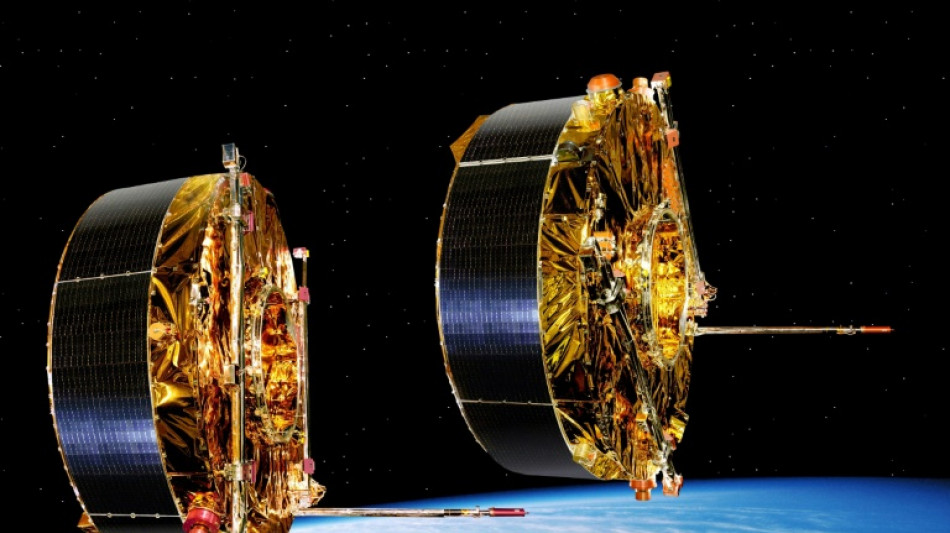
Old satellite to burn up over Pacific in 'targeted' re-entry first / Photo: © EUROPEAN SPACE AGENCY/AFP/File

 Marchand 'stressed' about racing Japanese rivals at LA Olympics

 Mobile boat clinics bring healthcare to India's remote islands

 Former India paceman Zaheer Khan named Chennai coach in IPL

 Six-year-old Chinese girl sets world record with Rubik's Cube

 Swimming prodigy Yu, 13, says 'interviews way harder than racing'

 Star coaches make their bows as Nations League returns

 Rams bounce back as Giants reel from Dart injury

 In Bangladesh, Pakistan's Jinnah photo stirs anger

 Two New Zealand naval ships transit Taiwan Strait

 Zidane gets down to work as France start new era

 Inside the Venezuelan prison meant to 'drive you insane'

 UK king braces as memoir by Diana's brother goes on sale

 Akkodis and Hamburg Public Transport Association Showcase hvv mia at InnoTrans 2026, Demonstrating the Future of AI-Powered Mobility

 Macron says talks with Trump on Red Sea, Ukraine 'constructive'

 Green policies just good politics, says UK minister

 Bardot auction in Paris fetches nearly one million euros

 No timeline on Daniels injury return, says Commanders coach

 British Columbia sues OpenAI in US court over Canada school shooting

 French star Batum retires after 18-year NBA career

 Zidane leads first France training session

 Man shot by ICE agent in Texas detained with bullet inside him: lawyer

 California declares state of emergency ahead of El Nino

 South Africa arrests three more suspects, after nine women murdered

 Carse needs time away from England, says captain Brook

 NOWPayments Releases Cross-Chain Payout Data Revealing Key Performance Benchmarks Across TRON, BNB Chain, and Solana

After 24 years diligently studying Earth's magnetic field, a satellite will mostly burn up over the Pacific Ocean on Sunday during a "targeted" re-entry into the atmosphere, in a first for the European Space Agency as it seeks to reduce space debris.
Since launching in 2000, the Salsa satellite has helped shed light on the magnetosphere, the powerful magnetic shield that protects Earth from solar winds -- and without which the planet would be uninhabitable.
According to the ESA, Salsa's return home will mark the first-ever "targeted" re-entry for a satellite, which means it will fall back to Earth at a specific time and place but will not be controlled as it re-enters the atmosphere.
Teams on the ground have already performed a series of manoeuvres with the 550-kilogram (1,200-pound) satellite to ensure it burns up over a remote and uninhabited region of the South Pacific, off the coast of Chile.
This unique re-entry is possible because of Salsa's unusual oval-shaped orbit. During its swing around the planet, which takes two and half days, the satellite strays as far as 130,000 kilometres (80,000 miles), and comes as close as just a few hundred kilometres.
Bruno Sousa, head of the ESA's inner solar system missions operations unit, said it had been crucial that Salsa came within roughly 110 kilometres during its last two orbits.
"Then immediately on the next orbit, it would come down at 80 kilometres, which is the region in space already within the atmosphere, where we have the highest chance (for it) to be fully captured and burned," he told a press conference.
When a satellite starts entering the atmosphere at around 100 kilometres above sea level, intense friction with atmospheric particles -- and the heat this causes -- starts making them disintegrate.
But some fragments can still make it back down to Earth.
- Fear of 'cascading' space junk -
The ESA is hoping to pinpoint where Salsa, roughly the size of a small car, re-enters the atmosphere to within a few hundred metres.
Because the satellite is so old, it does not have fancy new tech -- like a recording device -- making tracking this part tricky.
A plane will be flying at an altitude of 10 kilometres to watch the satellite burn up -- and track its falling debris, which is expected to be just 10 percent of its original mass.
Salsa is just one of four satellites that make up the ESA's Cluster mission, which is coming to an end. The other three are scheduled for a similar fate in 2025 and 2026.
The ESA hopes to learn from these re-entries which type of materials do not burn up in the atmosphere, so that "in the future we can build satellites that can be totally evaporated by this process," Sousa said.
Scientists have been sounding the alarm about space junk, which is the debris left by the enormous number of dead satellites and other missions that continue orbiting our planet.
Last year the ESA signed a "zero debris" charter for its missions from 2030.
There are two main risks from space junk, according to the ESA's space debris system engineer Benjamin Bastida Virgili.
"One is that in orbit, you have the risk that your operational satellite collides with a piece of space debris, and that creates a cascading effect and generates more debris, which would then put in risk other missions," he said.
The second comes when the old debris re-enters the atmosphere, which happens almost daily as dead satellite fragments or rocket parts fall back to Earth.
Designing satellites that completely burn up in the atmosphere will mean there is "no risk for the population," Bastida Virgili emphasised.
But there is little cause for alarm. According to the ESA, the chance of a piece of space debris injuring someone on the ground is less than one in a hundred billion.
This is 65,000 times lower than the odds of being struck by lightning.
J.Fankhauser--BTB