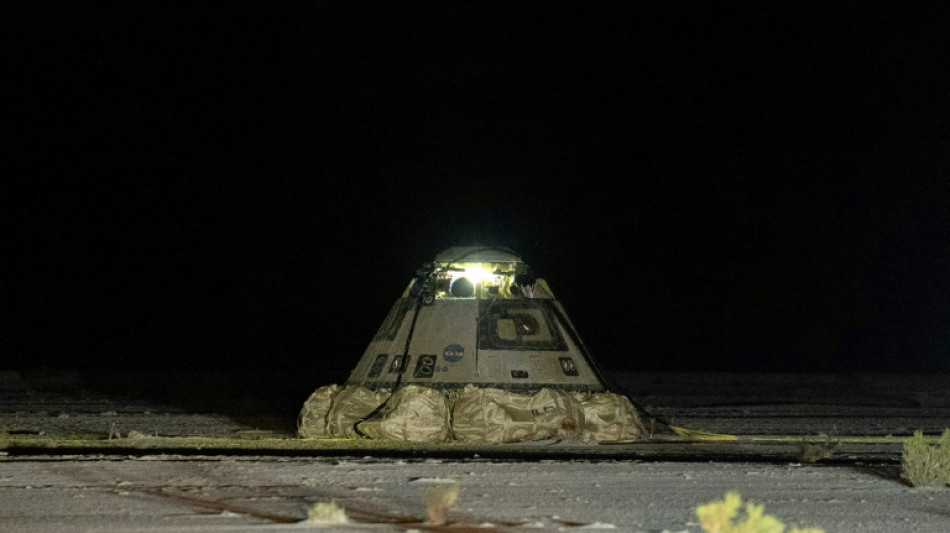
Boeing's beleaguered Starliner returns home without astronauts / Photo: © BOEING/AFP

 Marchand 'stressed' about racing Japanese rivals at LA Olympics
 Mobile boat clinics bring healthcare to India's remote islands

 Former India paceman Zaheer Khan named Chennai coach in IPL

 Six-year-old Chinese girl sets world record with Rubik's Cube
 Swimming prodigy Yu, 13, says 'interviews way harder than racing'

 Star coaches make their bows as Nations League returns
 Rams bounce back as Giants reel from Dart injury

 In Bangladesh, Pakistan's Jinnah photo stirs anger

 Two New Zealand naval ships transit Taiwan Strait

 Zidane gets down to work as France start new era
 Inside the Venezuelan prison meant to 'drive you insane'
 UK king braces as memoir by Diana's brother goes on sale

 Akkodis and Hamburg Public Transport Association Showcase hvv mia at InnoTrans 2026, Demonstrating the Future of AI-Powered Mobility
 Macron says talks with Trump on Red Sea, Ukraine 'constructive'
 Green policies just good politics, says UK minister

 Bardot auction in Paris fetches nearly one million euros
 No timeline on Daniels injury return, says Commanders coach

 British Columbia sues OpenAI in US court over Canada school shooting

 French star Batum retires after 18-year NBA career
 Zidane leads first France training session
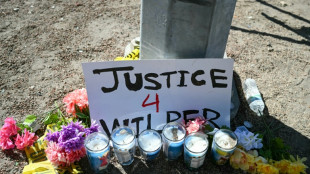 Man shot by ICE agent in Texas detained with bullet inside him: lawyer

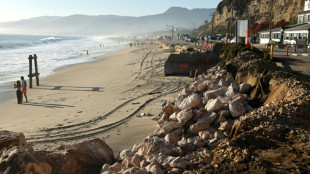 California declares state of emergency ahead of El Nino
 South Africa arrests three more suspects, after nine women murdered
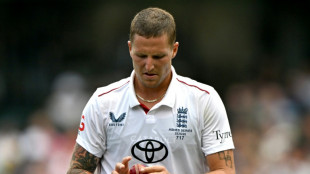 Carse needs time away from England, says captain Brook

 NOWPayments Releases Cross-Chain Payout Data Revealing Key Performance Benchmarks Across TRON, BNB Chain, and Solana

Boeing's beleaguered Starliner made its long-awaited return to Earth on Saturday without the astronauts who rode it up to the International Space Station, after NASA ruled the trip back too risky.
After years of delays, Starliner launched in June for what was meant to be a roughly weeklong test mission -- a final shakedown before it could be certified to rotate crew to and from the orbital laboratory.
But unexpected thruster malfunctions and helium leaks en route to the ISS derailed those plans, and NASA ultimately decided it was safer to bring crewmates Butch Wilmore and Suni Williams back on a rival SpaceX Crew Dragon -- though they'll have to wait until February 2025.
The gumdrop-shaped Boeing capsule touched down softly at the White Sands Space Harbor in New Mexico at 0401 GMT Saturday, its descent slowed by parachutes and cushioned by airbags, having departed the ISS around six hours earlier.
As it streaked red-hot across the night sky, ground teams reported hearing sonic booms. The spacecraft endured temperatures of 3,000 degrees Fahrenheit (1,650 degrees Celsius) during atmospheric reentry.
NASA lavished praise on Boeing during a post-flight press conference where representatives from the company were conspicuously absent.
"It was a bullseye landing," said Steve Stich, program manager for NASA's commercial crew program. "The entry in particular has been darn near flawless."
Still, he acknowledged that certain new issues had come to light, including the failure of a new thruster and the temporary loss of the guidance system.
He added it was too early to talk about whether Starliner's next flight, scheduled for August next year, would be crewed, instead stressing NASA needed time to analyze the data they had gathered and assess what changes were required to both the design of the ship and the way it is flown.
Ahead of the return leg, Boeing carried out extensive ground testing to address the technical hitches encountered during Starliner's ascent, then promised -- both publicly and behind closed doors -- that it could safely bring the astronauts home. In the end, NASA disagreed.
Asked whether he stood by that decision, NASA's Stich said: "It's always hard to have that retrospective look. We made the decision to have an uncrewed flight based on what we knew at the time and based on our knowledge of the thrusters and based on the modeling that we had."
- History of setbacks -
Even without crew aboard, the stakes were high for Boeing, a century-old aerospace giant.
With its reputation already battered by safety concerns surrounding its commercial jets, its long-term prospects for crewed space missions hung in the balance.
Shortly after undocking, Starliner executed a powerful "breakout burn" to swiftly clear it from the station and prevent any risk of collision -- a maneuver that would have been unnecessary if crew were aboard to take manual control if needed.
Mission teams then conducted thorough checks of the thrusters required for the critical "deorbit burn" that guided the capsule onto its reentry path around 40 minutes before touchdown.
Though it was widely expected that Starliner would stick the landing, as it had on two previous uncrewed tests, Boeing's program continues to languish behind schedule.
In 2014, NASA awarded both Boeing and SpaceX multibillion-dollar contracts to develop spacecraft to taxi astronauts to and from the ISS, after the end of the Space Shuttle program left the US space agency reliant on Russian rockets.
Although initially considered the underdog, Elon Musk's SpaceX surged ahead of Boeing, and has successfully flown dozens of astronauts since 2020.
The Starliner program, meanwhile, has faced numerous setbacks -- from a software glitch that prevented the capsule from rendezvousing with the ISS during its first uncrewed test flight in 2019, to the discovery of flammable tape in the cabin after its second test in 2022, to the current troubles.
With the ISS scheduled to be decommissioned in 2030, the longer Starliner takes to become fully operational, the less time it will have to prove its worth.
J.Horn--BTB