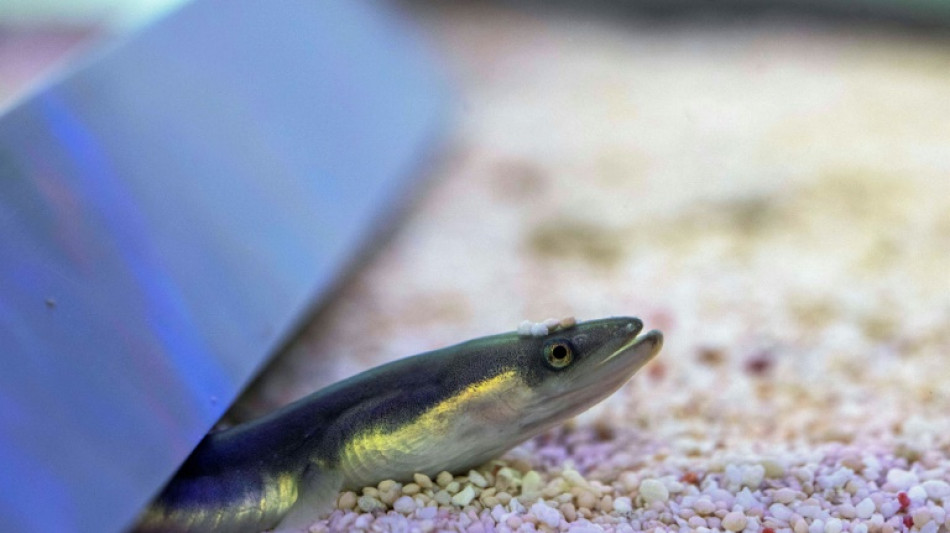
'Astonishing': Eaten eels recorded escaping from fish guts / Photo: © AFP/File

 Inside the Venezuelan prison meant to 'drive you insane'

 UK king braces as memoir by Diana's brother goes on sale

 No green light to lift EU sanctions on Russian oligarchs, talks to resume

 UK agrees support for Saudi in struggle with Houthis: reports

 EU foreign policy chief calls for continued sanctions on Russia

 Flights scrapped, evacuations urged as Typhoon Dujuan wallops Japan

 Fonseca to take break from tennis

 A Cuban zoo, and its animals, in epic battle for survival

 Infantino proposes consulting federations to reform FIFA

 El Nino weather pattern enters record territory: scientist

 OpenAI calls for US to lead global effort on AI standards

 South African ostriches plucked alive for luxury fashion: report

 US networks halt Trump coverage in revolt over White House ban

 Paramount settles with US states to clear Warner Bros. mega-merger

 Climate crisis a job for world leaders, not just activists: UK FM

 US networks halt Trump coverage over White House ban

 French singer accuses Miley Cyrus of plagiarism

 EU fines Google 403 mn euros for location data breach

 'Best is yet to come,' says De la Fuente after Spain extension

 Why diesel prices are rising more than crude oil

 COP31 host says AI's climate footprint to be a summit priority

 Renewables hit record in 2025, but world must move faster: report

 US media outlets to sue Trump administration after White House ban

 Global stocks rally on lower oil prices, US-China hopes

 EU proposes energy rating for data centres

Eels that have been swallowed by fish have been recorded for the first time sliding tail-first back out of their would-be predators' stomach and escaping out of their gills, a study said Monday.
The remarkable last-gasp getaway also marks the first time this kind of defensive tactic has been caught on video across the animal kingdom, according to the Japanese researchers.
The team behind the new study had already observed young Japanese eels surviving being eaten by sliding out of the gills of fish -- rather than out of the mouths that had swallowed them.
Nonetheless, the researchers had assumed the eels had been somewhat near the mouths of the fish when they broke free.
But the team was "really surprised" to find that the eels were all the way in the stomach of their predators before starting their escape bid, lead study author Yuha Hasegawa of Nagasaki University told AFP.
- Stomach turning -
Some eels even circled around the stomach several times before wriggling free, according to the study in the journal Current Biology.
To see what was happening inside the bodies of the predatory dark sleeper fish, the researchers injected them with fluid to increase the contrast for recording the results on an X-ray video system.
Out of 32 eels swallowed into the stomachs of the fish, all but four tried to escape by backing out through the digestive tract, towards the esophagus and eventually out the side door of the gills, the study said.
Thirteen managed to get at least some of their tails out of the gills, while nine went all the way and escaped with their lives.
The young eels, which were around seven centimetres (three inches) long, always went tail first. Unlike most fish, eels are skilled at swimming backwards, the researchers pointed out.
The whole process took around a minute. The eels could only survive around three minutes in the stomach acid.
The fish were not harmed when the eels burst free from their gills, Yuha Hasegawa said.
It was a "difficult" experiment, he added, and it took the team a year to capture convincing footage.
Previous research has shown that some invertebrates like worms can escape from the digestive system of frogs, but the inner workings have not been recorded on X-ray video.
Study co-author Yuuki Kawabata, also from Nagasaki University, said that scientists were only beginning to understand the "mysterious, astonishing" strategies that animals use to escape from predators.
He pointed out that Japanese eels are still offering up surprises despite being quite well known.
Fish are not the only animals with a taste for these eels -- they are a popular and expensive delicacy among many humans.
Japanese eels, called Unagi when cooked, make up the vast majority of commercially sold eel in Japan.
Overfishing has led the eels to be considered an endangered species by the International Union for Conservation of Nature.
L.Dubois--BTB