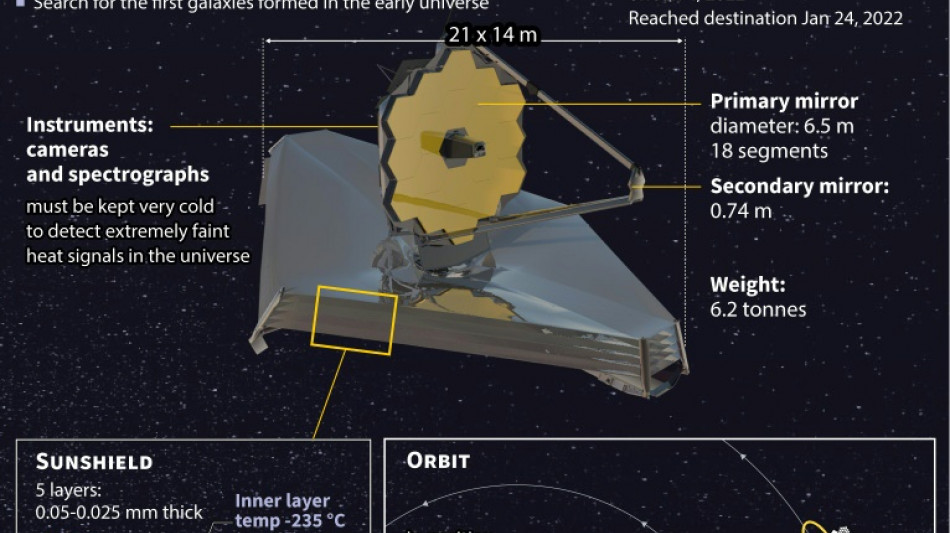
Webb telescope's first full color, scientific images coming in July / Photo: © AFP

 Indians living in Japan on stand-by to house Asian Games athletes
 Trump signs bill authorizing sweeping Russia sanctions
 Protesters form human chain at Kennedy Center after Trump threat

 Death toll from attack at police HQ in Pakistan rises to 31

 Trump says Denmark to give US 'permanent control' over Greenland security

 Kennedy Center: future unclear for iconic Washington arts hub

 Trump claims 'infinite' Greenland security deal with Denmark

 Helicopters battle wildfire threatening Ecuador's capital

 Brentford batter Chelsea to undo Alonso's promising start

 Kane hits Bundesliga century as Bayern rout Union
 Trump says CNN, MS NOW, Politico banned from White House

 Hushing and hedging: US companies retreat on climate

 Springboks to face Fiji before 2027 Rugby World Cup

 Nigeria miners struggled to breathe in cell before 37 died: survivors

 McIlroy on the charge at PGA Championship as Reed withdraws

 McIlroy on the charge at PGA Championship

 Crisis-wracked Volkswagen warns of 10-bn-euro hit to profits

 Costa Rica's Grynspan tops third informal poll for UN chief: diplomat

 Stock markets retreat after central bank rate hikes

 Russia labels director of Cannes Grand Prix winner a 'foreign agent'

 Macron warns of Russian 'hybrid' threat after meeting presidential hopefuls

 UN holds third informal poll for new chief

 Kulusevski return can spark Spurs: De Zerbi

 Shakira to cap off world tour with Madrid 12-gig run

 Isolated Syrian-Druze city blames Damascus for shortages
Get ready for a summer blockbuster.
The James Webb Space Telescope will produce "spectacular color images" of the cosmos in mid-July -- its first observations dedicated to its mission of scientific discovery, an astronomer overseeing the project said Monday.
The successor to Hubble has spent the last five months aligning its instruments in preparation for the big reveal, with scientists deliberately remaining coy about where the cameras will be pointed.
"We'd really like it to be a surprise," Klaus Pontoppidan, a scientist at the Space Telescope Science Institute in Baltimore told reporters, adding that the secrecy was partly due to the first targets not yet being finalized.
NASA and its partners the European Space Agency (ESA) and Canadian Space Agency (CSA) formed a committee to create a ranked list of objects, which they now intend to work through.
Webb's team has already released a series of star field images taken for calibration purposes, but the new photographs will be of astrophysics targets, key to deepening humankind's understanding of the universe, said Pontoppidan.
These images will actually be shot in infrared, and then colorized for public consumption.
Visible and ultraviolet light emitted by the very first luminous objects has been stretched by the universe's expansion, and arrives today in the form of infrared, which Webb is equipped to detect with unprecedented clarity -- giving it an unprecedented view of the first stars and galaxies that formed 13.5 billion years ago.
Webb, which is expected to cost NASA nearly $10 billion, is among the most expensive scientific platforms ever built, comparable to the Large Hadron Collider at CERN, and its predecessor telescope, Hubble.
Its mission also includes the study of distant planets, known as exoplanets, to determine their origin, evolution and habitability.
J.Fankhauser--BTB