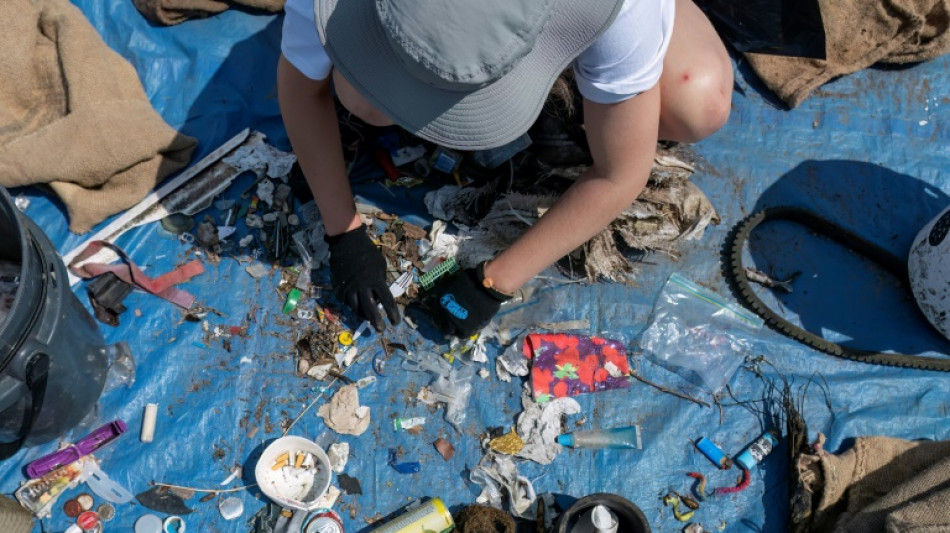
How plastic pollution poses challenge for Canada marine conservation / Photo: © AFP

 Newcomers South Korea face holders Italy in Davis Cup finals

 Japan's Kojima sounds Marchand warning with Asian Games gold

 England rugby star Pollock signs new Northampton deal

 STARTRADER Expands Its Chinese Equity CFD Range with CXMT and Unitree Robotics

 MEXC Expands Opportunity Compass with Stock Trading Handbook to Help Crypto Users Build Investment Knowledge

 England paceman Wood retires from international cricket

 Magnificent Mandhana's 79 helps India to Asian Games cricket gold

 Marchand 'stressed' about racing Japanese rivals at LA Olympics

 Mobile boat clinics bring healthcare to India's remote islands
 Former India paceman Zaheer Khan named Chennai coach in IPL

 Six-year-old Chinese girl sets world record with Rubik's Cube

 Swimming prodigy Yu, 13, says 'interviews way harder than racing'

 Star coaches make their bows as Nations League returns

 Rams bounce back as Giants reel from Dart injury

 In Bangladesh, Pakistan's Jinnah photo stirs anger

 Two New Zealand naval ships transit Taiwan Strait

 Zidane gets down to work as France start new era

 Inside the Venezuelan prison meant to 'drive you insane'

 UK king braces as memoir by Diana's brother goes on sale

 Akkodis and Hamburg Public Transport Association Showcase hvv mia at InnoTrans 2026, Demonstrating the Future of AI-Powered Mobility

 Macron says talks with Trump on Red Sea, Ukraine 'constructive'

 Green policies just good politics, says UK minister

 Bardot auction in Paris fetches nearly one million euros

 No timeline on Daniels injury return, says Commanders coach

 British Columbia sues OpenAI in US court over Canada school shooting

One of the largest producers of plastic waste per capita, Canada is struggling to protect its designated marine protected areas from this pollution, experts warn.
Here are some key points about the issue facing the North American country.
- Significant plastic pollution -
With more than four million tonnes produced each year, Canada generates "two to four times more" plastic pollution per person than the global average, said Anthony Merante of the NGO Oceana.
In 2020, more than 90 percent of plastic waste ended up in landfills or was incinerated, and only seven percent was recycled, according to the Canadian environment ministry.
The remaining roughly two percent, or 90,000 tonnes, ended up in the environment.
"Plastic pollution is so ubiquitous at this point, we can't protect marine protected areas from plastic pollution unless we stop plastic pollution at the source," said Merante, head of Oceana Canada's plastics campaign.
Globally, annual plastic production has more than doubled in 20 years to reach 460 million tonnes.
Only nine percent is recycled, according to the Organization for Economic Co-operation and Development (OECD).
And more than half of it is single-use packaging -- "things that we use for a few moments and that end up lasting hundreds of years," said Merante.
- New regulations -
In June 2022, Prime Minister Justin Trudeau's federal government banned six types of single-use plastics with the goal of achieving zero plastic waste by 2030.
The regulation is being challenged in court by Canadian and American plastics manufacturers, as well as petrochemical firms.
Several municipalities, including Montreal, Vancouver and Edmonton, have already banned certain single-use plastics.
More biodegradable utensils are being found on the banks near the island city of Montreal, said Anne-Marie Asselin, a marine biologist who has been carrying out collection campaigns along the Saint Lawrence River for five years.
This shows that people's "behaviors have not changed," but the kind of waste now generated has "much less impact on the environment," she noted.
Ottawa is also working on creating a federal plastics registry.
The goal is to hold manufacturers accountable by requiring them to report on the life cycle of the plastics they put into circulation.
In the case of federal marine protected areas, few measures have been put in place against plastic pollution.
The Department of Fisheries and Oceans maintains that it is, however, "taken into account" when creating new marine protected areas and that since 2019, it has been prohibited to dump waste in protected areas.
G.Schulte--BTB