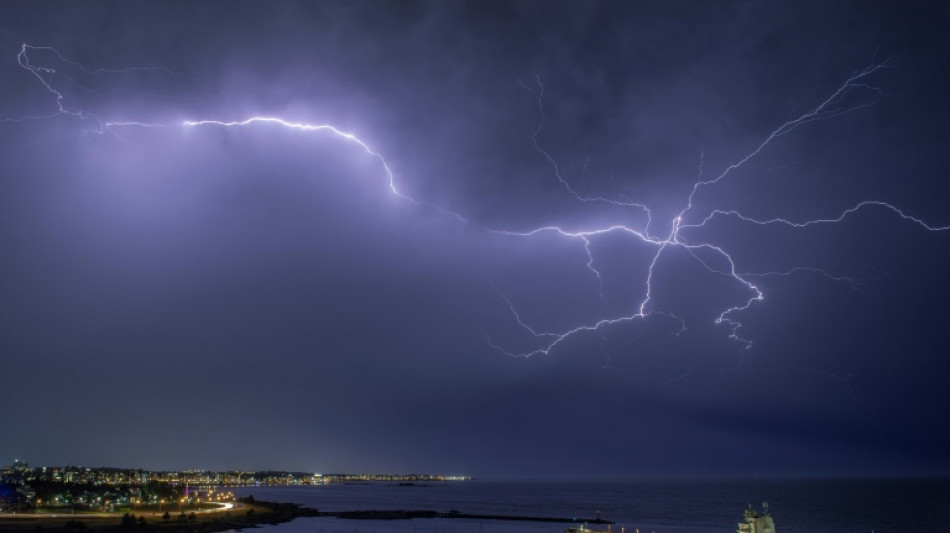
Thunderstorms are a 'boiling pot' of gamma rays, scientists find / Photo: © AFP/File

 Schoolgirl Yu, 13, fastest again in bid for third Asian Games gold

 Oil prices fall after Trump hails 'good' talks with Iran

 AI political ads warp reality ahead of US midterms

 Kenneth Branagh embraces action hero role -- to get in shape

 'New one' Klopp promises fresh approach as Germany reign begins

 Milne returns to New Zealand squad for India T20 series

 US-led Americas coalition backs sanctions against crime groups

 'Star Wars' fans and art lovers line up for new Lucas museum

 Trump renames AI 'super intelligence' as leaders jostle over dangers

 Oil prices retreat as markets welcome US-Iran talks

 US refusing to give Sudan's de facto leader visa for UN: diplomatic sources, UN

 Macron urges world to choose UN over 'law of the jungle'

 All-rounder Jacks stars as England beat Sri Lanka in 1st ODI

 Man City peg back Bayern to start Women's Champions League

 Trump beats 'America first' drum at UN as allies tread carefully

 Snedeker backs Spaun for Ryder Cup after Presidents snub

 French prosecutors probe secret filming of women with smart glasses

 Trump renames AI "super intelligence," rejects international oversight

 Trump rejects international regulation of AI

 How is the EU approaching record fuel prices?

 Sri Lanka's Colombage strikes on debut as England dismissed for 265 in first ODI

 Hurricane Polo strengthens to top category 5 off Mexico

 11 hurt as teen opens fire outside school in western Turkey

 UN chief says 'Big Oil' treats atmosphere as open sewer

 Tunisia says 2026 summer hottest on record

Big thunderstorms continuously emit gamma rays that are undetectable from the ground, two studies said on Wednesday, upending what was previously thought -- and potentially pointing towards a clue in the mystery of how lightning is sparked.
Despite the fact that 40,000 thunderstorms generate more than eight million lightning strikes above our heads every day, they "remain poorly understood", physicist Joseph Dwyer said in an analysis of the new research in the journal Nature.
Normally when people think of gamma rays -- bursts of an incredibly high-energy form of light -- they are coming from out of this world, such as solar flares, exploding stars or black holes.
However in the 1990s, NASA satellites tasked with hunting down high-energy particles from such cosmic sources detected gamma rays coming from Earth.
Other than inside nuclear reactors, nothing on our planet had been thought capable of generating gamma rays.
Since then, two different types of gamma rays have been observed inside thunderstorms -- both invisible to the naked eye.
Gamma-ray glows can last for a few minutes over a region roughly 20 kilometres (12 miles) wide, while more powerful "flashes" last less than a millisecond.
"As it turns out, essentially all big thunderstorms generate gamma rays all day long in many different forms," Steven Cummer, a researcher at Duke University and a co-author of one of the studies, said in a statement.
- Bubbling cauldron of gamma rays -
To find out more about what is happening inside thunderstorms, the international team of researchers used an NASA ER-2 airplane.
The scientific aircraft, based the American U-2 spy plane, can fly more than twice as high as a commercial airliner, soaring far above storm clouds.
Over a month in 2023, the plane left a Florida air force based to fly at an altitude of 20 kilometres over active storms, capturing evidence that gamma radiation is much more common than had been thought.
The storms almost continuously generated gamma-ray glows for hours across thousands of square kilometres, all of which were closely linked to the most intense areas of the storm.
The storms resemble "a huge gamma-glowing 'boiling pot' in both pattern and behaviour," said the author of the first Nature study, which was authored by Martino Marisaldi of Norway's University of Bergen.
The second study revealed that glows could intensify into what it called "flickering" gamma-ray flashes. These could be the elusive "missing link" between glows and flashes, it added.
These observations "blur the line between these two types of emission, suggesting that gamma-ray glows often morph into intense pulses", Dwyer explained.
Lightning often follows these intense gamma ray emissions, which suggests they might play some role in sparking lightning strikes, according to the second study.
"How lightning is initiated inside thunderstorms is one of the greatest mysteries in the atmospheric sciences," Dwyer said.
"It is amazing that, more than two decades into the 21st century, Earth's atmosphere has enough surprises in store to motivate an entirely new line of research."
M.Odermatt--BTB