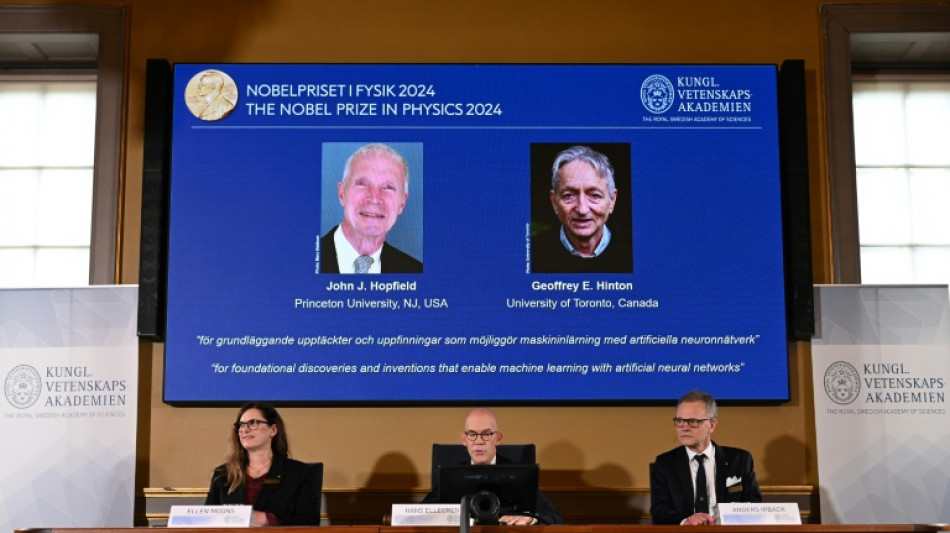
Nobel-winning physicist 'unnerved' by AI technology he helped create / Photo: © AFP

 Schoolgirl Yu, 13, fastest again in bid for third Asian Games gold
 Oil prices fall after Trump hails 'good' talks with Iran

 AI political ads warp reality ahead of US midterms
 Kenneth Branagh embraces action hero role -- to get in shape

 'New one' Klopp promises fresh approach as Germany reign begins
 Milne returns to New Zealand squad for India T20 series
 US-led Americas coalition backs sanctions against crime groups

 'Star Wars' fans and art lovers line up for new Lucas museum

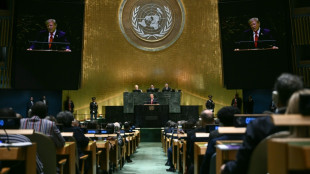 Trump renames AI 'super intelligence' as leaders jostle over dangers

 Oil prices retreat as markets welcome US-Iran talks
 US refusing to give Sudan's de facto leader visa for UN: diplomatic sources, UN
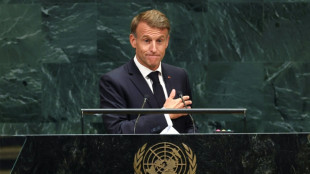 Macron urges world to choose UN over 'law of the jungle'
 All-rounder Jacks stars as England beat Sri Lanka in 1st ODI

 Man City peg back Bayern to start Women's Champions League

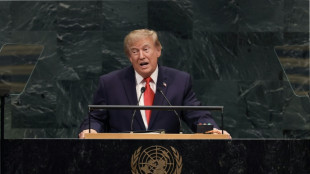 Trump beats 'America first' drum at UN as allies tread carefully

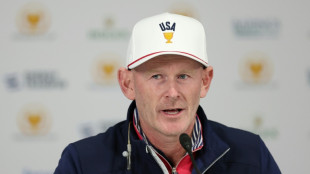 Snedeker backs Spaun for Ryder Cup after Presidents snub
 French prosecutors probe secret filming of women with smart glasses

 Trump renames AI "super intelligence," rejects international oversight
 Trump rejects international regulation of AI
 How is the EU approaching record fuel prices?

 Sri Lanka's Colombage strikes on debut as England dismissed for 265 in first ODI
 Hurricane Polo strengthens to top category 5 off Mexico
 11 hurt as teen opens fire outside school in western Turkey

 UN chief says 'Big Oil' treats atmosphere as open sewer
 Tunisia says 2026 summer hottest on record
A US scientist who won the 2024 Nobel physics prize for his pioneering work on artificial intelligence said Tuesday he found recent advances in the technology "very unnerving" and warned of possible catastrophe if it isn't kept in check.
John Hopfield, a professor emeritus at Princeton, joined co-winner Geoffrey Hinton in calling for a deeper understanding of the inner workings of deep-learning systems to prevent them from spiraling out of control.
Addressing a gathering at the New Jersey university via video link from Britain, the 91-year-old said that over the course of his life he had watched the rise of two powerful but potentially hazardous technologies -- biological engineering and nuclear physics.
"One is is accustomed to having technologies which are not singularly only good or only bad, but have capabilities in both directions," he said.
"And as a physicist, I'm very unnerved by something which has no control, something which I don't understand well enough so that I can understand what are the limits which one could drive that technology."
"That's the question AI is pushing," he continued, adding that despite modern AI systems appearing to be "absolute marvels," there is a lack of understanding about how they function, which he described as "very, very unnerving."
"That's why I myself, and I think Geoffrey Hinton also, would strongly advocate understanding as an essential need of the field, which is going to develop some abilities that beyond the abilities you can imagine at present."
Hopfield was honored for devising the "Hopfield network" — a theoretical model demonstrating how an artificial neural network can mimic the way biological brains store and retrieve memories.
His model was improved upon by British-Canadian Hinton, often dubbed the "Godfather of AI," whose "Boltzmann machine" introduced the element of randomness, paving the way for modern AI applications such as image generators.
With the meteoric rise of AI capabilities -- and the fierce race it has sparked among companies -- the technology has faced criticism for evolving faster than scientists can fully comprehend.
"You don't know that the collective properties you began with are actually the collective properties with all the interactions present, and you don't therefore know whether some spontaneous but unwanted thing is lying hidden in the works," stressed Hopefield.
He evoked the example of "ice-nine" -- a fictional, artificially engineered crystal in Kurt Vonnegut's 1963 novel "Cat's Cradle" developed to help soldiers deal with muddy conditions but which inadvertently freezes the world's oceans solid, causing the downfall of civilization.
"I'm worried about anything that says... 'I'm faster than you are, I'm bigger than you are...can you peacefully inhabit with me?' I don't know, I worry."
C.Kovalenko--BTB