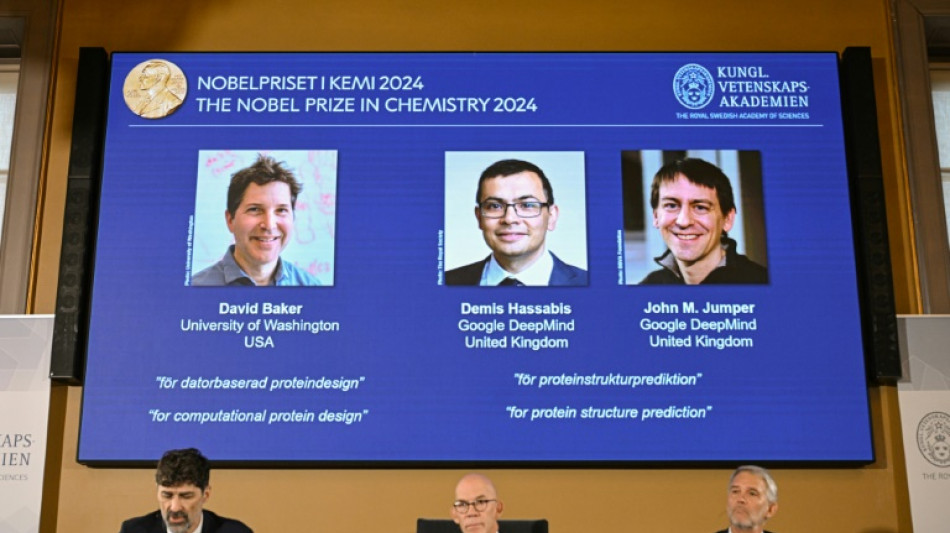
Nobel winners hope protein work will spur 'incredible' breakthroughs / Photo: © AFP

 Schoolgirl Yu, 13, fastest again in bid for third Asian Games gold
 Oil prices fall after Trump hails 'good' talks with Iran

 AI political ads warp reality ahead of US midterms

 Kenneth Branagh embraces action hero role -- to get in shape

 'New one' Klopp promises fresh approach as Germany reign begins
 Milne returns to New Zealand squad for India T20 series

 US-led Americas coalition backs sanctions against crime groups

 'Star Wars' fans and art lovers line up for new Lucas museum

 Trump renames AI 'super intelligence' as leaders jostle over dangers

 Oil prices retreat as markets welcome US-Iran talks
 US refusing to give Sudan's de facto leader visa for UN: diplomatic sources, UN
 Macron urges world to choose UN over 'law of the jungle'
 All-rounder Jacks stars as England beat Sri Lanka in 1st ODI

 Man City peg back Bayern to start Women's Champions League

 Trump beats 'America first' drum at UN as allies tread carefully

 Snedeker backs Spaun for Ryder Cup after Presidents snub
 French prosecutors probe secret filming of women with smart glasses

 Trump renames AI "super intelligence," rejects international oversight

 Trump rejects international regulation of AI
 How is the EU approaching record fuel prices?

 Sri Lanka's Colombage strikes on debut as England dismissed for 265 in first ODI
 Hurricane Polo strengthens to top category 5 off Mexico
 11 hurt as teen opens fire outside school in western Turkey

 UN chief says 'Big Oil' treats atmosphere as open sewer

 Tunisia says 2026 summer hottest on record

The winners of the Nobel Prize in Chemistry for work revealing the secrets of proteins through artificial intelligence said Wednesday they hoped their research would "open the door to many incredible scientific breakthroughs".
But they also warned of the dangers of AI, saying that while it had "extraordinary potential for good", it could also have negative effects if allowed to develop unchecked.
Americans David Baker and John Jumper, together with Briton Demis Hassabis, were honoured for cracking the code behind the structure of proteins, the building blocks of life.
The jury hailed their work as holding "enormous potential" in a range of fields.
At a press conference in London following the announcement, Jumper said the prize "represents the promise of computational biology".
"We want to make the world a better place, and we have these incredibly powerful tools to do it. We're ultimately going to make people healthy because of the work we do with AI," he added.
"I hope this is just a sign that we have opened the door to many incredible scientific breakthroughs."
Their work could have particular importance in the field of drug discovery, noted Hassabis.
"We think there's a huge potential there to revolutionise the way drug discovery is done, and try and shorten it down from almost a decade or more of work to... maybe months," he said.
AI particularly lends itself to molecular biology because it is able to identify "patterns that we never see," said Jumper.
"Medicine is hard because we don't understand how the body works in its extraordinary complexity," he added, calling their work "a step towards doing that".
- Late call -
Both Jumper and Hassabis said they had given up on getting the call, as the minutes ticked down to the announcement.
"I don't think they had either of our numbers, funnily enough," said Hassabis.
"So we got the call very late. We just thought 'it's not happening', or at least I did."
Jumper said that he was still waiting with only 30 minutes to go.
"I turned to my wife, and I said: 'Well, I guess it's not this year'.
"And then 30 seconds later, I got this phone call from Sweden, and I absolutely could not believe it."
Hassabis, 48, said his gaming background was the foundation of his computational expertise, and encouraged children to follow a similar path.
"I would actually encourage kids to play games, but not just to play them, but the most important thing is to try and make them.
"It's just a really fun way to get into the guts of how computers work," he added.
However, Hassabis sounded a note of caution about AI, which he called "one of the most transformative technologies in human history".
It has "the extraordinary potential for good... but also it can be used for harm," he said, warning "we have to really think very hard as these systems and techniques get more powerful".
"I'm a big believer in human ingenuity," Hassabis added, arguing "given enough time and enough resources and enough smart people", humanity can solve many of its most vexing problems.
L.Dubois--BTB