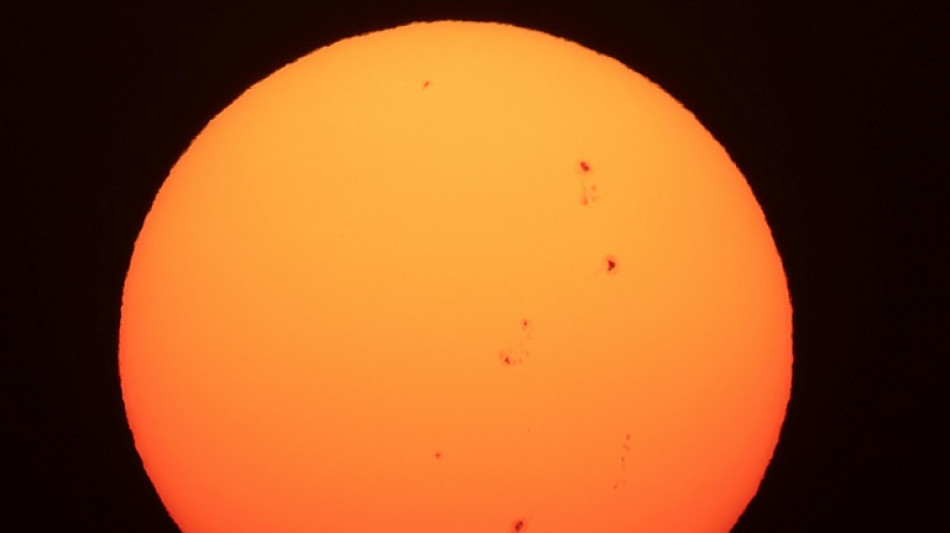
US forecasts severe solar storm starting Thursday / Photo: © AFP/File

 Schoolgirl Yu, 13, fastest again in bid for third Asian Games gold

 Oil prices fall after Trump hails 'good' talks with Iran

 AI political ads warp reality ahead of US midterms

 Kenneth Branagh embraces action hero role -- to get in shape

 'New one' Klopp promises fresh approach as Germany reign begins

 Milne returns to New Zealand squad for India T20 series

 US-led Americas coalition backs sanctions against crime groups

 'Star Wars' fans and art lovers line up for new Lucas museum

 Trump renames AI 'super intelligence' as leaders jostle over dangers

 Oil prices retreat as markets welcome US-Iran talks

 US refusing to give Sudan's de facto leader visa for UN: diplomatic sources, UN

 Macron urges world to choose UN over 'law of the jungle'

 All-rounder Jacks stars as England beat Sri Lanka in 1st ODI

 Man City peg back Bayern to start Women's Champions League

 Trump beats 'America first' drum at UN as allies tread carefully

 Snedeker backs Spaun for Ryder Cup after Presidents snub

 French prosecutors probe secret filming of women with smart glasses

 Trump renames AI "super intelligence," rejects international oversight

 Trump rejects international regulation of AI

 How is the EU approaching record fuel prices?

 Sri Lanka's Colombage strikes on debut as England dismissed for 265 in first ODI

 Hurricane Polo strengthens to top category 5 off Mexico

 11 hurt as teen opens fire outside school in western Turkey

 UN chief says 'Big Oil' treats atmosphere as open sewer

 Tunisia says 2026 summer hottest on record

A massive ball of plasma and accompanying magnetic field ejected from the Sun is expected to strike Earth on Thursday morning, potentially triggering auroras as far south as Alabama, according to US forecasters.
It comes as the Sun approaches -- or is possibly at -- the peak of its 11-year cycle, when activity is heightened.
In May, the planet experienced its most powerful geomagnetic storms in two decades, producing colorful displays across night skies far from the poles.
"The current anticipation is that it is going to arrive tomorrow morning to midday, Eastern time, and perhaps continue on into the following day," Shawn Dahl of the Space Weather Prediction Center told reporters at a briefing on Wednesday.
As the coronal mass ejection (CME) travels through space at 2.5 million miles (four million kilometers) an hour, the agency has put in place a level 4 geomagnetic storm watch (G4).
That is one level below the highest possible G5, seen in May -- but the final outcome could be either below or above G4.
Better predictions aren't possible until around 15-30 minutes before impact, when it crosses tracking satellites, a million miles from Earth.
Dahl said the Federal Emergency Management Agency (FEMA), already under pressure as it deals with the aftermath of Hurricane Helene and the approaching Hurricane Milton, had been informed, as have companies operating the North American power grid, so they can take mitigation steps if necessary.
When CMEs slam into Earth's magnetosphere, they can create geomagnetic storms.
The storms can disrupt satellites orbiting Earth and affect things like radio signals and GPS positioning systems.
They can also knock out electricity grids -- the "Halloween Storms" of October 2003 sparked blackouts in Sweden and damaged power infrastructure in South Africa.
May's storms disrupted precision GPS systems used by US farmers across the Midwest and caused some high-voltage transformers to trip, without large-scale disruption to the grid, said Dahl.
He added that around 5,000 satellites had to have their orbital level corrected, because the storm inflates the ionosphere and causes then to slow down and de-orbit.
For those living in the right latitudes -- potentially as far south as northern California or Alabama in the United States -- auroras would be most visible away from city lights, in the darkest skies possible, experts say.
People should use their cameras or phones to look, because today's digital imagery can often pick them up even when the naked eye cannot.
J.Bergmann--BTB