China's underground lab seeks answer to deep scientific riddle / Photo: © AFP

 Schoolgirl Yu, 13, fastest again in bid for third Asian Games gold

 Oil prices fall after Trump hails 'good' talks with Iran

 AI political ads warp reality ahead of US midterms

 Kenneth Branagh embraces action hero role -- to get in shape

 'New one' Klopp promises fresh approach as Germany reign begins
 Milne returns to New Zealand squad for India T20 series

 US-led Americas coalition backs sanctions against crime groups

 'Star Wars' fans and art lovers line up for new Lucas museum

 Trump renames AI 'super intelligence' as leaders jostle over dangers

 Oil prices retreat as markets welcome US-Iran talks
 US refusing to give Sudan's de facto leader visa for UN: diplomatic sources, UN
 Macron urges world to choose UN over 'law of the jungle'
 All-rounder Jacks stars as England beat Sri Lanka in 1st ODI

 Man City peg back Bayern to start Women's Champions League

 Trump beats 'America first' drum at UN as allies tread carefully

 Snedeker backs Spaun for Ryder Cup after Presidents snub

 French prosecutors probe secret filming of women with smart glasses

 Trump renames AI "super intelligence," rejects international oversight

 Trump rejects international regulation of AI

 How is the EU approaching record fuel prices?

 Sri Lanka's Colombage strikes on debut as England dismissed for 265 in first ODI

 Hurricane Polo strengthens to top category 5 off Mexico
 11 hurt as teen opens fire outside school in western Turkey

 UN chief says 'Big Oil' treats atmosphere as open sewer

 Tunisia says 2026 summer hottest on record

Far beneath the lush landscape of southern China, a sprawling subterranean laboratory aims to be the world's first to crack a deep scientific enigma.
China has emerged as a science powerhouse in recent years, with the country's Communist leadership ploughing billions of dollars into advanced research to contend with the United States and other rivals.
Its latest showpiece is the Jiangmen Underground Neutrino Observatory (Juno), a state-of-the-art facility for studying the minuscule subatomic particles.
The project is an "exciting" opportunity to delve into some of the universe's most fundamental -- but elusive -- building blocks, according to Patrick Huber, director of the Center for Neutrino Physics at the American university Virginia Tech, who is not involved in the facility's research.
AFP recently joined an international media tour of the observatory in Kaiping, Guangdong province, organised by the Chinese Academy of Sciences, the country's national science agency.
The lab is reached by a funicular train that travels down a tunnel to a cavern built 700 metres (2,300 feet) underground to limit radiation emissions.
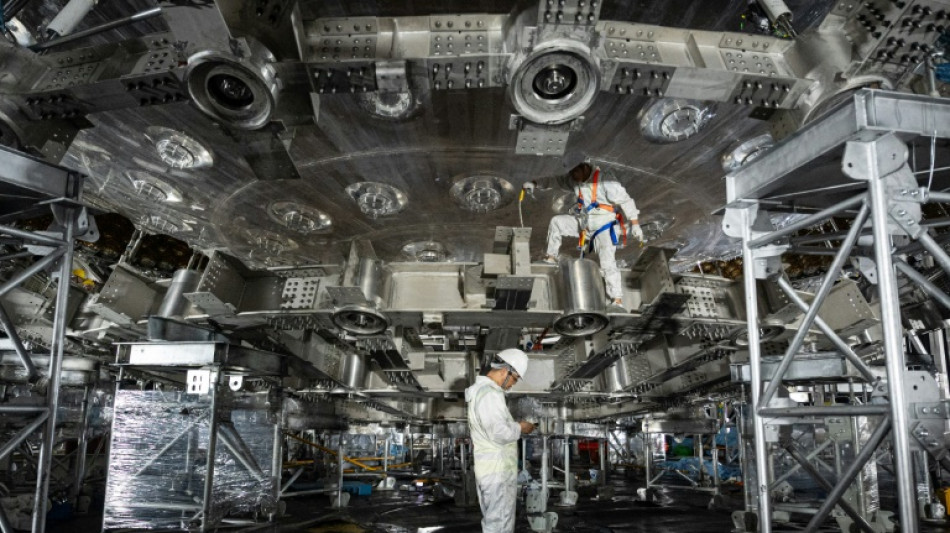
Inside stands the neutrino detector, a stainless steel and acrylic sphere around 35 metres in diameter, crisscrossed by cables.
"No one has built such a detector before," Wang Yifang, Juno's project manager and director of the Institute of High Energy Physics, said as workers in hard hats applied the finishing touches to the gleaming orb.
"You can see from the scale, it was technologically complicated," Wang said as he waved a laser pen over different parts of the installation.
Started in 2014, Juno has cost around 2.2 billion yuan ($311 million) to build and is due for completion next year.
It aims to solve a fundamental physics puzzle about the particles' nature faster than scientists in the United States, a world leader in the field.
Its research could also help us better understand planet Earth, the Sun, and other stars and supernovas.
- 'Second means nothing' -
Neutrinos are elementary particles that exist all around us and move close to the speed of light.
Physicists have known about them for decades but still lack in-depth knowledge of how they work.
Researchers will use Juno to detect neutrinos emitted by two Chinese nuclear power plants, each located 53 kilometres (33 miles) away.
They will then use the data to tackle something called the "mass hierarchy" problem, believed to be crucial for improving theories of particle physics.
Scientists already know that neutrinos come in three different mass states, but they don't know which is the heaviest and which is the lightest.
Solving that problem could help them better understand the standard model of particle physics, allowing them in turn to learn more about the past and future of the universe.
"(The project) will deeply test our understanding of neutrino oscillation and quantum mechanics," said Huber of Virginia Tech.
"If it turns out that Juno shows our (current) understanding is wrong, then that would be a revolution."
Wang, the project manager, said researchers were confident they would "get the result of mass hierarchy ahead of everybody".
In fundamental science, he said with a smile, being "the first means everything, and the second means nothing".
- Superpower tensions -
Scientists estimate that six years of data will be needed to crack the mass hierarchy question.
And although similar experiments will take place in the US and Japan in the coming years, Juno is "ahead in the race", said Jennifer Thomas, a physicist at University College London who also sits on the project's International Scientific Committee.
Around 750 scientists from 17 countries are taking part in the collaboration, including "two American groups", according to Wang.
More are interested in joining, he added, "but unfortunately, because of the many well known reasons... they are not allowed to".
As US-China competition over science and technology heats up, Washington has investigated US-based academics of Chinese origin for spying or stealing intellectual property, and it has encouraged domestic institutions to loosen ties with Chinese counterparts.
Beijing, for its part, has been accused by Western governments and international organisations of restricting access to certain data and hindering enquiries into sensitive topics, like the origins of Covid-19.
But one American scholar and member of Juno said he was looking forward to working on the "unique" project.
"We're not completely numb to the political situation, because there can sometimes be difficulties (for researchers) in obtaining visas" and navigating stricter bureaucratic hurdles, Juan Pedro Ochoa-Ricoux, an experimental physicist at the University of California, Irvine, told AFP.
He said such problems "affect both sides, perhaps our Chinese colleagues even more than us in the US".
But, he said, "by working together, we also show how science can and must be apolitical".
L.Janezki--BTB