2024's record ocean heat revved up Atlantic hurricane wind speeds: study / Photo: © AFP/File

 China's Factory Activity Contracts as Export Orders Weaken

 US Retail Sales and Fed Minutes Set Up a Critical Test for Consumers

 Oil Heads for Second Weekly Loss as Supply Surplus Emerges

 Four Mainland Universities Join Scheme for Hong Kong DSE Admissions from 2027

 Canada Signals Openness to Chinese Automakers if US Trade Talks Fail

 Canada Expands Asian Trade Push as US Negotiations Resume

 US Jobless Claims Rise to 200,000 but Layoffs Remain Historically Low

 Euro-Area Growth Slows to 0.4% While Employment Stalls

 US Wholesale Inflation Eases Monthly but Hits a Four-Year Annual High

 India's Wholesale Inflation Jumps to 12.29% as Fuel Costs Surge

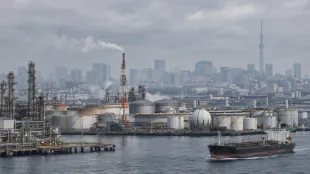 Japan's Economy Edges Into Contraction as Costly Oil Weighs on Demand

 Helen Haines Discharged from Hospital Following Attack That Cost Her Both Legs

 River Medway Reveals Financial Struggles Before 'Drag Race' Windfall

 OBI Pharma Signs Collaboration and License Agreement with Novartis
Human-driven warming of ocean temperatures increased the maximum wind speeds of every Atlantic hurricane in 2024, according to a new analysis released Wednesday, highlighting how climate change is amplifying the destructive power of storms.
The study, published by the research institute Climate Central, found that all eleven hurricanes in 2024 intensified by nine to 28 miles per hour (14-45 kph) during the record-breaking ocean warmth of the 2024 hurricane season.
"Emissions from carbon dioxide and other greenhouse gases have influenced the temperatures of sea surfaces around the world," author Daniel Gilford said in a call with reporters.
In the Gulf of Mexico, these emissions made sea surface temperatures around 2.5 degrees Fahrenheit (1.4C) hotter than they would have been in a world without climate change.
This rise fuels stronger hurricanes.
The increased temperatures intensified storms like Debby and Oscar, which grew from tropical storms into full-fledged hurricanes.
Other hurricanes were pushed up a category on the Saffir-Simpson scale, including Milton and Beryl which escalated from Category 4 to Category 5 due to climate change, while Helene climbed from Category 3 to Category 4.
Each rise in category corresponds to a roughly fourfold increase in destructive potential.
Helene proved particularly devastating, claiming more than 200 lives, making it the second deadliest hurricane to strike the US mainland in over half a century, surpassed only by Hurricane Katrina in 2005.
The new analytical approach allows researchers to hone in on a given storm's track -- showing for example that, at Hurricane Milton's point of peak intensification before landfall, climate change made the warm sea surface temperatures 100 times more likely to occur than otherwise, and increased maximum wind speed by 24 mph.
Gilford and his colleagues also published a peer-reviewed study in the journal Environmental Research Climate examining hurricane intensities from 2019 to 2023. They found that 84 percent of hurricanes during that period were significantly strengthened by human-caused ocean warming.
While their two studies focused on the Atlantic Basin, the researchers said that their methods could be applied to tropical cyclones globally.
Climatologist Friederike Otto of Imperial College London, who leads World Weather Attribution, praised the team's methodology for advancing beyond previous research that primarily linked climate change to hurricane-related rainfall.
Otto warned that these climate supercharged storms are occurring with the world at just 1.3C (2.3F) above pre-industrial temperatures, and that the impacts are likely to worsen as temperatures rise beyond 1.5C (2.7F).
"The hurricane scale is capped at Category Five -- but we might need to think about, should that continue to be the case just so that people are aware that something is going to hit them that is different from everything else they've experienced before," she said.
M.Furrer--BTB