India launches European 'artifical eclipse' satellites / Photo: © ESA/AFP/File

 Voting opens in Alaska's annual Fat Bear Week
 MLS coach axed for telling female ref 'It's a man's game'

 US refuses to give Sudan's de facto leader visa for UN
 Man City hold Bayern to start Women's Champions League, Arsenal win late

 Trump threatens Iran with 'hell' but reveals fresh talks

 Trump signs security deal with Greenland, Denmark at UN

 Trump threatens Iran with 'hell' but unveils fresh talks

 Chile's Atacama Desert blossoms with life after El Nino rains

 Sri Lanka hands 220-year jail terms to 15 convicted of Easter bombings

 Typhoon Dujuan leaves 7 dead in Japan from landslides, flooding: media

 Ganna and Borghini lead Italy to mixed relay gold at cycling worlds

 Drug cocktail killed former child star Hayden Panettiere: coroner
 Moldova declares energy, water emergency
 French Holocaust denier jailed for eight months

 Oil prices slide, AI stock buzz fades

 Trump threatens to 'annihilate' Iran in bombastic UN speech

 Prada's skirts take centre stage as Milan Fashion Week begins

 Quoin Pharmaceuticals Announces FDA Fast Track Designation for QRX003 for the Treatment of Peeling Skin Syndrome

 Brazil's Flavio Bolsonaro turns scandal into poll gains
 Republican senator seeks probe of Trump Jr Russian-funded wedding

 Memoir by Diana's brother goes on sale after rocking UK monarchy

 Newcomers South Korea face holders Italy in Davis Cup finals

 Japan's Kojima sounds Marchand warning with Asian Games gold

 England rugby star Pollock signs new Northampton deal

 STARTRADER Expands Its Chinese Equity CFD Range with CXMT and Unitree Robotics

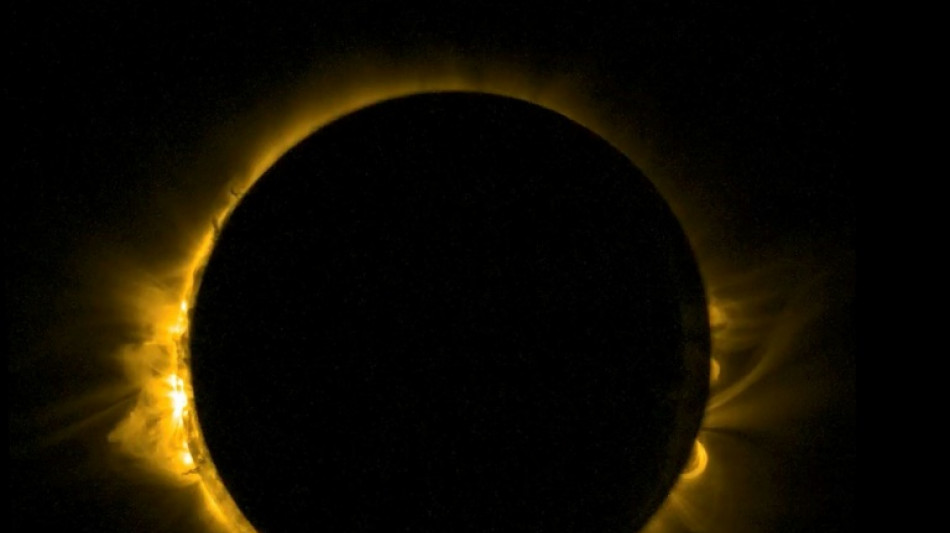
India on Thursday successfully launched into space a pair of European satellites that will create artificial solar eclipses to help scientists catch a rare glimpse of the Sun's mysterious atmosphere.
Scientists broke into rapturous applause at the Sriharikota launch site as the Indian Space Research Organisation (ISRO) chief announced the spacecraft had been ejected as planned.
"The spacecraft has been placed in the right orbit," ISRO chief S. Somanath said.
The launch, originally scheduled for Wednesday but delayed by a technical fault, was for the European Space Agency's "Project for On-Board Autonomy 3" (Proba-3) mission, part of a series of "in-orbit missions to test out new technologies".
The mission, at a cost of 200 million euros ($211 million), creates artificial total solar eclipses by positioning two satellites 150 metres (500 feet) apart from each other.
The shadow cast by one satellite allows the other to observe solar phenomena while blocking out the light from the Sun itself.
"For six hours at a time, it will be able to see the Sun's faint atmosphere, the corona, in the hard-to-observe region between the Sun's edge and 1.4 million kilometres from its surface," the European Space Agency said in a pre-launch analysis.
The project will help scientists answer key questions, including why the corona is so much hotter than the Sun itself, and how the Sun's energy output changes over time.
India has emerged as a reliable and low-cost option for putting commercial spacecraft and the satellites of other countries into space.
Experts say New Delhi can keep costs low by copying and adapting existing technology, and thanks to an abundance of highly skilled engineers who earn a fraction of their foreign counterparts' wages.
The world's most populous country has flexed its spacefaring ambitions in the last decade with its space programme growing considerably in size and momentum, matching the achievements of established powers at a much cheaper price tag.
In August 2023, it became just the fourth nation to land an unmanned craft on the Moon after Russia, the United States and China.
Prime Minister Narendra Modi also announced plans last year to send a man to the Moon by 2040.
J.Bergmann--BTB