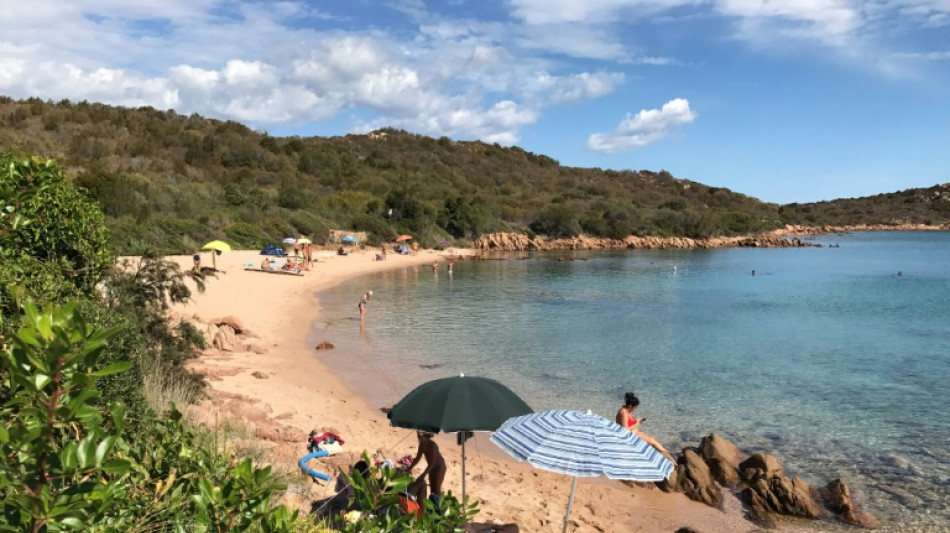
The secret to living to 110? Bad record-keeping, researcher says / Photo: © AFP/File

 Voting opens in Alaska's annual Fat Bear Week

 MLS coach axed for telling female ref 'It's a man's game'

 US refuses to give Sudan's de facto leader visa for UN

 Man City hold Bayern to start Women's Champions League, Arsenal win late

 Trump threatens Iran with 'hell' but reveals fresh talks

 Trump signs security deal with Greenland, Denmark at UN

 Trump threatens Iran with 'hell' but unveils fresh talks

 Chile's Atacama Desert blossoms with life after El Nino rains

 Sri Lanka hands 220-year jail terms to 15 convicted of Easter bombings

 Typhoon Dujuan leaves 7 dead in Japan from landslides, flooding: media

 Ganna and Borghini lead Italy to mixed relay gold at cycling worlds

 Drug cocktail killed former child star Hayden Panettiere: coroner

 Moldova declares energy, water emergency

 French Holocaust denier jailed for eight months

 Oil prices slide, AI stock buzz fades

 Trump threatens to 'annihilate' Iran in bombastic UN speech

 Prada's skirts take centre stage as Milan Fashion Week begins

 Quoin Pharmaceuticals Announces FDA Fast Track Designation for QRX003 for the Treatment of Peeling Skin Syndrome

 Brazil's Flavio Bolsonaro turns scandal into poll gains

 Republican senator seeks probe of Trump Jr Russian-funded wedding

 Memoir by Diana's brother goes on sale after rocking UK monarchy

 Newcomers South Korea face holders Italy in Davis Cup finals

 Japan's Kojima sounds Marchand warning with Asian Games gold

 England rugby star Pollock signs new Northampton deal

 STARTRADER Expands Its Chinese Equity CFD Range with CXMT and Unitree Robotics

Most of what we know about humans living to very old age is based on faulty data, including the science behind the "blue zones" famous for having a high proportion of people over 100, according to one researcher.
The desire to live as long as possible has driven a booming lifestyle industry selling supplements, books, tech and tips to those wanting to learn the secrets of the world's oldest people.
But Saul Justin Newman, a researcher at University College London's Centre for Longitudinal Studies, told AFP that most extreme old age data "is junk to a really shocking degree".
Newman's research, which is currently being peer-reviewed, looked at data about centenarians and supercentenarians -- people who live to 100 and 110 -- in the United States, Italy, England, France and Japan.
Contrary to what one might expect, he found that supercentenarians tended to come from areas with poor health, high levels of poverty -- and bad record-keeping.
The true secret to extreme longevity seems to be to "move where birth certificates are rare, teach your kids pension fraud and start lying", Newman said as he accepted an Ig Nobel prize, a humorous version of the Nobel, in September.
Just one of many examples is Sogen Kato, who was thought to be Japan's oldest living person until his mummified remains were discovered in 2010.
It turned out he had been dead since 1978. His family was arrested for collecting three decades of pensions payments.
The government then launched a review which found that 82 percent of Japan's centenarians -- 230,000 people -- were missing or dead.
"Their paperwork is in order, they're just dead," Newman said.
This illustrates the problem Newman has sought to shine a light on -- that confirming ages in this field involves triple-checking very old documents that could have been wrong from the start.
The industry that has popped up around blue zones is one "symptom" of this problem, he said.
- 'Only alive on pension day' -
Blue zones are regions around the world where people are said to live disproportionately longer and healthier lives.
The term was first used in 2004 by researchers referring to the Italian island of Sardinia.
The following year, National Geographic reporter Dan Buettner wrote a story that added the Japanese islands of Okinawa and the Californian city of Loma Linda.
Buettner admitted to the New York Times in October that he only included Loma Linda because his editor told him: "you need to find America's blue zone".
The reporter teamed up with some demographers to create the Blue Zones lifestyle brand, and they added Costa Rica's Nicoya Peninsula and the Greek island of Ikaria to the list.
However, as seen in Japan, later government records have cast doubt on old age data in these regions.
In Costa Rica, 2008 research showed that 42 percent of centenarians had "lied about their age" in an earlier census, Newman said.
For Greece, he found 2012 data suggesting that 72 percent of the country's centenarians were dead or imaginary.
"They're only alive on pension day," Newman said.
Several prominent blue zone researchers wrote a rebuttal earlier this year, calling Newman's work "ethically and academically irresponsible".
They accused Newman of referring to broader regions of Japan and Sardinia when the blue zones were smaller areas.
The demographers also emphasised they had "meticulously validated" the ages of supercentenarians in blue zones, double-checking historical records and registries dating back to the 1800s.
Newman said this argument illustrated his point.
"If you start with a birth certificate that's wrong, that gets copied to everything, and you get perfectly consistent, perfectly wrong records," he said.
- A clock to measure age -
The only "way out of this quagmire" is to physically measure people's ages, Newman said.
Steve Horvath, an ageing researcher at the University of California, told AFP he had created a new technique called a methylation clock "for the express purpose of validating claims of exceptional longevity".
The clock can "reliably detect instances of severe fraud", such as when a child assumes their parent's identity, but cannot yet tell the difference between a 115- and 120-year-old, he said.
Horvath has offered to test a DNA sample of France's Jeanne Calment, who died at 122 in 1997 and holds the record for the oldest confirmed age.
Newman's analysis "appears to be both rigorous and convincing", Horvath said, adding that several blue zones are overseen by rigorous scientists.
"I suspect both opinions hold some truth," he said.
So what can people at home take away from this debate?
"If you want to live a long time, step number one: don't buy anything," Newman said.
"Listen your GP (doctor), do some exercise, don't drink, don't smoke -- that's it."
Y.Bouchard--BTB