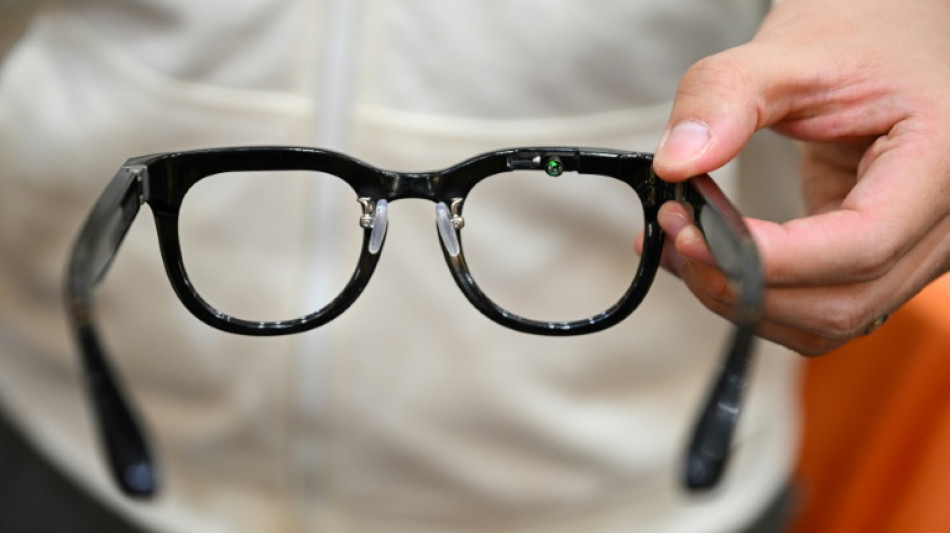
Smart glasses enter new era with sleeker designs, lower prices / Photo: © AFP

 Voting opens in Alaska's annual Fat Bear Week

 MLS coach axed for telling female ref 'It's a man's game'

 US refuses to give Sudan's de facto leader visa for UN

 Man City hold Bayern to start Women's Champions League, Arsenal win late

 Trump threatens Iran with 'hell' but reveals fresh talks

 Trump signs security deal with Greenland, Denmark at UN

 Trump threatens Iran with 'hell' but unveils fresh talks

 Chile's Atacama Desert blossoms with life after El Nino rains

 Sri Lanka hands 220-year jail terms to 15 convicted of Easter bombings

 Typhoon Dujuan leaves 7 dead in Japan from landslides, flooding: media

 Ganna and Borghini lead Italy to mixed relay gold at cycling worlds
 Drug cocktail killed former child star Hayden Panettiere: coroner

 Moldova declares energy, water emergency

 French Holocaust denier jailed for eight months

 Oil prices slide, AI stock buzz fades

 Trump threatens to 'annihilate' Iran in bombastic UN speech

 Prada's skirts take centre stage as Milan Fashion Week begins

 Quoin Pharmaceuticals Announces FDA Fast Track Designation for QRX003 for the Treatment of Peeling Skin Syndrome

 Brazil's Flavio Bolsonaro turns scandal into poll gains

 Republican senator seeks probe of Trump Jr Russian-funded wedding

 Memoir by Diana's brother goes on sale after rocking UK monarchy

 Newcomers South Korea face holders Italy in Davis Cup finals
 Japan's Kojima sounds Marchand warning with Asian Games gold

 England rugby star Pollock signs new Northampton deal

 STARTRADER Expands Its Chinese Equity CFD Range with CXMT and Unitree Robotics

Producers of hi-tech connected eyewear are multiplying their innovations with increasingly discreet models in an attempt to make a difference in a highly competitive -- and fast-emerging -- market.
Live translation, GPS, cameras: glasses are quickly adopting new functionalities.
"There are so many of these smart wearables, and more of them are going on your face," said Techsponential analyst Avi Greengart at the Consumer Electronics Show (CES) in Las Vegas, where numerous smart glasses manufacturers showcased their latest innovations.
The industry has come a long way from its early days. Gone are the conspicuous protrusions of Google Glass and the bulky frames and cables of Epson's Moverio from the early 2010s.
Today's smart glasses, all paired with smartphone apps, increasingly resemble traditional eyewear. The Ray-Ban Meta, developed by Mark Zuckerberg's social media giant, currently leads the market with this new approach.
According to a recent MarketsandMarkets study, the sector's growth is "driven by advancements in augmented reality, artificial intelligence, and miniaturization technologies, which are pushing the boundaries of what these wearable devices can achieve."
However, integrating technology into fashionable frames requires careful compromise.
The Ray-Ban Meta, for instance, can capture photos and videos, play music, and provide information about objects in view, but doesn't offer augmented reality with superimposed images.
Meta representative Robin Dyer explained that while AR capabilities may come later, they would likely double the current price.
- 200 dollars -
Price is a major battleground in this market, particularly with the entry of Chinese manufacturers.
While Google Glass initially retailed for around $1,500 in 2013, today's smart glasses are approaching the price of premium conventional frames.
Meta's James Nickerson noted that their Ray-Ban collaboration starts at $300, just $50 more than standard Ray-Bans, offering "a cool camera" as a bonus.
Chinese startup Vue has pushed prices even lower, offering basic models with voice assistant and music capabilities for $200.
Some manufacturers, like XReal, focus on augmented reality, projecting smartphone, computer, or gaming console displays -- though this is a market for which Apple's VisonPro failed to create excitement last year.
For AR, recent advances help move away from the bulk of a virtual reality headset towards that of classic sunglasses, even if they require a cable to be connected to the device.
Meta's ambition is to launch its own pared down version, the Orion, currently in the test phase but not expected to be marketed until 2027 at the earliest.
- Chasing cool -
Companies like Even Realities and Halliday are pioneering ultra-thin frames that look identical to standard glasses while offering basic AR capabilities.
"If we want to make a good pair of smart glasses, we must first make a pair of cool glasses," emphasized Carter Hou, Halliday's second-in-command.
Halliday's $489 model, launching in March, displays text in the upper corner of the wearer's vision. Using AI, it can suggest responses during conversations, provide real-time translation, and function as a discrete teleprompter.
Even Realities has also taken a minimalist approach.
"We got rid of the speaker, we got rid of the camera," explained the company's Tom Ouyang. "Glasses are for the eyes, not the ears."
E.Schubert--BTB