Five things to know about New Glenn, Blue Origin's new rocket / Photo: © BLUE ORIGIN/AFP/File

 Voting opens in Alaska's annual Fat Bear Week

 MLS coach axed for telling female ref 'It's a man's game'

 US refuses to give Sudan's de facto leader visa for UN

 Man City hold Bayern to start Women's Champions League, Arsenal win late

 Trump threatens Iran with 'hell' but reveals fresh talks

 Trump signs security deal with Greenland, Denmark at UN

 Trump threatens Iran with 'hell' but unveils fresh talks

 Chile's Atacama Desert blossoms with life after El Nino rains

 Sri Lanka hands 220-year jail terms to 15 convicted of Easter bombings

 Typhoon Dujuan leaves 7 dead in Japan from landslides, flooding: media

 Ganna and Borghini lead Italy to mixed relay gold at cycling worlds

 Drug cocktail killed former child star Hayden Panettiere: coroner

 Moldova declares energy, water emergency

 French Holocaust denier jailed for eight months

 Oil prices slide, AI stock buzz fades

 Trump threatens to 'annihilate' Iran in bombastic UN speech

 Prada's skirts take centre stage as Milan Fashion Week begins

 Quoin Pharmaceuticals Announces FDA Fast Track Designation for QRX003 for the Treatment of Peeling Skin Syndrome

 Brazil's Flavio Bolsonaro turns scandal into poll gains

 Republican senator seeks probe of Trump Jr Russian-funded wedding

 Memoir by Diana's brother goes on sale after rocking UK monarchy

 Newcomers South Korea face holders Italy in Davis Cup finals

 Japan's Kojima sounds Marchand warning with Asian Games gold

 England rugby star Pollock signs new Northampton deal

 STARTRADER Expands Its Chinese Equity CFD Range with CXMT and Unitree Robotics

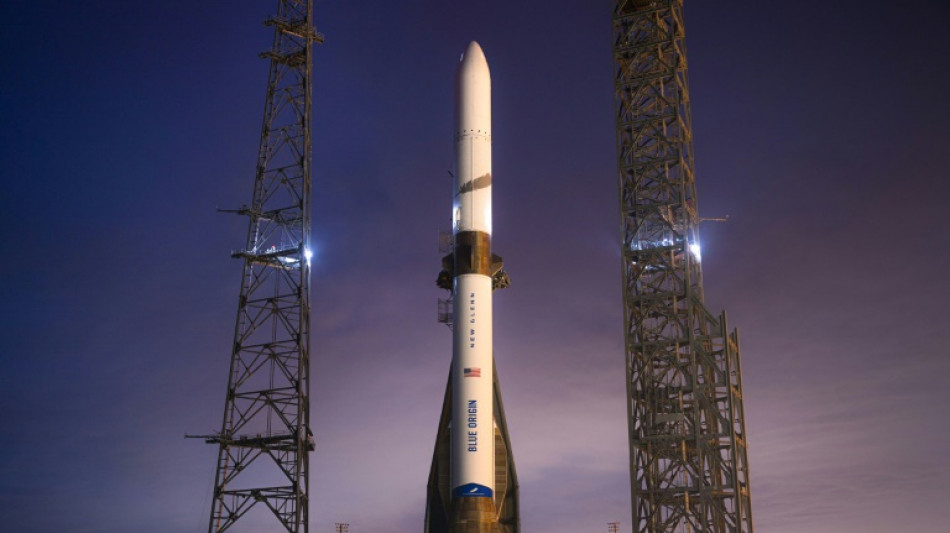
Blue Origin, the US space company founded by billionaire Jeff Bezos in 2000, is poised for a historic first: its maiden voyage into orbital space with a brand new rocket, New Glenn.
Here are five key things to know about the heavy-lift vehicle aiming to challenge SpaceX's dominance in the commercial space market.
- Homage -
New Glenn honors a legendary astronaut: John Glenn, the first American to orbit Earth in 1962.
It follows in the steps of New Shepard, Blue Origin's first rocket which was named for Alan Shepard, the first American in space.
Standing 320 feet (98 meters) tall -- roughly equivalent to a 32-story building -- New Glenn is both larger and more powerful than its smaller sibling, which is used for suborbital space tourism.
- Heavy-lift -
New Glenn is classified as a "heavy-lift launcher," capable of placing substantial payloads into low-Earth orbit. It is expected to carry up to 45 tons into orbit.
That is more than double that of SpaceX's Falcon 9, which can lift around 22 tons, though it falls short of the Falcon Heavy's 63.8-ton capacity.
However, New Glenn has a unique edge: its wider payload fairing, which can accommodate larger objects.
It "has the largest capacity to put objects in space, large objects" as a result of its wider payload fairing, Elliott Bryner, a professor at Embry-Riddle Aeronautical University, told AFP.
- Swiss knife -
Its versatility means New Glenn could become a "Swiss Army knife" of rockets, capable of deploying a diverse array of payloads to both low and higher orbits.
These are set to include commercial and military satellites -- as well as Project Kuiper, Bezos's planned space internet constellation, to compete with SpaceX's Starlink.
New Glenn also has the potential to carry crewed spacecraft, notes George Nield, president of Commercial Space Technologies. "One other potential use is for commercial space stations," he adds.
With the International Space Station slated for decommissioning in 2030, the race is on to develop replacements. Blue Origin is among the contenders vying to build the first privately run platform.
- Partially reusable -
Like SpaceX's Falcon 9, New Glenn features a reusable first-stage booster -- designed for up to 25 flights -- and an expendable second stage.
But to reuse the rocket, Blue Origin first has to land it. The company has mastered the technique with its much smaller New Shepard rocket, which touches down on solid ground. However, reusing New Glenn will require a successful landing on a drone ship stationed in the Atlantic Ocean.
This is no small feat: It took SpaceX six years to perfect the maneuver with Falcon 9 after its debut launch in 2010.
"Landing a rocket like this, the way they're doing it, is definitely not simple," said Bryner. "The level of technology required to do this is unbelievable."
Yet achieving reusability is crucial to reducing costs and broadening access to space, added Nield.
- Higher tech -
Under the hood, New Glenn's propulsion system represents a step up.
The first stage is powered by liquid methane, a cleaner and more efficient fuel than the kerosene used in both stages of Falcon 9.
Its second stage uses liquid hydrogen, an even cleaner and more powerful fuel, though more challenging to handle due to its cryogenic properties.
"It's the difference between driving a, you know, a Ferrari or a Volkswagen," William Anderson, a professor of aeronautics and astronautics at Purdue University told AFP, comparing the technology behind New Glenn and Falcon 9.
H.Seidel--BTB