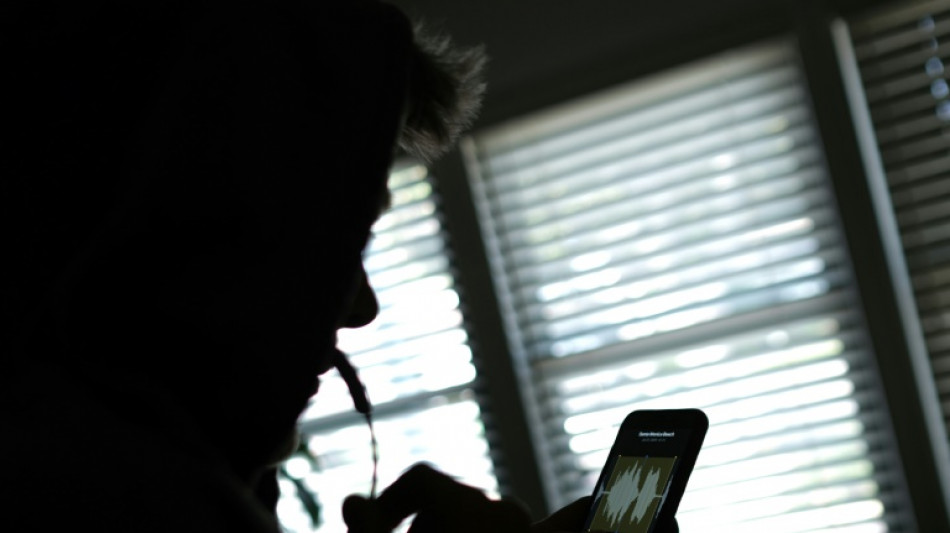
India's 'digital arrest' scammers stealing savings / Photo: © AFP

 Trump renames AI 'super intelligence' as leaders jostle over dangers

 Oil prices retreat as markets welcome US-Iran talks

 US refusing to give Sudan's de facto leader visa for UN: diplomatic sources, UN

 Macron urges world to choose UN over 'law of the jungle'

 All-rounder Jacks stars as England beat Sri Lanka in 1st ODI

 Man City peg back Bayern to start Women's Champions League

 Trump beats 'America first' drum at UN as allies tread carefully

 Snedeker backs Spaun for Ryder Cup after Presidents snub

 French prosecutors probe secret filming of women with smart glasses

 Trump renames AI "super intelligence," rejects international oversight

 Trump rejects international regulation of AI

 How is the EU approaching record fuel prices?

 Sri Lanka's Colombage strikes on debut as England dismissed for 265 in first ODI

 Hurricane Polo strengthens to top category 5 off Mexico

 11 hurt as teen opens fire outside school in western Turkey

 UN chief says 'Big Oil' treats atmosphere as open sewer

 Tunisia says 2026 summer hottest on record

 England's Rashid out of Sri Lanka ODIs with hand injury

 Houthis accuse Saudi Arabia of deadly strikes as thousands flee

 Stocks climb as oil slides, AI buzz returns

 India cricketers win in style as Afghan savours 'special' Games silver

 La Liga president hits out at Real Madrid refereeing 'conspiracy' claims

 MEXC Launches “Real Stocks, Real Friends” with Rewards for Bringing Friends to Wall Street

 Mbappe continues media push for Ballon d'Or recognition

 Stocks rise on AI buzz, oil prices cool

Within five hours while sitting at home in India, retired professor Kamta Prasad Singh handed over his hard-earned savings to online fraudsters impersonating police.
The cybercrime known as "digital arrest" -- where fraudsters pose online as law enforcement officials and order people to transfer huge amounts of money -- has become so rampant that Prime Minister Narendra Modi has issued warnings.
Singh told AFP that money was his life savings.
"Over the years, I have skipped having tea outside, walked to avoid spending on public transport," the 62-year-old said, his voice breaking.
"Only I know how I saved my money."
Police say scammers have exploited the vast gap between the breakneck speed of India's data digitalisation, from personal details to online banking, and the lagging awareness of many of basic internet safety.
Fraudsters are using technology for data breaches, targeting information their victims believe is only available to government authorities, and making otherwise unlikely demands appear credible.
Indians have emptied their bank accounts "out of sheer fear", Modi said in an October radio broadcast, adding fraudsters "create so much psychological pressure on the victim".
- 'Ruined' -
Mobile phones, and especially video calling, have allowed fraudsters to reach straight into people's homes.
India runs the world's largest biometric digital identity programme -- called "Aadhaar", or foundation in Hindi -- a unique card issued to India's more than one billion people, and increasingly required for financial transactions.
Scammers often claim they are police investigating questionable payments, quoting their target's Aadhaar number to appear genuine.
They then request their victim make a "temporary" bank transfer to validate their accounts, before stealing the cash.
Singh, from India's eastern state of Bihar, said the web of lies began when he received a call in December, seemingly from the telecom regulatory authority.
"They said... police were on their way to arrest me," Singh said.
The fraudsters told Singh that his Aadhaar ID was being misused for illegal payments.
Terrified, Singh agreed to prove he had control of his bank account, and after spiralling threats, transferred over $16,100.
"I have lost sleep, don't feel like eating," he said. "I have been ruined."
- 'Rot in proverbial hell' -
The surge of online scams is worrying because of "how valid they make it look and sound", said police officer Sushil Kumar, who handled cybercrimes for half a decade.
The perpetrators range from school dropouts to highly educated individuals.
"They know what to search for on the internet to find out basic details of how government agencies work," Kumar added.
India registered 17,470 cybercrimes in 2022, including 6,491 cases of online bank fraud, according to the latest government data.
Tricks vary. Kaveri, 71, told AFP her story on condition her name was changed.
She said fraudsters posed as officials from the US courier FedEx, claiming she had sent a package containing drugs, passports and credit cards.
They offered her full name and Aadhaar ID details as "proof", followed by well-forged letters from the Central Bank of India and Central Bureau of Investigation, the country's top investigative agency.
"They wanted me to send money, which would be returned in 30 minutes," she said, adding she was convinced when they sent a "properly signed letter".
She transferred savings from a house sale totalling around $120,000 in four instalments over six days before the fraudsters vanished.
Kaveri says those days felt "like a tunnel".
Meeta, 35, a private health professional from Bengaluru who also did not want to be identified, was conned by fake police via a video call.
"It seemed like a proper police station, with walkie-talkie noises," she said.
The scammers told her to prove she controlled her bank account by taking out a 200,000 rupee ($2,300) loan via her bank's phone app, before demanding she make a "temporary" transfer.
Despite making it clear to the bank that she had been scammed, Meeta continues to be asked to pay back the loan.
"My trust in banks has mostly gone," she said, before cursing the thieves.
"I hope they rot in proverbial hell."
K.Thomson--BTB