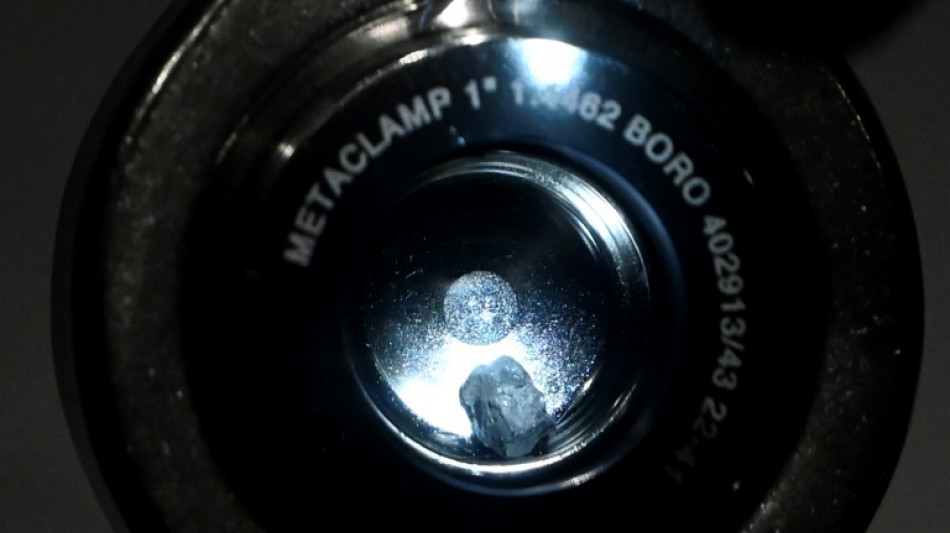
Life's 'basic building blocks' found in asteroid samples / Photo: © AFP

 Trump renames AI 'super intelligence' as leaders jostle over dangers

 Oil prices retreat as markets welcome US-Iran talks

 US refusing to give Sudan's de facto leader visa for UN: diplomatic sources, UN

 Macron urges world to choose UN over 'law of the jungle'

 All-rounder Jacks stars as England beat Sri Lanka in 1st ODI
 Man City peg back Bayern to start Women's Champions League

 Trump beats 'America first' drum at UN as allies tread carefully

 Snedeker backs Spaun for Ryder Cup after Presidents snub

 French prosecutors probe secret filming of women with smart glasses

 Trump renames AI "super intelligence," rejects international oversight

 Trump rejects international regulation of AI

 How is the EU approaching record fuel prices?

 Sri Lanka's Colombage strikes on debut as England dismissed for 265 in first ODI

 Hurricane Polo strengthens to top category 5 off Mexico

 11 hurt as teen opens fire outside school in western Turkey

 UN chief says 'Big Oil' treats atmosphere as open sewer

 Tunisia says 2026 summer hottest on record

 England's Rashid out of Sri Lanka ODIs with hand injury

 Houthis accuse Saudi Arabia of deadly strikes as thousands flee

 Stocks climb as oil slides, AI buzz returns

 India cricketers win in style as Afghan savours 'special' Games silver

 La Liga president hits out at Real Madrid refereeing 'conspiracy' claims

 MEXC Launches “Real Stocks, Real Friends” with Rewards for Bringing Friends to Wall Street

 Mbappe continues media push for Ballon d'Or recognition

 Stocks rise on AI buzz, oil prices cool

Pristine samples of the asteroid Bennu transported to Earth contain the "basic building blocks" for life, shedding new light on the perennial question of how life began on our planet.
The revelation, in two studies published Wednesday, is the result of work on just 120 grams of material -- about the weight of a banana -- collected from Bennu by NASA's OSIRIS-REx spacecraft in 2020.
The samples from Bennu, then around 300 million kilometres (186 million miles) from Earth, were returned in a capsule that OSIRIS-REx dropped off during a pass-by in 2023.
Initial analysis had already revealed evidence of high-carbon content and water.
But the new research found that evaporated water on Bennu's parent asteroid left behind "the raw ingredients of life", said Tim McCoy, curator of meteorites at the Smithsonian's National Museum of Natural History and co-lead author of one of the studies.
"We have discovered that next step on a pathway to life," he said in a press release issued by the museum.
Bennu appears to have formed around 65 million years ago from the debris of a parent asteroid dating back some 4.5 billion years.
The findings suggest Bennu's parent was once home to pockets of liquid water. When these evaporated, they left behind a "briny broth" of salts and minerals.
Some of the minerals include compounds that have never been seen in samples from outer space, the museum said.
And analysis of the samples strongly suggests a "non-terrestrial origin", adds one of the studies.
That could lend support to the theory that life on Earth was seeded from outer space.
- 'Unprecedented insight' -
The samples "give unprecedented insight into the processes that drove the formation of the Solar System," according to Yasuhito Sekine, a professor at the Institute of Science Tokyo.
"This discovery was only possible by analysing samples that were collected directly from the asteroid then carefully preserved back on Earth," he added.
"The salts would otherwise have rapidly absorbed moisture in the Earth's humid atmosphere."
The researchers believe similar salty brines may exist on other extraterrestrial bodies, including the dwarf planet Ceres and Saturn's moon Enceladus, as well as other asteroids.
They plan to reexamine specimens already on Earth for traces of compounds that previous research might have missed.
"Even though asteroid Bennu has no life, the question is could other icy bodies harbour life?" said Nick Timms, an associate professor at Curtin University's School of Earth and Planetary Sciences also involved in the research.
Much about life's origin remains unclear despite the secrets revealed from Bennu, McCoy cautioned.
"We now know we have the basic building blocks to move along this pathway towards life, but we don't know how far along that pathway this environment could allow things to progress," he said.
Still, Sara Russell, co-lead author with McCoy and a cosmic mineralogist at the museum, said the research had made "huge progress in understanding how asteroids like Bennu evolved, and how they may have helped make the Earth habitable".
M.Odermatt--BTB