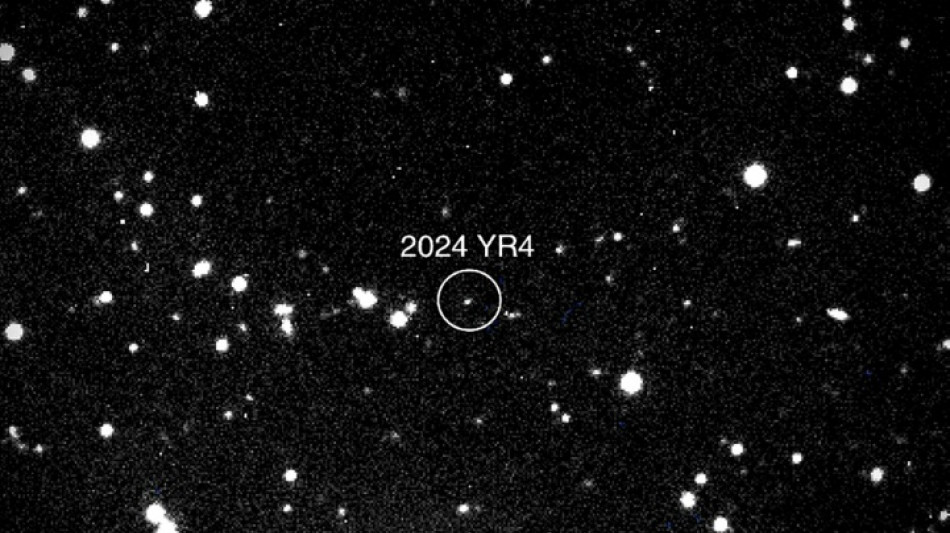
Chance huge asteroid will hit Earth down to 0.001 percent / Photo: © NASA/Magdalena Ridge 2.4m telescope/New Mexico Institute of Technology/Ryan/AFP/File

 Trump renames AI 'super intelligence' as leaders jostle over dangers

 Oil prices retreat as markets welcome US-Iran talks

 US refusing to give Sudan's de facto leader visa for UN: diplomatic sources, UN
 Macron urges world to choose UN over 'law of the jungle'

 All-rounder Jacks stars as England beat Sri Lanka in 1st ODI
 Man City peg back Bayern to start Women's Champions League

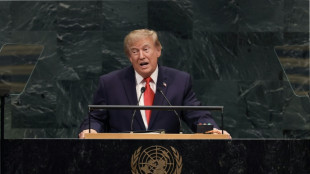 Trump beats 'America first' drum at UN as allies tread carefully

 Snedeker backs Spaun for Ryder Cup after Presidents snub

 French prosecutors probe secret filming of women with smart glasses

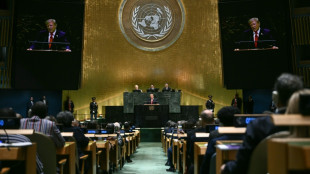 Trump renames AI "super intelligence," rejects international oversight

 Trump rejects international regulation of AI

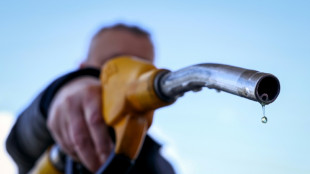 How is the EU approaching record fuel prices?

 Sri Lanka's Colombage strikes on debut as England dismissed for 265 in first ODI
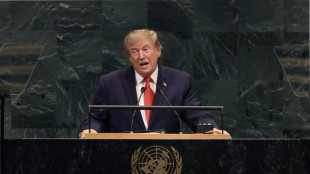
 Hurricane Polo strengthens to top category 5 off Mexico

 11 hurt as teen opens fire outside school in western Turkey

 UN chief says 'Big Oil' treats atmosphere as open sewer

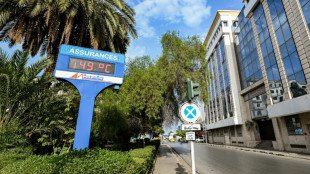 Tunisia says 2026 summer hottest on record

 England's Rashid out of Sri Lanka ODIs with hand injury

 Houthis accuse Saudi Arabia of deadly strikes as thousands flee

 Stocks climb as oil slides, AI buzz returns

 India cricketers win in style as Afghan savours 'special' Games silver

 La Liga president hits out at Real Madrid refereeing 'conspiracy' claims

 MEXC Launches “Real Stocks, Real Friends” with Rewards for Bringing Friends to Wall Street

 Mbappe continues media push for Ballon d'Or recognition

 Stocks rise on AI buzz, oil prices cool

The chance that a football field-sized asteroid capable of destroying a city will strike Earth in 2032 has fallen to 0.001 percent, the European Space Agency said on Tuesday.
A week ago, the asteroid set a new record for having the highest probability of hitting Earth -- 3.1 percent according to NASA and 2.8 percent according to the ESA. The planetary defence community has been scanning the skies.
However, as had been widely expected, fresh observations from telescopes around the world narrowed the area of uncertainty where the asteroid could strike, increasingly ruling out the odds of a direct hit.
The ESA said the chance was now down to 0.001 percent, adding that the threat level on the Torino Impact Hazard Scale was now at zero -- after hitting level three out of a possible 10 last week.
The asteroid, called 2024 YR4, was discovered in December. It is estimated to be 40-90 metres (130 to 300 feet) wide, which means it has the potential to devastate a city.
The impact date would have been December 22, 2032 -- but it is now extremely likely the asteroid will simply zoom past Earth.
Despite the plummeting risk, the James Webb Space Telescope will still observe the asteroid in the coming months, the ESA said.
Scientists had emphasised that even if the asteroid had been heading our way, Earth is now capable of fighting back. In the first test of our planetary defences, NASA's DART mission successfully altered a harmless asteroid's trajectory in 2022 by smashing a spacecraft into it.
Richard Moissl, head of the ESA's planetary defence office, told AFP that observing the asteroid -- then ruling out a direct hit -- was "a very exciting and educational exercise".
Praising the early detection of the asteroid, he emphasised that "there is still ample room for improvement".
Several new telescopes, such as the Vera Rubin and Flyeye, which are near becoming operational will enable astronomers to spot asteroids more quickly, Moissl said. So will Europe's planned early warning mission NEOMIR, he added.
The last time an asteroid bigger than 30 metres wide posed such a significant risk was Apophis in 2004, when it briefly had a 2.7 percent chance of striking Earth in 2029 -- a possibility also ruled out through additional observations.
L.Dubois--BTB