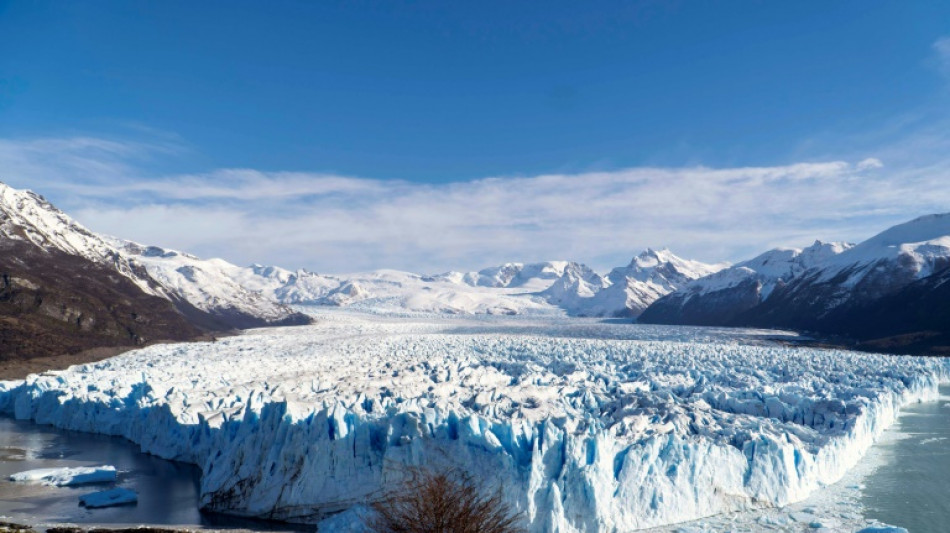
Study reveals how Earth's orbit controls ice ages / Photo: © AFP

 Macron urges world to choose UN over 'law of the jungle'

 All-rounder Jacks stars as England beat Sri Lanka in 1st ODI

 Man City peg back Bayern to start Women's Champions League

 Trump beats 'America first' drum at UN as allies tread carefully

 Snedeker backs Spaun for Ryder Cup after Presidents snub

 French prosecutors probe secret filming of women with smart glasses

 Trump renames AI "super intelligence," rejects international oversight

 Trump rejects international regulation of AI

 How is the EU approaching record fuel prices?

 Sri Lanka's Colombage strikes on debut as England dismissed for 265 in first ODI

 Hurricane Polo strengthens to top category 5 off Mexico

 11 hurt as teen opens fire outside school in western Turkey

 UN chief says 'Big Oil' treats atmosphere as open sewer

 Tunisia says 2026 summer hottest on record

 England's Rashid out of Sri Lanka ODIs with hand injury

 Houthis accuse Saudi Arabia of deadly strikes as thousands flee

 Stocks climb as oil slides, AI buzz returns

 India cricketers win in style as Afghan savours 'special' Games silver

 La Liga president hits out at Real Madrid refereeing 'conspiracy' claims

 MEXC Launches “Real Stocks, Real Friends” with Rewards for Bringing Friends to Wall Street

 Mbappe continues media push for Ballon d'Or recognition

 Stocks rise on AI buzz, oil prices cool

 India narrowly survive huge scare against minnows Japan

 Missing F-35 fighter parts 'not sensitive', says Australia minister

 Cambodia showcases scams crackdown with global conference

The Earth's next ice age is expected to begin in about 11,000 years -- unless human-caused global warming disrupts natural cycles.
That's according to a new study published Thursday in Science, which analyzed how subtle shifts in Earth's orbit around the Sun have historically triggered massive climate changes.
A research team examined a million-year record of climate change, focusing on land-based ice sheets across the Northern Hemisphere and deep ocean temperatures.
They then paired this data with small but cyclical variations in Earth's orbital patterns.
"For many years, the difficulty in answering how small changes in Earth's orbit around the Sun translate to large shifts between glacial and interglacial states has been a central theme in paleoclimate research," lead author Stephen Barker, a professor at Cardiff University, told AFP.
Earth has long alternated between ice ages and warmer interglacial periods, with the last glaciation ending approximately 11,700 years ago. This transition marked the beginning of the Holocene epoch, an era of relative climate stability that enabled early human societies to shift from nomadic hunting and gathering to settled agriculture.
Scientists have long recognized a connection between Earth's orbit and ice ages. However, due to challenges in accurately dating climate changes that occurred so far in the past, they struggled to pinpoint which orbital parameters were responsible for starting and ending these glacial cycles.
According to Barker, the key breakthrough came from analyzing the "shape" of the ancient climate record -- the curves showing how temperatures rose and fell over time -- rather than just the timing of ice age transitions.
This approach allowed the team to determine how the three orbital factors -- tilt, wobble, and the shape of Earth's orbit around the Sun -- interact to drive ice age cycles over the past 900,000 years.
Barker said that without the Industrial Revolution, assuming fossil fuels had never been burned, "we would expect a glaciation to occur within the next 11,000 years, and it would end in 66,000 years' time."
Co-author Lorraine Lisiecki, a professor at the University of California, Santa Barbara, emphasized the significance of the study, stating that it "confirms the natural climate change cycles we observe on Earth over tens of thousands of years are largely predictable and not random or chaotic."
However, Barker strongly cautioned against interpreting the findings to suggest that human-caused climate change is beneficial.
Carbon dioxide levels have nearly doubled since the Industrial Revolution, and if emissions remain unchecked, "then in around 8,000 years' time, Antarctica would have melted, leading to around 70 meters of sea-level rise," said Barker.
"Instead of there being glaciers, you'll be underwater," he warned.
Looking ahead, the research team aims to expand on their findings by investigating the long-term impact of human-driven climate change and how it may reshape the planet's natural climate cycles.
J.Bergmann--BTB