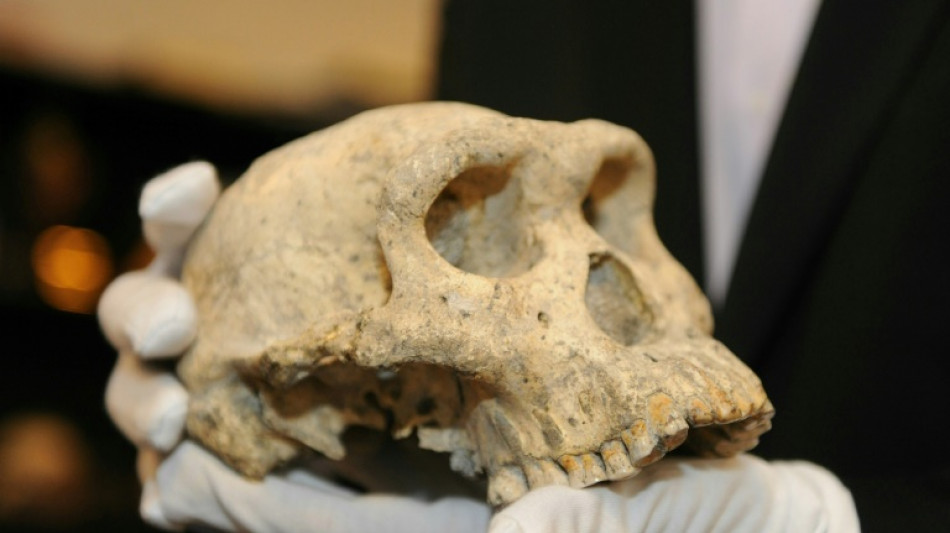
Meet 'Pink', the new face of human evolution in Europe / Photo: © AFP/File

 Macron urges world to choose UN over 'law of the jungle'

 All-rounder Jacks stars as England beat Sri Lanka in 1st ODI

 Man City peg back Bayern to start Women's Champions League

 Trump beats 'America first' drum at UN as allies tread carefully

 Snedeker backs Spaun for Ryder Cup after Presidents snub

 French prosecutors probe secret filming of women with smart glasses

 Trump renames AI "super intelligence," rejects international oversight

 Trump rejects international regulation of AI

 How is the EU approaching record fuel prices?

 Sri Lanka's Colombage strikes on debut as England dismissed for 265 in first ODI

 Hurricane Polo strengthens to top category 5 off Mexico

 11 hurt as teen opens fire outside school in western Turkey

 UN chief says 'Big Oil' treats atmosphere as open sewer

 Tunisia says 2026 summer hottest on record

 England's Rashid out of Sri Lanka ODIs with hand injury

 Houthis accuse Saudi Arabia of deadly strikes as thousands flee

 Stocks climb as oil slides, AI buzz returns

 India cricketers win in style as Afghan savours 'special' Games silver

 La Liga president hits out at Real Madrid refereeing 'conspiracy' claims

 MEXC Launches “Real Stocks, Real Friends” with Rewards for Bringing Friends to Wall Street

 Mbappe continues media push for Ballon d'Or recognition

 Stocks rise on AI buzz, oil prices cool

 India narrowly survive huge scare against minnows Japan

 Missing F-35 fighter parts 'not sensitive', says Australia minister

 Cambodia showcases scams crackdown with global conference

Western Europe has a new oldest face: the facial bones of an adult nicknamed "Pink" discovered in Spain are from a potential new member of the human family who lived more than 1.1 million years ago, scientists said Wednesday.
Until now, the oldest-known human species in Western Europe was the slender-faced Homo antecessor, dating back around 850,000 years.
But research published in the journal Nature "introduces a new actor in the history of human evolution in Europe", lead study author Rosa Huguet of Spain's University of Rovira i Virgili told a press conference.
The fossilised upper jawbone and partial cheekbone of Pink were discovered at the Atapuerca archaeological site in northern Spain in 2022.
Since then, a team of Spanish scientists have been working to find out more about Pink, whose nickname is a reference to prog rock band Pink Floyd.
The bones were excavated from a layer of silt and red mud 16 metres (52 feet) deep at a site known as Sima del Elefante -- or "elephant pit".
They were found less than 250 metres from where the fossils of Western Europe's previous oldest human, Homo antecessor, were discovered nearly two decades ago.
But the title of oldest human in all of Europe is still held by the Dmanisi people -- also called Homo georgicus -- who lived up to 1.8 million years ago in what is now Georgia.
They were the first members of the human family, or hominins, known to have made it to Europe from Africa, the cradle of humanity.
We modern Homo sapiens first showed up in Africa around 300,000 years ago -- and took our time getting to Europe.
- Face value -
The Spanish researchers used 3D imaging techniques to flesh out Pink's full face.
Homo antecessor had a "very modern" face which is "vertical and flat" similar to our own, said Maria Martinon-Torres, director of Spain's National Research Center on Human Evolution.
But Pink's face is more "projected forward and more robust," the study co-author added.
This means it bears some similarities to the face of Homo erectus -- but not enough that the scientists could confirm that Pink was a member of this important human ancestor.
So the scientists made up a new name for the possible species that Pink could belong to: Homo "affinis" erectus.
"This is the most honest proposal we can make with the evidence we have," Martinon-Torres said.
From just a few face bones, the researchers could not determine Pink's age or gender.
But by analysing small stone tools and animals bones found at the site, they were able to get an idea of the environment Pink lived in.
It was a humid forest landscape, roamed by horses, ancient cattle, monkeys and even some hippos.
The area was a wildlife corridor with plenty of water, making it an "ideal" place for our ancient relatives to settle, Huguet said.
- What happened to them? -
The new discovery supports the hypothesis that early humans settled Europe going from east to west at least 1.4 million years ago, according to the Spanish researchers.
If Pink is a representative of a previously unknown human species, it could have been a bridge between the Dmanisi hominins and Homo antecessors, they added.
But this raises another question: what became of these people?
Spanish paleoanthropologist Jose Maria Bermudez de Castro felt that Pink's people likely did not survive a severe human "bottleneck" nearly 900,000 years ago thought to have been caused by global cooling.
"I think that Homo affinis erectus probably disappeared," the study co-author said.
Future research will aim to shed light on these mysteries. The Spanish team has not yet reached the bottom of the elephant pit -- nor other sites around it.
W.Lapointe--BTB