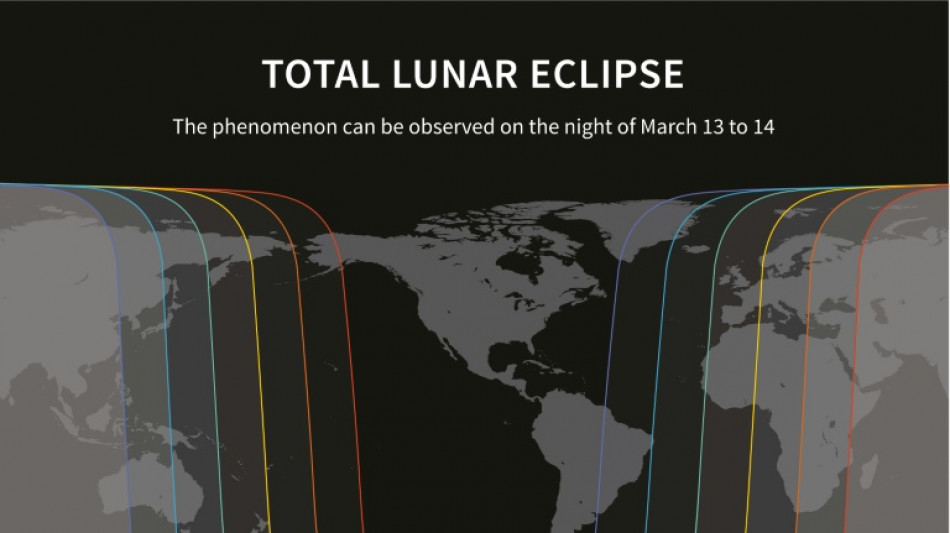
Americas to witness rare 'Blood Moon' total lunar eclipse / Photo: © AFP

 Macron urges world to choose UN over 'law of the jungle'

 All-rounder Jacks stars as England beat Sri Lanka in 1st ODI

 Man City peg back Bayern to start Women's Champions League

 Trump beats 'America first' drum at UN as allies tread carefully

 Snedeker backs Spaun for Ryder Cup after Presidents snub

 French prosecutors probe secret filming of women with smart glasses

 Trump renames AI "super intelligence," rejects international oversight

 Trump rejects international regulation of AI

 How is the EU approaching record fuel prices?

 Sri Lanka's Colombage strikes on debut as England dismissed for 265 in first ODI

 Hurricane Polo strengthens to top category 5 off Mexico

 11 hurt as teen opens fire outside school in western Turkey

 UN chief says 'Big Oil' treats atmosphere as open sewer

 Tunisia says 2026 summer hottest on record

 England's Rashid out of Sri Lanka ODIs with hand injury

 Houthis accuse Saudi Arabia of deadly strikes as thousands flee

 Stocks climb as oil slides, AI buzz returns

 India cricketers win in style as Afghan savours 'special' Games silver

 La Liga president hits out at Real Madrid refereeing 'conspiracy' claims

 MEXC Launches “Real Stocks, Real Friends” with Rewards for Bringing Friends to Wall Street

 Mbappe continues media push for Ballon d'Or recognition

 Stocks rise on AI buzz, oil prices cool

 India narrowly survive huge scare against minnows Japan

 Missing F-35 fighter parts 'not sensitive', says Australia minister

 Cambodia showcases scams crackdown with global conference

Stargazers in North and South America will be able to view a red-colored "Blood Moon" starting Thursday night in the first total lunar eclipse visible on the continents since 2022.
The celestial event, observable with the naked eye, will have more than an hour of totality and can additionally be seen in parts of western Europe and Africa, as well as New Zealand.
A lunar eclipse occurs when the Earth goes between the Moon and the Sun, casting the Earth's shadow on the Moon.
A rare total lunar eclipse involves the Earth's umbra, the darkest part of the planet's shadow, covering the Moon.
According to NASA, this type of eclipse can also be called a "Blood Moon" due to the reddish-orange color the Moon can become during totality.
The coloration occurs due to sunlight scattering through the Earth's atmosphere before reaching the Moon's surface -- shorter wavelengths like blue and violet fail to reach the Moon, leaving only longer wavelengths such as red and orange to illuminate it.
As a result, the more items there are in the Earth's atmosphere -- such as clouds or dust -- the redder the Moon will appear during the eclipse.
"Keep a close eye on the weather forecast leading up to the eclipse," said NASA Chief Scientist Renee Weber in a statement. "That totality will last for close to an hour, so even if it's cloudy you may still be able to glimpse it if the clouds are scattered."
The timing of totality occurs simultaneously across time zones, and is expected to begin at 2:26 am Friday for those in Eastern Daylight Time and 11:26 pm Thursday in Pacific Daylight Time.
For about an hour both before and after totality, the moon will also be obscured in a partial eclipse.
A.Gasser--BTB