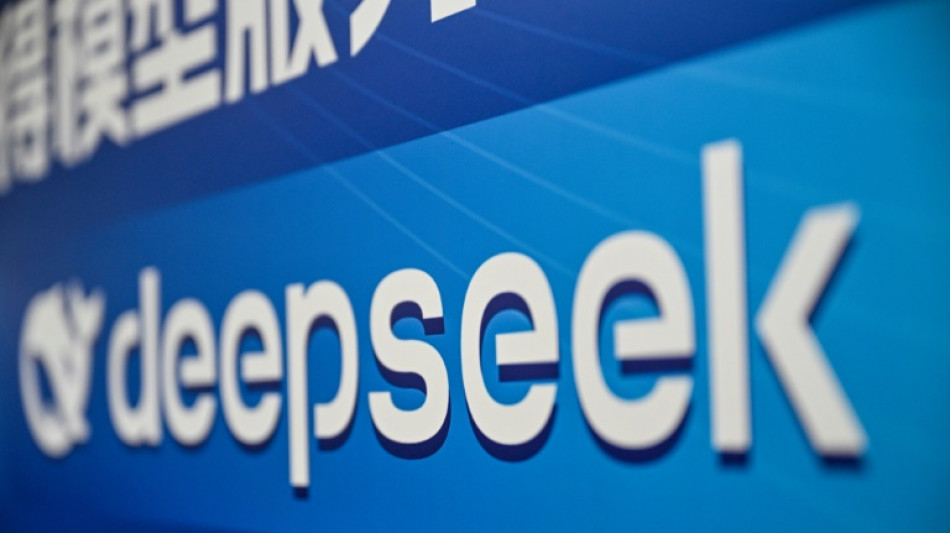
DeepSeek dims shine of AI stars / Photo: © AFP/File

 Macron urges world to choose UN over 'law of the jungle'

 All-rounder Jacks stars as England beat Sri Lanka in 1st ODI

 Man City peg back Bayern to start Women's Champions League

 Trump beats 'America first' drum at UN as allies tread carefully

 Snedeker backs Spaun for Ryder Cup after Presidents snub

 French prosecutors probe secret filming of women with smart glasses

 Trump renames AI "super intelligence," rejects international oversight

 Trump rejects international regulation of AI

 How is the EU approaching record fuel prices?
 Sri Lanka's Colombage strikes on debut as England dismissed for 265 in first ODI

 Hurricane Polo strengthens to top category 5 off Mexico

 11 hurt as teen opens fire outside school in western Turkey

 UN chief says 'Big Oil' treats atmosphere as open sewer

 Tunisia says 2026 summer hottest on record

 England's Rashid out of Sri Lanka ODIs with hand injury

 Houthis accuse Saudi Arabia of deadly strikes as thousands flee

 Stocks climb as oil slides, AI buzz returns

 India cricketers win in style as Afghan savours 'special' Games silver

 La Liga president hits out at Real Madrid refereeing 'conspiracy' claims

 MEXC Launches “Real Stocks, Real Friends” with Rewards for Bringing Friends to Wall Street

 Mbappe continues media push for Ballon d'Or recognition

 Stocks rise on AI buzz, oil prices cool

 India narrowly survive huge scare against minnows Japan

 Missing F-35 fighter parts 'not sensitive', says Australia minister

 Cambodia showcases scams crackdown with global conference

China-based DeepSeek shook up the world of generative artificial intelligence (GenAI) early this year with a low-cost but high-performance model that challenges the hegemony of OpenAI and other big-spending behemoths.
Since late 2022, just a handful of AI assistants -- such as OpenAI's ChatGPT, Anthropic's Claude, and Google's Gemini -- have reigned supreme, becoming ever more capable thanks to multi-billion-dollar investments in engineers, data centers, and high-performance AI chips.
But then DeepSeek upended the sector with its R1 model, which it said cost just $6 million or so, powered by less-advanced chips.
While specialists suspect DeepSeek may have cost more than its creators claim, its debut fueled talk that GenAI assistants are becoming just a regular commodity, thanks to innovation and market forces.
"The first company to train models must expend lots of resources to get there," said CFRA senior equity analyst Angelo Zino.
"The second mover can get there cheaper and more quickly."
At a HumanX AI conference in Las Vegas this week, Hugging Face co-founder Thomas Wolf said it is getting less expensive to launch GenAI models -- and less important which one people use.
"I feel like we are moving to this multi-model world, which is a good thing," Wolf said, pointing to the muted reception given to the most recent version of ChatGPT.
- Stay flexible -
At the conference, OpenAI chief product officer Kevin Weil pushed back against the notion that all models are created equal.
"That's actually not true," Weil said.
"The days of us having a 12-month lead are probably gone, but I think we have a three- to six-month lead, and that is really valuable."
Weil said OpenAI plans to fight to keep that narrowing edge over its competitors.
With 400 million users, San Francisco-based OpenAI has the advantage of being able to use data from massive traffic to continually improve its models, Weil explained.
"OpenAI has the Google advantage of being the thing that's in everybody's minds," said Alpha Edison equity firm research director Fen Zhao.
Jeff Seibert, chief of the accounting and AI start-up Digits, agreed that OpenAI will stay ahead of the pack but added that he expects the gap to eventually close.
"For advanced use cases, yes, there will be a lot of advantages," he said of OpenAI's position.
"But for a lot of stuff, it won't matter as much."
Seibert advises entrepreneurs to design their technology to allow them to swap out GenAI models, affording them flexibility in a quickly changing industry.
- Cash burn -
Improved use of chips and new optimization techniques have driven down the cost of designing the large language models (LLMs) that power ChatGPT, Gemini and their rivals.
An open-source approach taken by some LLMs is credited with helping accelerate innovation by making the software free for anyone to tinker with and improve.
The valuation of closed-model startups such as Anthropic and OpenAI has likely peaked as their "first-mover advantage dissipates," according to Zino.
Japanese investment colossus SoftBank pumped $40 billion into OpenAI in February in a deal that valued the startup at $300 billion -- almost double what it was last year.
“If you're burning a billion dollars a month, which I think OpenAI is, you have to keep raising money," said Jai Das of private equity firm Sapphire Ventures.
"I have a hard time seeing how they get to a point where revenues are higher than the amount of cash they burn."
Anthropic raised $3.5 billion in early March, valuing the champion of responsible AI at $61.5 billion.
I.Meyer--BTB