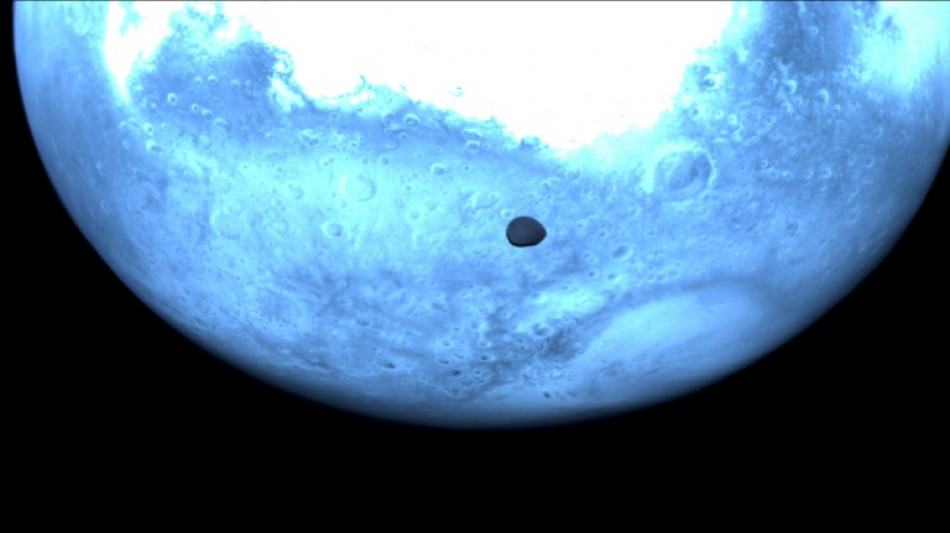
Asteroid probe snaps rare pics of Martian moon / Photo: © ESA/AFP

 South Africa's Universal Health Coverage Depends on Tackling Poverty and Inequality

 Rare Siberian Rubythroat Dies in UK Garden After Cat Attack

 Go Kyung-pyo Drunk Driving Incident Prompts Heavy Editing Across Multiple TV Shows

 KFF Health News Reporters Discuss ACA Enrollment Challenges, Rising Costs, and Measles Risks

 Alberta Unveils New High School Graduation Requirements to Increase Student Choice

 Daily Horoscope for November 14, 2026: Astrological Predictions for All Zodiac Signs

 Yes Bank Petitions Supreme Court to Reverse AT-1 Bond Write-Off Ruling

On the way to investigate the scene of a historic asteroid collision, a European spacecraft swung by Mars and captured rare images of the red planet's mysterious small moon Deimos, the European Space Agency said Thursday.
Europe's HERA mission is aiming to find out how much of an impact a NASA spacecraft made when it deliberately smashed into an asteroid in 2022 in the first-ever test of our planetary defences.
But HERA will not reach the asteroid -- which is 11 million kilometres (seven million miles) from Earth in the asteroid belt between Mars and Jupiter -- until late 2026.
On the long voyage there, the spacecraft received a gravity boost by slingshotting around Mars on Wednesday.
For an hour, it flew as close as 5,600 kilometres from the Martian surface, at a speed of 33,480 kilometres an hour.
It used the opportunity to test some of its scientific instruments, snapping around 600 pictures, including rare ones of Deimos.
The lumpy, 12.5 kilometre-wide moon is the smaller and less well-known of the two moons of Mars.
Exactly how Deimos and the bigger Phobos were formed remains a matter of debate.
The new images add "another piece of the puzzle" to efforts to determine their origin, Marcel Popescu of the Astronomical Institute of the Romanian Academy told an ESA press conference on Wednesday.
There are hopes that data from HERA's "HyperScout" and thermal infrared imagers -- which observe colours beyond the limits of the human eye -- will, in particular, shed light on the moon's composition.
Those infrared imagers are why the red planet appears blue in some of the photos.
Next, HERA will turn its focus back to the asteroid Dimorphos.
When NASA's DART mission smashed into Dimorphos in 2022, it shortened the 160-metre-wide asteroid's orbit around its big brother Didymos by 33 minutes.
Though Dimorphos itself posed no threat to Earth, HERA intends to discover whether this technique could be an effective way for Earth to defend itself against possibly existence-threatening asteroids in the future.
Earlier this year, a newly discovered asteroid capable of destroying a city was briefly given a more than three percent chance of hitting Earth in 2032.
However further observations sent the chances of a direct hit back down to nearly zero.
M.Odermatt--BTB