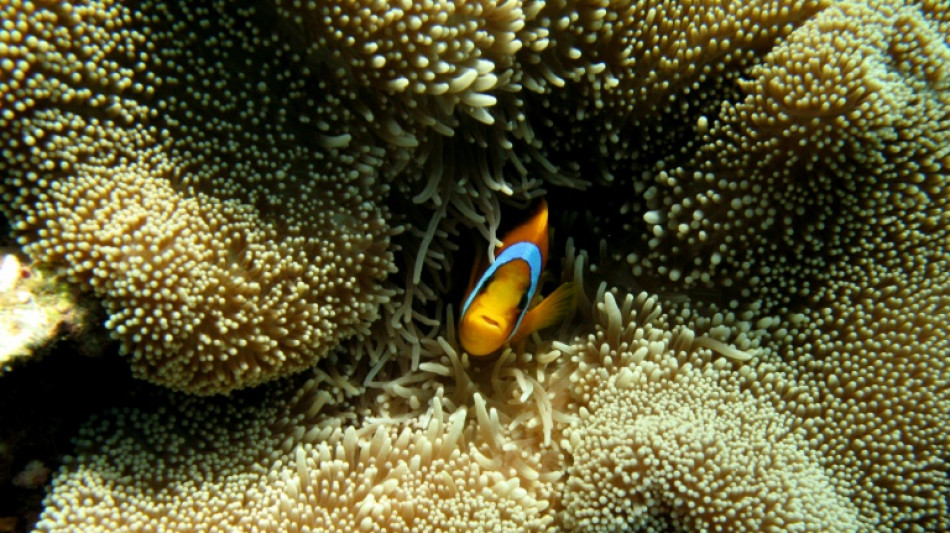
From oil spills to new species: how tech reveals the ocean / Photo: © AFP

 Macron urges world to choose UN over 'law of the jungle'

 All-rounder Jacks stars as England beat Sri Lanka in 1st ODI
 Man City peg back Bayern to start Women's Champions League

 Trump beats 'America first' drum at UN as allies tread carefully

 Snedeker backs Spaun for Ryder Cup after Presidents snub

 French prosecutors probe secret filming of women with smart glasses

 Trump renames AI "super intelligence," rejects international oversight

 Trump rejects international regulation of AI

 How is the EU approaching record fuel prices?

 Sri Lanka's Colombage strikes on debut as England dismissed for 265 in first ODI

 Hurricane Polo strengthens to top category 5 off Mexico

 11 hurt as teen opens fire outside school in western Turkey

 UN chief says 'Big Oil' treats atmosphere as open sewer

 Tunisia says 2026 summer hottest on record

 England's Rashid out of Sri Lanka ODIs with hand injury

 Houthis accuse Saudi Arabia of deadly strikes as thousands flee

 Stocks climb as oil slides, AI buzz returns

 India cricketers win in style as Afghan savours 'special' Games silver

 La Liga president hits out at Real Madrid refereeing 'conspiracy' claims

 MEXC Launches “Real Stocks, Real Friends” with Rewards for Bringing Friends to Wall Street

 Mbappe continues media push for Ballon d'Or recognition

 Stocks rise on AI buzz, oil prices cool

 India narrowly survive huge scare against minnows Japan

 Missing F-35 fighter parts 'not sensitive', says Australia minister

 Cambodia showcases scams crackdown with global conference
The ocean covers nearly three-quarters of our planet but scientists say we have barely scratched the surface of what lives in our seas.
But new technologies are helping to change that, revealing hidden oil spills, speeding up the discovery of new species and uncovering how light pollution impacts marine life.
Uncovering hidden oil spills
Satellite imagery means large oil spills in the ocean are relatively easily detected. When a tanker crashes or a pipe bursts, scientists know where to look.
But smaller pollution events can appear as nothing more than a thin streak against the smooth sea surface -- the maritime equivalent of a needle in a haystack.
"It used to take human analysts weeks if not months to be able to detect a single (small-scale) oil pollution incident," explained Mitchelle De Leon of US-based NGO SkyTruth.
The group harnesses machine learning to comb through large datasets of satellite imagery and find spills that might previously have gone undetected.
SkyTruth has revealed spills in the Red Sea and the Mediterranean and helped expose pollution from shadowy Russian ships.
There are limitations to the technology, including determining the composition of a spill, but the group says it offers an early warning system for scientists, media and governments.
"We think of our tool as a starting point... to make hidden human pollution events more visible," said De Leon.
Understanding light pollution
We have long known that our obsession with lighting the night sky obscures the stars and confuses terrestrial animals, but what impact does it have on the sea?
To understand that, scientists need satellite images to show how light spreads from coastal megacities, as well as complex models that can calculate how light penetrates the ocean, said Tim Smyth, a marine biogeochemistry specialist at Britain's Plymouth Marine Laboratory.
Seawater generally absorbs more red light, but that can change in the presence of phytoplankton or high turbidity.
"We're able to programme computers such that we can model the light field under the water with a high degree of accuracy," said Smyth.
His research found two million square kilometres (770,000 square miles) of ocean -- an area 10 times the size of Britain -- is affected by light pollution globally.
The effects are profound, from disrupting feeding by fish and seabirds, to interfering with coral spawning and the nightly migrations of phytoplankton up and down the water column.
The good news is "it's something we can do something about", said Smyth.
Switching off unnecessary illuminations such as billboards and redesigning lights to reduce "spillage" into the sky will bring down costs and carbon emissions while benefitting wildlife on land and in the sea, he explained.
Species discovery
Advances in technology have allowed us to reach the ocean's darkest depths but scientists estimate we know about just 10 percent of what lives in our seas.
And before we even realise a new species exists, "we are losing that diversity", said Lucy Woodall, a marine biologist and head of science at Ocean Census.
Launched in 2023, the global alliance of scientists aims to speed up the discovery of ocean species from coral to crabs.
That works in part by collaborating with high-tech, lab-equipped research vessels where researchers can immediately start work on collected specimens.
Genetic sequencing can now be done in the field, "which even 10 years ago would have been months and months worth of work back on land", said Woodall.
On average, it takes more than 13 years from finding a possible new species to officially describing it for science.
"We can't afford to wait for that," said Woodall.
The project encourages scientists to share findings sooner, with an explanation of why they believe a species is new.
It won't replace the slower work of proving new species with methods such as genetic testing but it can accelerate knowledge at a time of urgency.
The project has documented more than 800 new discoveries, which are shared on its open-access biodiversity platform.
"We want to ensure that companies, countries, individuals really value the ocean and ocean life for what it does for them and our planet," said Woodall.
E.Schubert--BTB