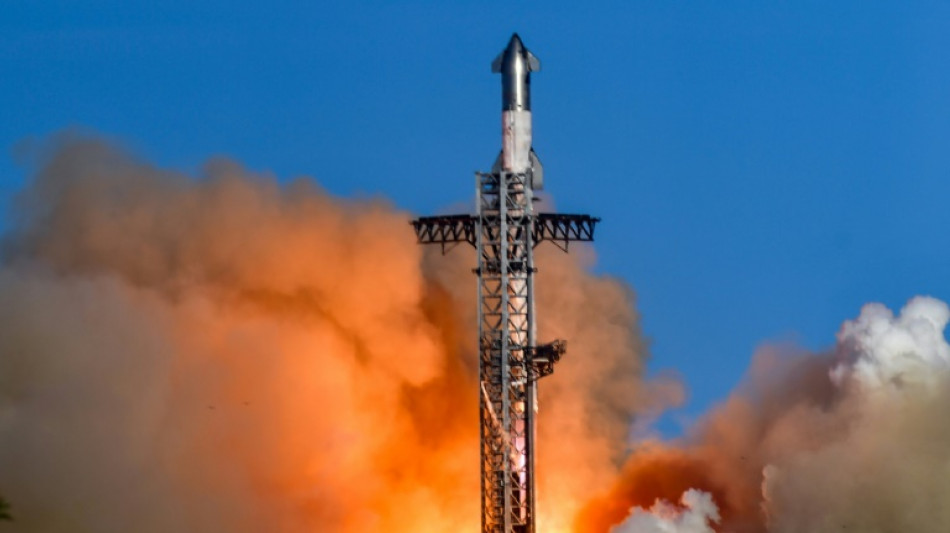
Musk says Starship to depart for Mars at end of 2026 / Photo: © AFP/File

 South Africa's Universal Health Coverage Depends on Tackling Poverty and Inequality

 Rare Siberian Rubythroat Dies in UK Garden After Cat Attack

 Go Kyung-pyo Drunk Driving Incident Prompts Heavy Editing Across Multiple TV Shows

 KFF Health News Reporters Discuss ACA Enrollment Challenges, Rising Costs, and Measles Risks

 Alberta Unveils New High School Graduation Requirements to Increase Student Choice

 Daily Horoscope for November 14, 2026: Astrological Predictions for All Zodiac Signs

 Yes Bank Petitions Supreme Court to Reverse AT-1 Bond Write-Off Ruling
SpaceX founder Elon Musk said Saturday its massive Starship rocket would leave for Mars at the end of 2026 with Tesla humanoid robot Optimus onboard, adding that human landings could follow "as soon as 2029."
"Starship departs for Mars at the end of next year, carrying Optimus. If those landings go well, then human landings may start as soon as 2029, although 2031 is more likely," Musk said on his X social network.
Musk, who is also the Tesla CEO, brought out the company's Optimus robots at an event last year.
He said the dancing robots would one day be able to do menial tasks, as well as offer friendship, and expected them to retail for $20,000 to $30,000.
Starship -- the world's largest and most powerful rocket -- is key to Musk's long-term vision of colonizing Mars.
Standing 403 feet (123 meters) tall -- about 100 feet taller than the Statue of Liberty -- Starship is designed to eventually be fully reusable.
NASA is also awaiting a modified version of Starship as a lunar lander for its Artemis program, which aims to return astronauts to the Moon this decade.
But before SpaceX can carry out those missions, it must prove the vehicle is reliable, safe for crew, and capable of complex in-orbit refueling -- critical for deep space missions.
- Setback -
SpaceX faced a setback this month when its latest test flight of the Starship prototype ended in a fiery explosion, even as the booster was successfully caught in its orbital test.
It was a near replay of the previous attempt.
Minutes after liftoff and booster separation, a live video feed showed the upper stage tumbling uncontrollably before the signal abruptly cut.
Dramatic footage circulating online showed red-hot debris raining down over the Bahamas.
It marked its eighth uncrewed orbital test.
The Federal Aviation Administration (FAA) said SpaceX will be required to conduct an investigation before it can fly again.
Despite the setback, SpaceX's "fail fast, learn fast" approach has helped it become the world's dominant launch services provider.
But Musk's status as one of President Donald Trump's closest advisors, and his influence over federal regulators, are raising concerns about potential conflicts of interest.
During Joe Biden's presidency, Musk frequently clashed with the FAA, accusing it of over-regulating SpaceX over safety and environmental concerns.
Trump vowed in his inauguration speech in January "to plant the Stars and Stripes on the planet Mars."
C.Meier--BTB