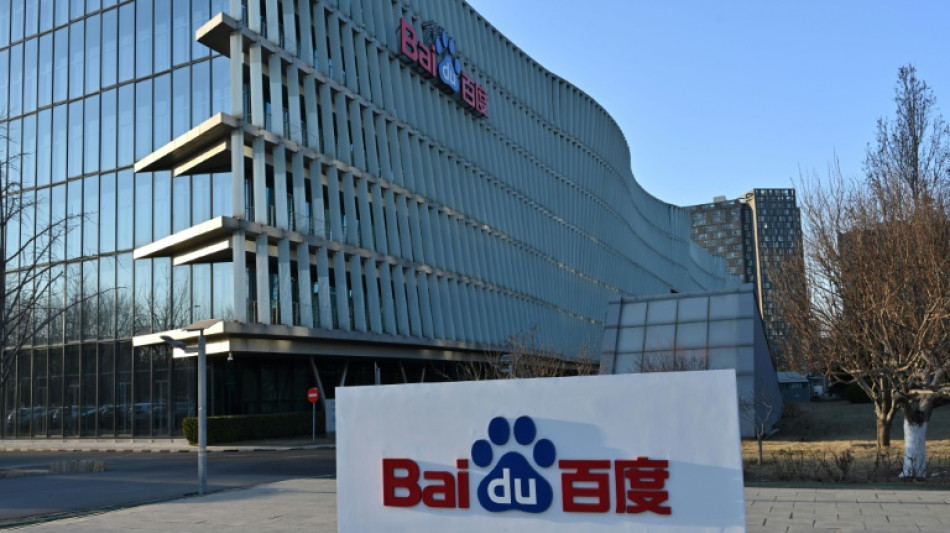
China's Baidu releases new AI model to compete with DeepSeek / Photo: © AFP/File

 South Africa's Universal Health Coverage Depends on Tackling Poverty and Inequality

 Rare Siberian Rubythroat Dies in UK Garden After Cat Attack

 Go Kyung-pyo Drunk Driving Incident Prompts Heavy Editing Across Multiple TV Shows

 KFF Health News Reporters Discuss ACA Enrollment Challenges, Rising Costs, and Measles Risks

 Alberta Unveils New High School Graduation Requirements to Increase Student Choice

 Daily Horoscope for November 14, 2026: Astrological Predictions for All Zodiac Signs

 Yes Bank Petitions Supreme Court to Reverse AT-1 Bond Write-Off Ruling

Chinese internet search giant Baidu released a new artificial intelligence reasoning model Sunday and made its AI chatbot services free to consumers as ferocious competition grips the sector.
Technology companies in China have been scrambling to release improved AI platforms since start-up DeepSeek shocked its rivals with its open source and highly cost-efficient model in January.
In a post on WeChat, Baidu announced the launch of its latest X1 reasoning model -- which the company claims performs similarly to DeepSeek's but for lower cost -- and a new foundation model, Ernie 4.5.
Baidu also made its AI chatbot Ernie Bot free for individual users more than two weeks ahead of schedule. Previously, users had to pay a subscription to access the company's latest AI models via Ernie Bot.
Ernie 4.5 "outperforms" US-based OpenAI's GPT-4.5 model in "multiple benchmarks", while Ernie X1 features "enhanced capabilities in understanding, planning, reflection, and evolution", Baidu said.
The Beijing-based company was one of China's first to roll out a generative AI platform publicly, in 2023, but rival chatbots from companies such as TikTok owner ByteDance and Moonshot AI have since gained more users.
Baidu faces stiff competition in the consumer-facing AI sector where startup DeepSeek shook up the industry at home and abroad with a model that performed comparably to competitors such as US-made ChatGPT, but cost much less to develop.
Since then, Chinese companies and local government agencies have rushed to incorporate DeepSeek's open-source model into their work, while other technology companies have been playing catch-up.
Baidu itself has integrated DeepSeek's R1 reasoning model into its search engine.
In February, WeChat owner Tencent released a new AI model that it claimed answers queries faster than DeepSeek, even as it incorporated its rival's technology into its messaging platform.
The same month, Alibaba, which has partnered with Apple to develop AI for the US company's phones in China, said it would invest 380 billion yuan ($52 billion) in AI and cloud computing over the next three years.
Alibaba this month also released a new version of its AI assistant app powered by its open-source Qwen reasoning model.
Baidu has also announced plans to follow DeepSeek's lead by making its Ernie AI models open-source from June 30.
K.Thomson--BTB