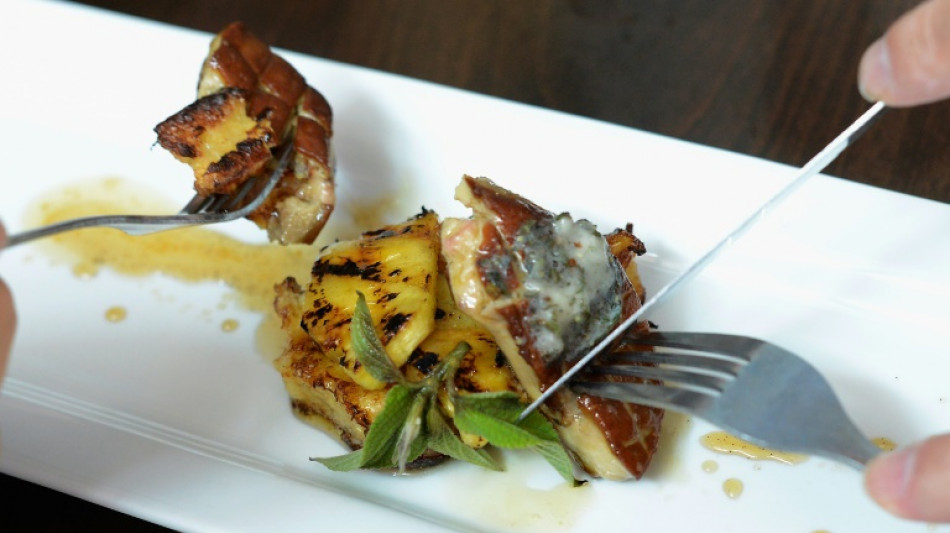
Faux gras? Scientists craft 'more ethical' version of French delicacy / Photo: © GETTY IMAGES NORTH AMERICA/AFP/File

 Trump renames AI "super intelligence," rejects international oversight

 Trump rejects international regulation of AI

 How is the EU approaching record fuel prices?

 Sri Lanka's Colombage strikes on debut as England dismissed for 265 in first ODI
 Hurricane Polo strengthens to top category 5 off Mexico

 11 hurt as teen opens fire outside school in western Turkey

 UN chief says 'Big Oil' treats atmosphere as open sewer

 Tunisia says 2026 summer hottest on record

 England's Rashid out of Sri Lanka ODIs with hand injury

 Houthis accuse Saudi Arabia of deadly strikes as thousands flee

 Stocks climb as oil slides, AI buzz returns

 India cricketers win in style as Afghan savours 'special' Games silver

 La Liga president hits out at Real Madrid refereeing 'conspiracy' claims

 MEXC Launches “Real Stocks, Real Friends” with Rewards for Bringing Friends to Wall Street

 Mbappe continues media push for Ballon d'Or recognition

 Stocks rise on AI buzz, oil prices cool

 India narrowly survive huge scare against minnows Japan

 Missing F-35 fighter parts 'not sensitive', says Australia minister

 Cambodia showcases scams crackdown with global conference

 Afghan cyclist who disguised herself as man wins Asian Games silver
 Typhoon Dujuan leaves four dead in Japan, 45,000 houses without power

 G7 leaders condemn Houthi strikes on Saudi Arabia

 Google data centre sparks protests in Austria

 Shin Ohashi: Junk food-loving teen and Japan's next big swimming hope

 Stocks rise on AI buzz, drop in oil prices

Foie gras — the fattened liver of ducks or geese — is a French delicacy prized for its rich, buttery flavor. But its production, which involves force-feeding the animals, has led to bans in several countries.
Now, a team of scientists says they've developed a more ethical alternative: one that mimics the taste and texture of the dish, minus the controversy.
The results were published Tuesday in the journal Physics of Fluids.
"It was always a dream to make foie gras more accessible and better for animal welfare," said lead author Thomas Vilgis, a professor of food science at the Max Planck Institute for Polymer Research in Mainz, Germany. "It's good to stop these force-feeding practices —- or at least reduce them."
Vilgis and his colleagues from his own institute and the University of Southern Denmark were adamant about one thing: no outside additives.
They initially tried cooking collagen from the birds' skin and bones into the liver-fat emulsion, but the result lacked the signature silky texture.
Then came the breakthrough: treating the fat with the bird's own lipases: enzymes the body naturally uses to break down fats. This tweak replicated a key part of the foie gras formation process, without resorting to force-feeding.
"At the end of the process, it allows the fat to recrystallize into the large crystals which form aggregates like the ones we see in the original foie gras," Vilgis said.
According to the authors, the elegance of the method lies in its simplicity: harvest the liver and fat, treat the fat with lipases, mix, sterilize — and voila.
Laser microscopy gave the new product a thumbs-up: the emulsion structure, fat droplet size, and shape closely matched traditional foie gras. Even the aroma passed the test.
To test texture, the team turned to industrial compression devices -— machines that gently press on food samples to measure firmness. The new foie gras held up well, offering a mouthfeel strikingly close to the original.
"We could really see the influence of these large fat particles, which we call in the paper 'percolating clusters,'" Vilgis said.
"At the beginning of the 'bite,' these large clusters have a high resistance, creating a similar mouthfeel of elasticity -— without being too rubbery like after the collagen or gelatin addition."
Vilgis has filed a patent for the process and now hopes to partner with companies to bring this kinder foie gras to market.
Y.Bouchard--BTB