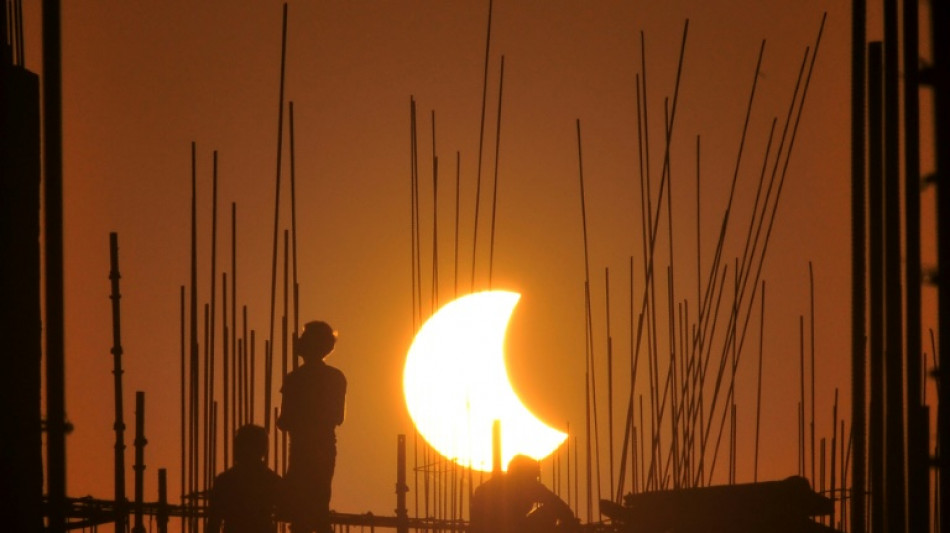
Partial solar eclipse in northern areas on Saturday / Photo: © AFP/File

 Trump renames AI "super intelligence," rejects international oversight

 Trump rejects international regulation of AI

 How is the EU approaching record fuel prices?

 Sri Lanka's Colombage strikes on debut as England dismissed for 265 in first ODI

 Hurricane Polo strengthens to top category 5 off Mexico

 11 hurt as teen opens fire outside school in western Turkey

 UN chief says 'Big Oil' treats atmosphere as open sewer

 Tunisia says 2026 summer hottest on record

 England's Rashid out of Sri Lanka ODIs with hand injury

 Houthis accuse Saudi Arabia of deadly strikes as thousands flee

 Stocks climb as oil slides, AI buzz returns

 India cricketers win in style as Afghan savours 'special' Games silver

 La Liga president hits out at Real Madrid refereeing 'conspiracy' claims

 MEXC Launches “Real Stocks, Real Friends” with Rewards for Bringing Friends to Wall Street

 Mbappe continues media push for Ballon d'Or recognition

 Stocks rise on AI buzz, oil prices cool

 India narrowly survive huge scare against minnows Japan

 Missing F-35 fighter parts 'not sensitive', says Australia minister

 Cambodia showcases scams crackdown with global conference

 Afghan cyclist who disguised herself as man wins Asian Games silver

 Typhoon Dujuan leaves four dead in Japan, 45,000 houses without power

 G7 leaders condemn Houthi strikes on Saudi Arabia

 Google data centre sparks protests in Austria

 Shin Ohashi: Junk food-loving teen and Japan's next big swimming hope

 Stocks rise on AI buzz, drop in oil prices

The moon will cross in front of the Sun for around four hours on Saturday, creating a partial solar eclipse that careful skygazers will able to see in parts of the Northern Hemisphere.
The eclipse will stretch from eastern Canada to northern Russia, and potentially be visible in most of Europe and some areas of northeastern North America and northwest Africa, according to France's Paris Observatory.
The eclipse will begin at 0850 GMT on Saturday and end at 1243 GMT.
The relatively rare celestial event occurs when the Sun, Moon and Earth all line up. A total solar eclipse is when the moon totally blots out the Sun, creating an eerie twilight.
But this time, the Moon will cover at most 90 percent of the Sun in some northern latitudes, turning the Sun's rays into "cold light", Paris Observatory astronomer Florent Deleflie told AFP.
The maximum amount of eclipse will be visible in northeastern Canada and Greenland at 1047 GMT.
It will be less spectacular in other areas. In France, for example, between 10 to 30 percent of the Sun's disc will be obscured, depending on the region.
"The naked eye will not be able to see any difference," Deleflie said.
- Be careful -
People wanting to see the moon apparently take a bite out of the Sun will need to take precautions.
Looking straight at the Sun -- during an eclipse or otherwise -- can lead to irreversible vision loss.
"Using special glasses is one solution," Deleflie said.
However if the glasses are not new, even a slight defect or "microscopic hole" can cause eye damage, he warned, advising people to try observing an eclipse at a local astronomy observation centre.
There, "you can safely verify the precision of celestial mechanics and marvel at interesting details on the Sun's surface, such as sunspots", he said.
The partial eclipse will not turn up on a smartphone camera without a suitable filter, Deleflie added.
"The light is so intense that the obscured part won't appear."
The latest celestial show will come two weeks after skygazers across much of the world marvelled at a rare total lunar eclipse, dubbed a "Blood Moon".
Saturday's partial solar eclipse will be the first of the year, and the 17th of this century.
A bigger one is coming -- On August 12, 2026 a total solar eclipse will be visible in Iceland, northern Spain and a parts of Portugal.
More than 90 percent of the Sun will also be obscured in parts of Europe including Britain, France and Italy.
It will be the first total solar eclipse since one swept across North America in April 2024.
W.Lapointe--BTB