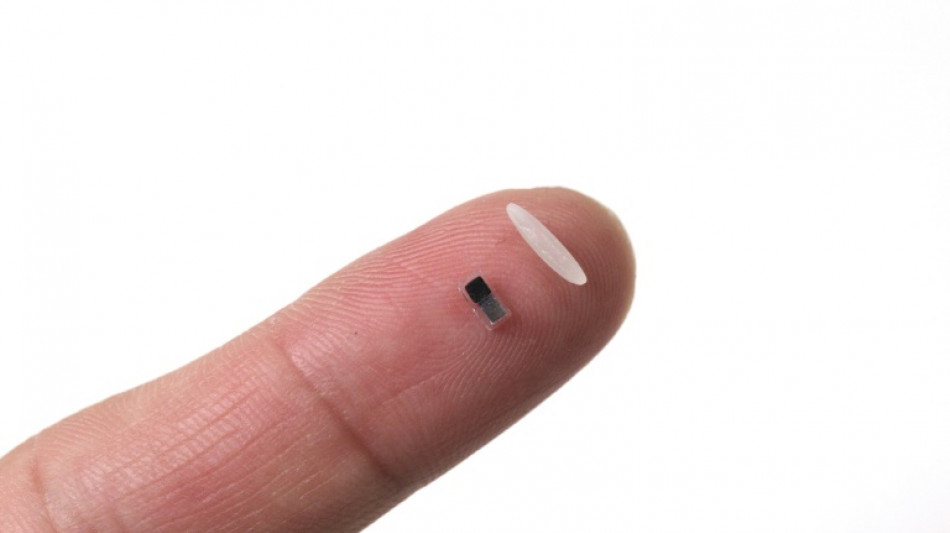
World's tiniest pacemaker is smaller than grain of rice / Photo: © Northwestern University/AFP

 Trump renames AI "super intelligence," rejects international oversight

 Trump rejects international regulation of AI

 How is the EU approaching record fuel prices?

 Sri Lanka's Colombage strikes on debut as England dismissed for 265 in first ODI

 Hurricane Polo strengthens to top category 5 off Mexico

 11 hurt as teen opens fire outside school in western Turkey

 UN chief says 'Big Oil' treats atmosphere as open sewer

 Tunisia says 2026 summer hottest on record

 England's Rashid out of Sri Lanka ODIs with hand injury

 Houthis accuse Saudi Arabia of deadly strikes as thousands flee

 Stocks climb as oil slides, AI buzz returns

 India cricketers win in style as Afghan savours 'special' Games silver

 La Liga president hits out at Real Madrid refereeing 'conspiracy' claims

 MEXC Launches “Real Stocks, Real Friends” with Rewards for Bringing Friends to Wall Street

 Mbappe continues media push for Ballon d'Or recognition

 Stocks rise on AI buzz, oil prices cool

 India narrowly survive huge scare against minnows Japan

 Missing F-35 fighter parts 'not sensitive', says Australia minister

 Cambodia showcases scams crackdown with global conference

 Afghan cyclist who disguised herself as man wins Asian Games silver

 Typhoon Dujuan leaves four dead in Japan, 45,000 houses without power

 G7 leaders condemn Houthi strikes on Saudi Arabia

 Google data centre sparks protests in Austria

 Shin Ohashi: Junk food-loving teen and Japan's next big swimming hope

 Stocks rise on AI buzz, drop in oil prices

Scientists said Wednesday they have developed the world's tiniest pacemaker, a temporary heartbeat regulator smaller than a grain of rice that can be injected and controlled by light before dissolving.
While still years away from being tested in humans, the wireless pacemaker was hailed as a "transformative breakthrough" that could spur advances in other areas of medicine.
Millions of people across the world have permanent pacemakers, which stimulate hearts with electrical pulses to ensure they beat normally.
The US-led team of researchers behind the new device said they were motivated to help the one percent of children born with congenital heart defects who need a temporary pacemaker in the week after surgery.
The pacemaker could also help adults restore a normal heartbeat as they recover from heart surgery.
Currently, temporary pacemakers require surgery to sew electrodes onto heart muscles, with wires connecting to a powered device on the patient's chest.
When the pacemaker is no longer needed, doctors or nurses pull out the wires, which can sometimes cause damage.
Neil Armstrong, the first person to walk on the Moon, died from internal bleeding after his temporary pacemaker was removed in 2012.
But the newly developed pacemaker is wireless. And at just one millimetre thick and 3.5 millimetres long, it can fit into the tip of a syringe.
It has also been designed to dissolve into the body when no longer needed, sparing patients invasive surgery.
- 'Significant leap forward' -
The pacemaker is paired to a soft patch worn on the patient's chest, according to a study describing the device in the journal Nature.
When the patch detects irregular heartbeats, it automatically flashes light that tells the pacemaker what heartbeat it should stimulate.
The pacemaker is powered by what is called a galvanic cell, which uses the body's fluids to convert chemical energy into electrical pulses that stimulate the heart.
So far, the pacemaker has worked effectively in tests on mice, rats, pigs, dogs and human heart tissue in the lab, according to the study.
Senior study author John Rogers of Northwestern University in the United States told AFP he estimated the pacemaker could be tested in humans in two to three years.
His lab has launched a start-up to pursue this goal, he added.
In the future, the underlying technology could also "create unique and powerful strategies to address societal challenges in human health," Rogers said.
Bozhi Tian, whose lab at the University of Chicago has also developed light-activated pacemakers but was not involved in the latest research, called it a "significant leap forward".
"This new pacemaker is a transformative breakthrough in medical technology," he told AFP.
"It's a paradigm shift in temporary pacing and bioelectronic medicine, opening up possibilities far beyond cardiology -- including nerve regeneration, wound healing and integrated smart implants."
Heart disease is the world's leading cause of death, according to the World Health Organization.
R.Adler--BTB