'It's gone': conservation science in Thailand's burning forest / Photo: © AFP

 Trump renames AI "super intelligence," rejects international oversight

 Trump rejects international regulation of AI

 How is the EU approaching record fuel prices?

 Sri Lanka's Colombage strikes on debut as England dismissed for 265 in first ODI

 Hurricane Polo strengthens to top category 5 off Mexico

 11 hurt as teen opens fire outside school in western Turkey

 UN chief says 'Big Oil' treats atmosphere as open sewer

 Tunisia says 2026 summer hottest on record

 England's Rashid out of Sri Lanka ODIs with hand injury

 Houthis accuse Saudi Arabia of deadly strikes as thousands flee

 Stocks climb as oil slides, AI buzz returns

 India cricketers win in style as Afghan savours 'special' Games silver

 La Liga president hits out at Real Madrid refereeing 'conspiracy' claims

 MEXC Launches “Real Stocks, Real Friends” with Rewards for Bringing Friends to Wall Street

 Mbappe continues media push for Ballon d'Or recognition

 Stocks rise on AI buzz, oil prices cool

 India narrowly survive huge scare against minnows Japan

 Missing F-35 fighter parts 'not sensitive', says Australia minister
 Cambodia showcases scams crackdown with global conference

 Afghan cyclist who disguised herself as man wins Asian Games silver

 Typhoon Dujuan leaves four dead in Japan, 45,000 houses without power

 G7 leaders condemn Houthi strikes on Saudi Arabia

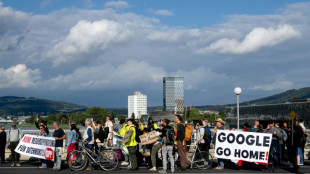 Google data centre sparks protests in Austria

 Shin Ohashi: Junk food-loving teen and Japan's next big swimming hope

 Stocks rise on AI buzz, drop in oil prices

Scientist Inna Birchenko began to cry as she described the smouldering protected forest in Thailand where she was collecting samples from local trees shrouded in wildfire smoke.
"This beautiful, diverse community of trees and animals is being destroyed as you see it, as you watch it," she said.
Birchenko, a geneticist at Royal Botanic Gardens, Kew, was collecting seeds and leaves in Umphang Wildlife Sanctuary with colleagues from Britain and Thailand.
They will study how temperature and moisture affect germination and whether genetics dictate those responses.
That may one day help ensure that reforestation is done with trees that can withstand the hotter temperatures and drier conditions caused by climate change.
But in Umphang, a remote region in Thailand's northwest, the scientists confronted the toll that human activity and climate change are already having on forests that are supposed to be pristine and protected.
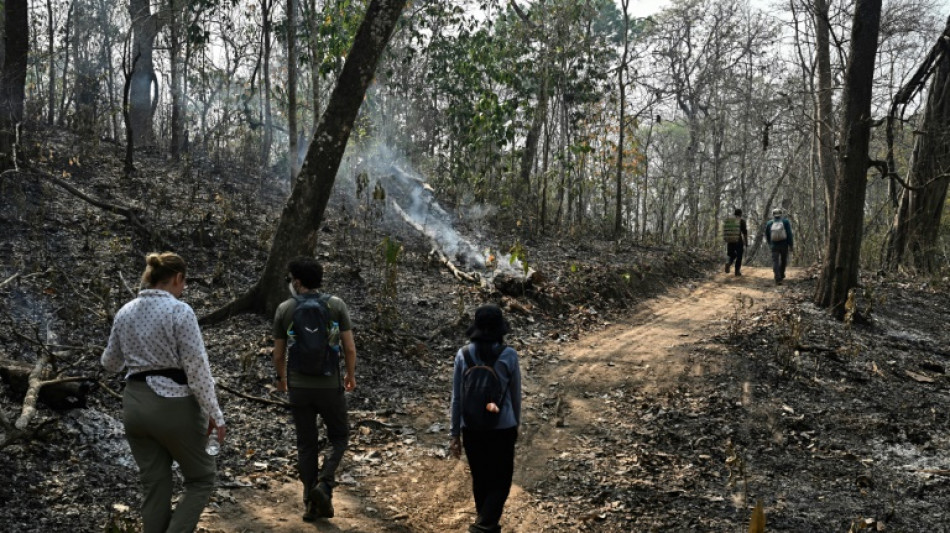
Birchenko and her colleagues hiked kilometre after kilometre through burned or still-smouldering forest, each footstep stirring up columns of black and grey ash.
They passed thick fallen trees that were smoking or even being licked by dancing flames, and traversed stretches of farmland littered with corn husks, all within the sanctuary's boundaries.
The wildlife for which the sanctuary is famous -- hornbills, deer, elephants and even tigers -- was nowhere to be seen.
Instead, there were traces of the fire's effect: a palm-sized cicada, its front neon yellow, its back end charred black; and the nest of a wild fowl, harbouring five scorched eggs.
"My heart is broken," said Nattanit Yiamthaisong, a PhD student at Chiang Mai University's Forest Restoration and Research Unit (FORRU) who is working with Birchenko and her Kew colleague Jan Sala.
"I expected a wildlife sanctuary or national park is a protected area. I'm not expecting a lot of agricultural land like this, a lot of fire along the way."
- Global threat of wildfires -
The burning in Umphang Wildlife Sanctuary is hardly an outlier.
Wildfires are common in Thailand during the country's spring burning season, when farmers set fields alight to prepare for new crops.
Some communities have permission to live and farm plots inside protected areas because of their long-standing presence on the land.
Traditionally, burning has helped farmers enrich soil, and fire can be a natural part of a forest's ecosystem. Some seeds rely on fire to germinate.
But agricultural burning can quickly spread to adjacent forest -- intentionally or by accident.
The risks are heightened by the drier conditions of climate change and growing economic pressure on farmers, who are keen to plant more frequently and across larger areas.
Experts warn that forests subjected to repeated, high-intensity fires have no chance to regenerate naturally, and may never recover.
Fire data based on satellite images compiled by US space agency NASA shows hotspots and active fires burning across many protected areas in Thailand over recent weeks.
Around tourist hotspot Chiang Mai, firefighting helicopters drop water on local wildfires, at a cost of thousands of dollars per mission.
But remote Umphang is far from the public eye.
Park rangers protect the area, but they are frequently underpaid, poorly resourced and overstretched, local environmentalists say.
It's a long-standing problem in Thailand, whose Department of National Parks has sometimes closed protected areas in a bid to prevent fires from spreading. The department did not respond to AFP requests for comment.
And the challenge is hardly unique to Thailand. Devastating blazes have ravaged wealthy California, Japan and South Korea in recent months.
- Deforestation at 'very high speed' -
Still, it was a sobering sight for Sala, a seed germination expert at Kew.
"The pristine rainforest that we were expecting to see, it's actually not here any more, it's gone," he said.
"It really shows the importance of conservation, of preserving biodiversity. Everything is being deforested at a very, very high speed."
Sala and Birchenko work with Kew's Millennium Seed Bank, which holds nearly 2.5 million seeds from over 40,000 wild plant species.
They want to "unlock" knowledge from the seed bank and help partners like FORRU, which has spent decades working out how to rebuild healthy forests in Thailand.
The partnership will map the genetic structure and diversity of three tree species, predict their resilience to climate change, and eventually delineate seed zones in Thailand.
"We hope that some of the population will be more resilient to climate change. And then... we can make better use of which populations to use for reforestation," said Sala.
Back in Britain, seeds will be germinated at varying temperatures and moisture levels to find their upper limits.
Genetic analysis will show how populations are related and which mutations may produce more climate-resilient trees.
But first the team needs samples.
The scientists are focusing on three species: albizia odoratissima, phyllanthus emblica -- also known as Indian gooseberry -- and sapindus rarak, a kind of soapberry tree.
The three grow across different climates in Thailand, are not endangered and have traditionally been used by local communities, who can help locate them.
Still, much of the search unfolds something like an Easter egg hunt, with the team traipsing through forest, scanning their surroundings for the leaf patterns of their target trees.
- 'Capsule of genetic diversity' -
"Ma Sak?" shouts Sala, using the local name for sapindus rarak, whose fruits were once used as a natural detergent.
It's up to FORRU nursery and field technician Thongyod Chiangkanta, a former park ranger and plant identification expert, to confirm.
Ideally seeds are collected from fruit on the tree, but the branches may be dozens of feet in the air.
A low-tech solution is at hand -- a red string with a weight attached to one end is hurled towards the canopy and looped over some branches.
Shaking it sends down a hail of fruit, along with leaves for Birchenko to analyse. Separate leaf and branch samples are carefully pressed to join the more than seven million specimens at Kew's herbarium.
The teams will collect thousands of seeds in all, carefully cutting open samples at each stop to ensure they are not rotten or infested.
They take no more than a quarter of what is available, leaving enough for natural growth from the "soil seed bank" that surrounds each tree.
Each successful collection is a relief after months of preparation, but the harsh reality of the forest's precarious future hangs over the team.
"It's this excitement of finding the trees... and at the same time really sad because you know that five metres (16 feet) next to the tree there's a wildfire, there's degraded area, and I assume that in the next years these trees are going to be gone," said Sala.
The team is collecting at seven locations across Thailand, gathering specimens that are "a capsule of genetic diversity that we have preserved for the future", said Birchenko.
"We are doing something, but we are doing so little and potentially also so late."
C.Meier--BTB